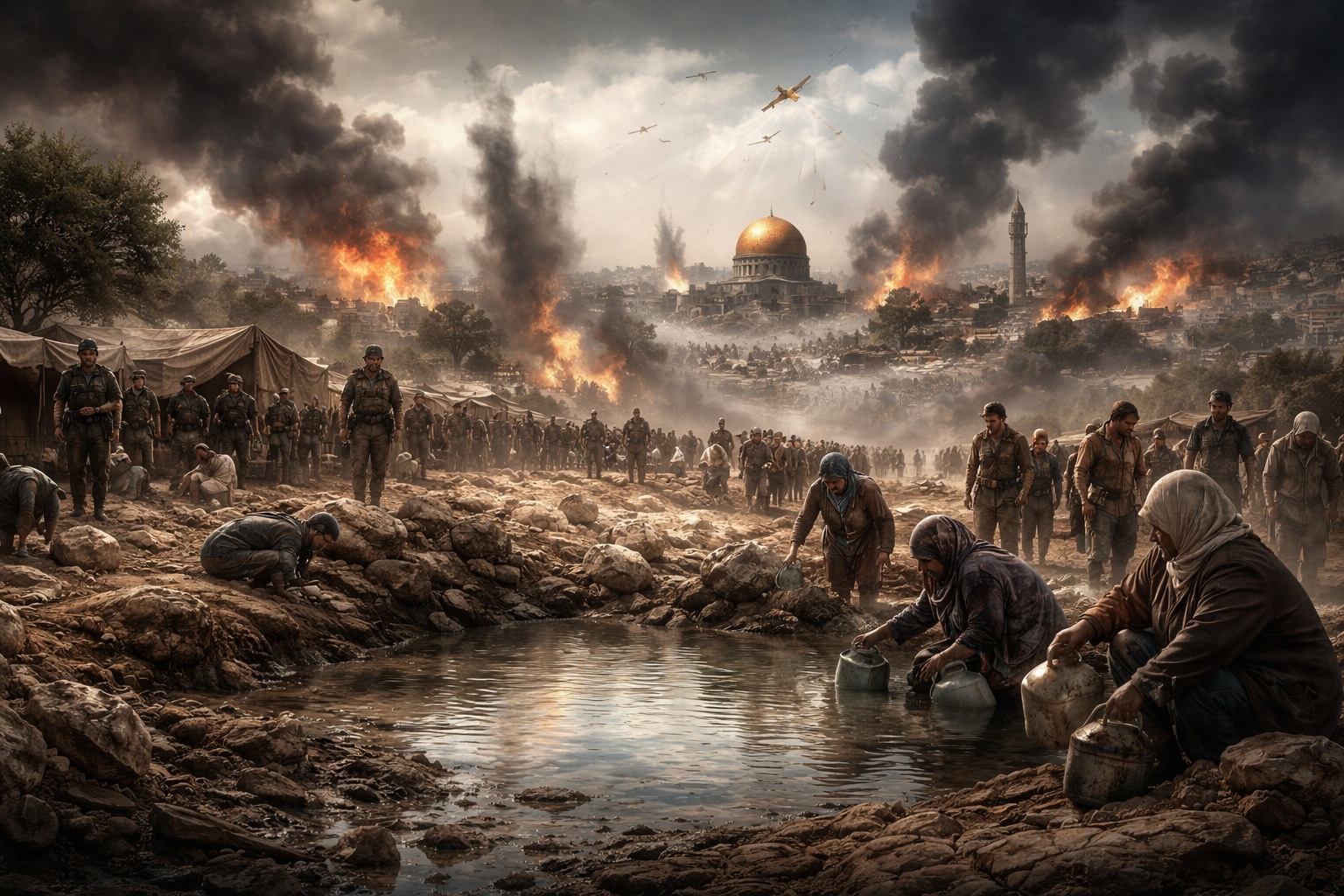
From Oil to Water: The Last War
As of this writing, the United States and Israel have been bombing Iran for nine days. Iran's Supreme Leader Khamenei is dead. Yesterday, March 8, Iran's Assembly of Experts appointed his son Mojtaba Khamenei, 56, as the new Supreme Leader. The appointment was made under pressure from the Revolutionary Guards, in an online session whose atmosphere the assembly members themselves described as "unnatural." Trump called the new leader "a lightweight" and said he would not last long without American approval. Israel declared him a legitimate target.
A dynastic transfer of power in a country whose 1979 revolution was fought precisely to topple a dynasty is not a sign of strength but of vulnerability. The Strait of Hormuz is under threat. Hundreds have died in Lebanon. An Iranian missile struck Sultan's Pool in Jerusalem, just tens of metres from the Old City wall. The world watches fire and smoke and declares the start of World War III. The most eager go further still, declaring that the war with Iran marks the beginning of the biblical war of Gog and Magog described in the Book of Revelation.
Jesus told His disciples two thousand years ago:
"And ye shall hear of wars and rumours of wars: see that ye be not troubled: for all these things must come to pass, but the end is not yet." — Matthew 24:6 (KJV)
Right now we are hearing of wars. Every news broadcast, every headline, every notification on our phone screens feeds fear and fuels prophecies of the end of the world and World War III. Jesus did not say there would be no wars. He said: all these things must come to pass. But the end is not yet.
It is not the end, because the end is something entirely different from what today's headlines describe.
This war will end soon. What follows is far worse.
The Iran war ends because its purpose is fulfilled
The war in Iran is not being fought for Iran's sake. It is being fought for four reasons, none of which require a prolonged conflict. The White House estimates the war will last 4–6 weeks.
The first reason is China. This is a proxy war whose target is not merely Iran but the entire alternative energy system that China has built to circumvent United States dollar hegemony. In 2025, China purchased over 80 per cent of Iran's oil exports: 1.38 million barrels per day, roughly 13–14 per cent of China's total seaborne oil imports. Iran's oil revenues in 2024 were approximately $35.76 billion, of which China's share was $32.5 billion. Iran is China's cheapest oil source, $8–10 per barrel below market price. China's small "teapot" refineries in Shandong province depend on this cheap crude to remain profitable.
This system was built to circumvent US sanctions. Shadow fleets, falsified GPS coordinates, relabelled cargoes (China imports more "Malaysian" oil than Malaysia produces), yuan payment systems, and BRICS structures form an entire alternative trade infrastructure that challenges the dollar's position. Trump's security directive NSPM-2, signed in February 2025, explicitly orders to "drive Iran's oil exports to zero, including exports to the People's Republic of China."
In January, the United States seized Venezuela's oil industry. Venezuela supplied China with 389,000 barrels per day. Now in February, Iran is in the crosshairs. The Carnegie Endowment states it plainly: "One of the biggest losers of the Iran war is China." China's two cheapest oil sources have been eliminated in one stroke. Roughly one-fifth of China's oil imports are now in jeopardy.
China is not in panic, however, because it prepared. In 2025, China's oil stockpiling increased fivefold compared to the previous year: 430,000 barrels per day, up from 84,000 in 2024. China can increase imports from Russia, which is already its largest single oil supplier with a 17.5 per cent share. This benefits Russia: as a consequence of the Iran war, China becomes even more dependent on Russia. The Power of Siberia 2 gas pipeline project, agreed upon at the political level in September 2025, is accelerating. The United States weakens China but simultaneously strengthens Russia's grip on China.
The second reason is also oil. The China dimension connects directly to the broader oil game. Venezuela's proven oil reserves, 303 billion barrels, are the world's largest. Production has collapsed but the infrastructure can be rebuilt. When the Strait of Hormuz closes, one-fifth of the entire world's oil supply is removed from the market. The gap is enormous. The ones ready to fill it are already waiting: Venezuelan and American oil at premium prices. First secure the reserves, then remove the competitor, then sell. China's cheap oil pipeline is severed and replaced with American oil at American prices.
The third reason is Ukraine. Europe lost Russian gas in 2022 and replaced it with liquefied natural gas, a significant portion of which transits through the Strait of Hormuz. When the strait closes, Europe loses access to all Persian Gulf energy. The economy weakens. Supporting Ukraine requires resources that simply do not exist. An energy crisis accomplishes the diplomatic work that pressure could not. Hunger and cold have always been more effective weapons than any army. Ukraine yields to peace because Europe can no longer afford to sustain the war.
The fourth reason is stockpiles. The United States has a massive problem with ageing munitions being replaced by new ones. Emptying massive and ageing stockpiles into Iran is more cost-effective than decommissioning them. Iran is bombed for as long as there are excess old stockpiles. This is not strategy but logistics.
Russia is already benefiting: rising oil prices bring millions in additional revenue per day without a single shot fired. Russia's exports do not transit the Strait of Hormuz, making it one of the few major producers still able to deliver. Sanctions lose their bite when buyers are desperate. Wheat futures have risen 16 per cent in three weeks from the combined effects of war, drought, and logistical disruptions. The FAO Food Price Index rose in February for the first time in five months.
When these four objectives are met, the war ends. China's alternative energy system is crushed. Ukraine yields to peace. Oil markets reorganise on American terms. Surplus munitions stockpiles are depleted. Iran is neutralised as a regional threat.
This is not World War III. This is the last regional obstacle being removed before what is truly coming.
There will be no Third Temple
Many pro-Israel Christians eagerly await a Third Temple in Jerusalem. The expectation is based on Daniel's mention of the cessation of the daily sacrifice and on Ezekiel chapters 40–48, which describe a detailed temple vision.
However, a Third Temple will not be built. There are many reasons for this, the most essential being this: it is not needed.
Israel offered sacrifices for hundreds of years before any temple existed. The Tabernacle built in the time of Moses, in Hebrew mishkan, was a tent of cloth where sacrifices were performed. This arrangement lasted from Moses to Solomon, over four hundred years. When Israel returned from the Babylonian exile, the Book of Ezra tells us they erected an altar and began offering sacrifices before even the foundation of the temple had been laid (Ezra 3:2–6). The altar came first. The building came later.
The most zealous Levitical priests and the drivers behind the Temple Institute know this. A temporary altar with a tent can be erected practically anywhere they want it on the Temple Mount. No temple is needed. A tabernacle is enough.
The Bible itself supports this conclusion more strongly than the assumption of a Third Temple. Jesus transferred the temple's significance from a building to His own person: "Destroy this temple, and in three days I will raise it up" (John 2:19, KJV). John explains: "But he spake of the temple of his body" (John 2:21, KJV). To the Samaritan woman, Jesus declared the coming of an age when worship would not be bound to a place: "But the hour cometh, and now is, when the true worshippers shall worship the Father in spirit and in truth" (John 4:23, KJV). Paul taught that the congregation is the temple of God (1 Cor. 3:16–17). The Epistle to the Hebrews argues thoroughly that Christ's sacrifice is final and the old sacrificial system has ended (Heb. 9:11–12). The Book of Revelation closes the entire biblical narrative with an image in which there is no temple at all: "And I saw no temple therein: for the Lord God Almighty and the Lamb are the temple of it" (Rev. 21:22, KJV).
The entire direction of the Bible moves from external to internal, from building to body, from stone to flesh, from place to presence. The expectation of a Third Temple runs against this current.
No interpretations that predict a Third Temple are biblical. They are interpretations born of itching ears, serving people's desire to see spectacular signs rather than looking at what the Bible actually says.
The obstacles are being removed one by one
Consider what has happened to Israel over the past two years, and especially over the last three weeks.
Hamas has been destroyed as a military force in Gaza. Hezbollah lost a significant portion of its capacity, and although the ceasefire broke down on March 2, 2026, Israel has responded with massive strikes and a ground offensive into Lebanon. Syria has collapsed. Iraq is in a drought crisis. Egypt has no political will to resist. Now Iran, the last regional military power, is in the crosshairs and its Supreme Leader is dead.
On the Temple Mount, developments have accelerated dramatically. In February 2026, as Ramadan began, Israeli police expanded Jewish visiting hours for the first time in history during Ramadan: a five-hour window from 6:30 to 11:30 in the morning. Police now permit open Jewish prayer, kneeling in prayer, singing, and bringing printed prayer booklets to the compound. In February, 4,800 Jews ascended the Temple Mount. In the Hebrew year ending in 2025, the total was over 68,000, a 22 per cent annual increase.
In January 2026, Netanyahu openly backed Ben Gvir's changes for the first time: "The changes Ben-Gvir is making do not change the status quo and are coordinated with me." On February 25, the Knesset approved the holy sites bill in its first reading by a vote of 56–47. Ben Gvir stated publicly that the law "enables dramatic changes on the Temple Mount."
Then came the war that changed everything.
February 28 — An Iranian strike hit Sultan's Pool in Jerusalem, just tens of metres from the Old City wall and less than a kilometre from the Temple Mount. Police admitted: "If it had deviated by a few hundred metres, the holy site could have been destroyed full of worshippers." On March 1, missile defence interceptions were visible in the sky directly above the Dome of the Rock.
March 1 — All holy sites were closed as an emergency measure: the Western Wall, Al-Aqsa, the Church of the Holy Sepulchre. On March 5, Israel officially cancelled the third Friday prayer of Ramadan. On March 6, drone footage showed the Al-Aqsa compound completely empty. For the first time in history during Ramadan. Eight days of total closure. No reopening date announced.
Al-Aqsa is empty right now. As of this writing. During Ramadan.
Meanwhile, the Israeli news site Arutz Sheva published an article on February 19 explicitly calling by name for the commencement of sacrificial activity on the Temple Mount without a temple: "Restoring such sacrifices as are permitted without the Holy Temple being built; the Korban Pesach foremost among them." The demand for a Passover sacrifice, publicly, in mainstream media. The PLO immediately warned against the attempt.
The Temple Institute maintains over 70 sacred vessels ready for use. Over 500 Levites have been trained for sacrificial service. The red heifers were rejected in August 2025, but a November clarification revealed that four animals remain in Shiloh and their halachic status "has not been definitively determined." A breeding programme continues locally in Israel. The Temple Institute maintains secrecy and states: "This is a long process that requires patience and perseverance."
Political will exists and the instruments are ready. The priests are trained. Military obstacles are being removed. Al-Aqsa is empty. The White House estimate for the war's duration is 4–6 weeks, meaning it ends by early April. Passover begins in the first week of April. Ascension Day is May 14, one week before the commencement of the daily sacrifice.
The greatest desecration and apostasy: the beginning of sacrificial activity
On May 14, 2026, Ascension Day, the red heifer is burned and its ashes collected. On the feast day commemorating Christ's ascension into heaven, the process begins that purifies the priests and the altar for sacrificial service. On the third day, the first sprinkling; on the seventh day, the second sprinkling and washing, as commanded in the nineteenth chapter of Numbers. On May 21, 2026, the first daily tamid sacrifice rises from a temporary tabernacle on the Temple Mount. Not in a temple. As in the days of Ezra.
This date is not random. Ascension Day is the feast commemorating Christ's ascension into heaven. The day on which Christendom remembers Jesus' ascent to the right hand of the Father is the same day the red heifer is burned and the purification process begins. One week later, the first sacrificial smoke rises. It is a counter-declaration to Christ's ascension. It is a deliberate and public proclamation that the work of Christ was not enough.
This is the great apostasy of which the Bible writes and warns.
2 Thessalonians 2:3 warns: "Let no man deceive you by any means: for that day shall not come, except there come a falling away first" (KJV). The falling away is not the spread of atheism. It is a return to that which Christ has already fulfilled. It is the re-establishment of an external sacrificial system after the internal reality has already come.
Hebrews 10:29 speaks of those who "hath trodden under foot the Son of God, and hath counted the blood of the covenant, wherewith he was sanctified, an unholy thing" (KJV). This is the New Testament's own verdict on what a return to the old sacrificial system means. It is not a neutral religious ceremony. It is an active declaration that the blood of Christ was not sufficient, that the sacrifice of the Lamb was deficient, that the blood of bulls and goats is still required.
To understand this, one must see what the covenant truly is and to whom it belongs.
Jesus said: "Think not that I am come to destroy the law, or the prophets: I am not come to destroy, but to fulfil" (Matt. 5:17, KJV). He did not come to establish a second covenant alongside the old. He came to fulfil that to which the old covenant had always pointed. The old covenant was not deficient but incomplete. It pointed toward something that was coming. Christ is what it pointed to. Hebrews 8:5 says that the old covenant priests "serve unto the example and shadow of heavenly things" (KJV). A shadow is not an error. It is a precursor of form — but when the form arrives, remaining in the shadow is a refusal to see.
Galatians 3:16 makes the decisive clarification: "Now to Abraham and his seed were the promises made. He saith not, And to seeds, as of many; but as of one, And to thy seed, which is Christ" (KJV). Abraham's true seed is Christ. Not a people, not a state, not an ethnic group, but one person. Galatians 3:29 completes the thought: "And if ye be Christ's, then are ye Abraham's seed, and heirs according to the promise" (KJV). Everyone who is in Christ is a true heir of Abraham. Whether one is a Jew or a Gentile, it does not matter.
Ephesians 2:14–16 describes this concretely: Christ "hath made both one, and hath broken down the middle wall of partition between us" and "for to make in himself of twain one new man, so making peace" (KJV). Not two covenants side by side, then, but one new man in Christ. The dividing wall is torn down. The separation is over.
Romans 2:28–29 defines true Jewishness: "For he is not a Jew, which is one outwardly... But he is a Jew, which is one inwardly; and circumcision is that of the heart, in the spirit, and not in the letter" (KJV). True Israel is not a state or a nationality. It is a reality of the heart in Christ.
There is therefore one covenant, which passed through Abraham, Moses, the prophets, and David, and received its temporary form in the law, the sacrifices, and the temple service. In Christ, it received its final form. The entire purpose of the old covenant reached its fulfilment in Him. Whoever is in Christ is a partaker of this covenant. Whoever rejects Christ stands outside this covenant, whether ethnically Jewish or not.
In light of this, it must be said plainly: those Christians who now cheer for Israel are utterly blinded. The secular State of Israel today has nothing whatsoever to do with Jesus Christ. This secular state does not recognise Christ as its Messiah in any respect. Salvation is in no way tied to Israel. The only salvation comes from Jesus Christ. The secular State of Israel is neither to be blessed nor cursed. To bless the Israel that currently holds secular power is to bless the synagogue of Satan (Rev. 2:9, 3:9) — one of many that has utterly fallen away from the will of God.
The fact that God will also save Israel has nothing to do with temples or sacrifices. It has to do with God saving all who turn to Jesus. In the end, when sacrificial activity ceases on November 1, 2029, and the great earthquake comes, even these pagans will be seized with fear, and they too will turn to the Lord.
A false peace
When sacrificial activity begins on May 21, 2026, all wars will have ended: Iran, Ukraine, all of them.
This is the magnificent false miracle on the basis of which many will be deceived into believing that the first covenant's sacrificial activity brought about this peace. The world looks to Jerusalem and sees the sacrificial smoke rising. Fanatical Christians admire the beauty of the ceremony and say that we must study the Torah, as Jesus did, proclaiming that this is the religion of Jesus and the people of Jesus. Religious leaders praise the return to roots. "All roads lead to the same God," they declare.
1 Thessalonians 5:3 warns: "For when they shall say, Peace and safety; then sudden destruction cometh upon them, as travail upon a woman with child; and they shall not escape" (KJV).
The peace is real but false. The wars have ended, but the cause is not human. Three and a half years of false peace begin, May 21, 2026 – November 1, 2029. During this time, the sacrificial activity is the greatest desecration that humanity can commit against the Son of God.
As stated earlier in this article, the beginning of sacrificial activity is the great apostasy of which the Bible writes and warns. This desecration and the pursuit of secular Israel is the same thing that has been done for 2,000 years: the denial of Christ's perfect sacrifice, the rejection of Jesus.
When the heavens close
The turning point of human history, May 21, 2026, marks the beginning of a great global drought. Not a single drop of rain will fall. First in Israel, then in no other country either.
History repeats itself: In the days of Elijah, the heavens were shut for three and a half years because Israel had abandoned the true God (1 Kings 17:1). The same duration. The same cause. The same consequence.
The signs are already visible — and not only far away but here, in Finland, right now.
In Finland, the winter of 2025–2026 brought extreme cold and exceptionally thin snow cover simultaneously. In Enontekiö, temperatures reached −44.3°C, the coldest reading of the 21st century. January 2026 was 5.5 degrees below the average and precipitation was 70 per cent below normal. Snow cover on Finland's agricultural regions is 4–22 centimetres in areas where it should be 30–40 centimetres. Frost has penetrated a third deeper than normal. Approximately 100,000 hectares of winter grain are at risk of winter damage. Groundwater levels in Central Finland have dropped 70–115 centimetres below normal; in western Finland, as much as 100 centimetres. The Flood Centre confirmed on March 4 that spring floods will be very small in southern, western, and central Finland. In Satakunta and Northern Ostrobothnia, floods may be record low. Snow water equivalent on the west coast is only about 10 millimetres. The spring replenishment that normally restores groundwater reserves will not come.
Yet as of March 9, 2026, no Finnish authority has published an official winter damage assessment or groundwater warning that acknowledges the severity of the situation.
In the Middle East, the Sea of Galilee is 5 centimetres below the lower red line. Israel is pumping desalinated seawater into the freshwater lake — something never done anywhere in the world before. Agricultural water allocations are proposed to be cut by 35 per cent. Iraq is experiencing its driest year since measurements began in 1933. Lake Tharthar has fallen to its lowest level since the dam was built in 1958. The Tigris and Euphrates have lost up to 60 per cent of their flow. Syria's agricultural output has collapsed by 82 per cent since 2020.
In the United States, the western snowpack is at a 40-year low. The upper Colorado River basin's snow water equivalent is only 36 per cent of median. Lake Powell's storage level is at 25 per cent, Lake Mead at 34 per cent. The polar vortex split three times in a single winter — an exceptional frequency that produced Europe's coldest January since 2010.
Cyprus is experiencing its worst drought since hydrological measurements began in 1901. A fourth consecutive drought year. Reservoir levels have dropped to 13.7 per cent of capacity. Dam inflows are the lowest ever recorded.
All of this is happening simultaneously. Everywhere. Climate scientists search for explanations. They speak of climate change, La Niña, polar vortex disruptions. Each explanation is mechanistically true. None explains why everything is happening at once.
The UN declared the world's water systems bankrupt
On January 20, 2026, the United Nations University's Institute for Water published a report titled "Global Water Bankruptcy." For the first time, UN scientists declared freshwater systems bankrupt. Not stressed. Not strained. Bankrupt.
The figures are crushing. Approximately four billion people face severe water scarcity for at least one month per year. Over 50 per cent of the world's large lakes have declined since 1990. Approximately 70 per cent of major groundwater reserves are in long-term decline. 324 billion cubic metres of freshwater disappear every year. The annual economic cost of drought alone is $307 billion.
At the same time, the UN World Food Programme warned that acute food insecurity is deepening in 16 countries. Famine has been confirmed simultaneously in Gaza and Sudan — the first time this century that two famines are occurring at once. The humanitarian funding gap is the largest in eight years: only $10.55 billion of the $29 billion needed has been raised.
The world's water systems are already bankrupt. Before the drought has even properly begun. Before the heavens have closed.
Right now the fight is over oil; soon it will be over water
The entire world's attention is on oil right now. The Strait of Hormuz, Venezuela's reserves, Russia's exports, the Brent crude price. Oil dominates every headline, every analysis, every strategic calculation. This is understandable, because oil has driven world politics for a hundred years. But oil is not the resource over which the conflicts of the future will be fought.
Water is.
As the drought advances from 2026 onward, water becomes the world's most valuable resource. Not theoretically, but concretely. Fields dry up. Groundwater reserves deplete. Rivers shrink. Drinking water becomes a scarcity. What is taken for granted today — turning on a tap — becomes a privilege, and eventually something to fight over.
The world's water systems are already bankrupt. Before the drought has even properly begun. Before the heavens have closed.
Right now, the world imagines it is fighting over oil. For the moment, that is true. But soon the fight will be over water. Before long, humanity will unite because of water. Or because of its absence.
"Whosoever drinketh of this water shall thirst again: But whosoever drinketh of the water that I shall give him shall never thirst; but the water that I shall give him shall be in him a well of water springing up into everlasting life."
— John 4:13–14 (KJV)
In the name and love of Jesus.
Sources:
Iran war: Washington Post, Al Jazeera, NPR, Britannica, Times of Israel, Wikipedia (2026 Iran conflict), House of Commons Library
Venezuela operation: Wikipedia (United States intervention in Venezuela 2026), CNN, CNBC, Al Jazeera
China's oil dependence on Iran: Modern Diplomacy, Carnegie Endowment, The Diplomat, Financial Tribune, Kpler, OFAC, Congress.gov (CRS IF12952)
Temple Mount preparations and situational overview: Times of Israel, Temple Institute, Jerusalem Post, Beyadenu, Charisma Magazine, Arutz Sheva, ACLED
Wheat markets: USDA WASDE, FAO Food Price Index (March 2026), Chicago SRW and Kansas City HRW futures
UN water bankruptcy report: UNU-INWEH, "Global Water Bankruptcy", 20.1.2026
Drought data: Copernicus Climate Change Service, Finnish Meteorological Institute, USDA WASDE, Israel Water Authority, FEWS NET Iraq, SYKE groundwater status, vesi.fi, Flood Centre (4.3.2026 spring flood forecast), Yara Kotkaniemi frost measurements, Natural Resources Institute Finland (Luke), NOAA NCEI, US Drought Monitor, California DWR
Biblical references: King James Version (KJV)
Our previous articles: Peace agreement reached for Ukraine, 17.2.2025 | When the heavens close, 5.8.2025 | What has happened, 14.2.2026 | Crop destruction and water shortage in Finland, 14.2.2026 | What connects, 1.3.2026