
The Memory of Water: The Destruction of Civilisations and the Rejection of Repentance
This text is primarily a spiritual interpretation of history's great turning points and the role of natural phenomena in the fates of civilisations. It does not aim to be a purely scientific analysis, though it draws heavily on historical and palaeoclimatological research.
The purpose is to identify spiritual laws operating behind the scenes of history: invisible forces that govern the rise and destruction of nations. Science provides us with facts and timelines, but spiritual understanding reveals the deeper meaning. When we read the past from this perspective, the signs of the present begin to speak more clearly than ever before.
Meteorologists' supercomputers run around the clock trying to forecast weather phenomena that increasingly defy all models and expectations.
Researchers openly acknowledge that recent anomalies do not fit any known natural cycle¹.
At the same time, a prophetic revelation speaks of a coming three-and-a-half-year total drought beginning in May 2025 — a period that science cannot predict but that the Bible knows well as a time of judgement. Meanwhile, the ruins of history's great civilisations tell a recurring story: every one of them turned away from the living God toward their own creations just before nature rose up to judge them. This is not coincidence but a spiritual law that operates as surely as gravity — and at its centre is water, the source of life and the bringer of death.
When we examine the fate of past empires, the same pattern repeats with remarkable regularity. At the height of the Mayan civilisation in the 800s–900s AD, the number of human sacrifices grew exponentially². Kings who claimed to be descendants of the gods demanded ever more blood to "preserve cosmic balance." Children's hearts were torn from their chests, prisoners of war were ritually tortured to death, and entire communities were subjugated to serve a cult of death. At precisely the same time, a prolonged drought began that lasted for decades. Palaeoclimatological studies confirm that the Yucatán Peninsula experienced its worst drought in a thousand years at the exact time of the Maya civilisation's collapse³. Rainforests that had fed millions turned to dust, and the temple pyramids down which sacrificial blood had flowed stood as empty monuments to human hubris.

The fate of the Roman Empire is bound by the same spiritual law. Emperors declared themselves gods, demanding worship and sacrifice; Nero burned Christians as torches for his garden parties; and the Romans practised every conceivable mystery cult of the East⁴. Kyle Harper's groundbreaking research shows that the cooling of the climate in the 400s–500s coincided precisely with the period when Rome had abandoned its old virtues and surrendered to total decadence⁵. The volcanic winter of 536 AD, caused by multiple successive eruptions, brought with it a "year without summer," famine, and plague⁶. The barbarians whom the Romans had despised marched across frozen rivers and conquered an empire that was already dead within.

The case of Angkor Wat in Cambodia reveals the same pattern with particular clarity. The Khmer Empire built the world's largest religious complex, dedicated first to the Hindu god Vishnu, then to Buddhist deities⁷. The Devaraja cult — the worship of the "god-king" — demanded a constant supply of labour and resources. Tree-ring studies reveal that the monsoons became unpredictable precisely when religious arrogance reached its peak, alternating between excessively powerful and non-existent⁸. This hydraulic civilisation, which had masterfully managed monsoon waters for centuries, collapsed completely in the 1400s.
The role of water as an instrument of judgement extends even further through history. The Babylonian Empire met its destruction when the Euphrates and Tigris flooded uncontrollably, and salinisation ultimately turned once-fertile land into desert⁹. The Minoan civilisation on Crete was swept away by a tsunami triggered by the eruption of Santorini around 1500 BC¹⁰. The Harappan civilisation in the Indus Valley flourished from 2600 to 1900 BC. Shifting monsoons caused first floods, then complete desiccation — and the sacred Sarasvati River dried up entirely¹¹. Carthage, which sacrificed children to Baal-Hammon, was destroyed and its soil salted, rendering it barren for ever¹². Teotihuacan in Mexico burned and was abandoned between 550 and 650 AD as a prolonged drought set in¹³. The Ancestral Puebloans in the American Southwest — among whom contested evidence of violence and possible cannibalism has been found — were driven out by a century-long megadrought from 1276 to 1299¹⁴.

In every one of these cases, the warning signs were clear decades in advance. Rainfall became irregular, earthquakes increased, minor floods or droughts preceded greater catastrophes. Systematically, these signs were misread. The Babylonians trusted in stellar prophecies, the Minoans saw Poseidon's temporary displeasure, the Maya responded by increasing the number of sacrifices. Modern palaeoclimatology confirms that the changes were detectable in tree rings, sediment layers, and ice cores¹⁵. The warnings were written into nature. The spiritually blind could not read them correctly.
What is particularly revealing is how every one of these civilisations practised the harming of children in some form:
The Maya sacrificed children literally on blood-soaked altars; the Romans through infanticide and gladiatorial games; the rulers of Angkor used child labour in massive construction projects; and Carthage's Tophet burial grounds contain thousands of children's remains — though the scientific consensus on their purpose remains divided¹⁶.
The Bible is clear: "There shall not be found among you any one that maketh his son or his daughter to pass through the fire" (Deut. 18:10, KJV)¹⁷. God hates the sacrifice of children above all else — it is a sin that cries out for vengeance to heaven.
Today, abortion is institutionalised child sacrifice, transgenderism destroys the bodily integrity of children, and digital addiction steals their souls.
The history of science is full of moments when prevailing paradigms proved inadequate. Thomas Kuhn's theory of paradigm shifts describes how science advances through crises and revolutions¹⁸. We now stand at the threshold of a similar upheaval in climate science. Modern climate models are based on the assumption that we know all the significant variables. In reality, the atmosphere is a system that extends from the Earth's core to the edges of space. Solar activity cycles, magnetospheric variations, the effect of cosmic radiation on cloud formation, and the reflection of the Earth's internal processes in the atmosphere form a network whose complexity exceeds the capacity of current models¹⁹.
The biblical model of judgement upon nations reveals the spiritual laws operating behind history. The Flood of Noah came when "God saw that the wickedness of man was great in the earth, and that every imagination of the thoughts of his heart was only evil continually" (Gen. 6:5, KJV)²⁰. Sodom and Gomorrah were destroyed in a rain of fire and brimstone²¹. The kingdoms of Israel and Judah were scattered when they forsook the covenant²². In every one of these cases, natural phenomena were instruments of God's judgement — not random catastrophes. Water in particular is a consistent instrument of judgement throughout the Bible: the Flood, the Red Sea swallowing Pharaoh's army, the Jordan halting before Israel yet overflowing upon their enemies²³.
Why, then, has repentance always been so rare, even when the warnings were clear? The hardness of the human heart runs deeper than most understand. Sin blinds spiritual perception, creating the illusion that humanity can control its own destiny. "Because that, when they knew God, they glorified him not as God, neither were thankful; but became vain in their imaginations, and their foolish heart was darkened" (Rom. 1:21, KJV)²⁴. Every civilisation has believed itself to be the exception — special, too great to fall. The Romans believed in the "eternal city," the Maya in themselves as "keepers of the cosmic order," the Babylonians in the endurance of the "gate of heaven." Our present technological superiority creates the same illusion: we believe we can solve every problem with science and technology.
The rejection of repentance is systematic and always follows the same pattern. First comes denial: the problem is not real, or it is exaggerated. Then rationalisation: it is a natural cycle, not a spiritual judgement. Next, technological hubris: we can solve this with innovation and engineering. Finally, a religious substitute: more rituals, more sacrifices — or in modern terms, more "green technology" — instead of genuine repentance. "They have healed also the hurt of the daughter of my people slightly, saying, Peace, peace; when there is no peace" (Jer. 6:14, KJV)²⁵.
Historically, only rare examples of genuine repentance can be found. Nineveh repented after the preaching of Jonah and was spared judgement²⁶. England experienced a spiritual awakening under John Wesley in the 1700s, avoiding a bloody revolution of the kind that engulfed France²⁷. These are exceptions. More often, pride prevents the acknowledgement of sin's reality. Today, "climate change" has replaced the concept of sin, providing a scientific explanation for what is fundamentally a spiritual problem.
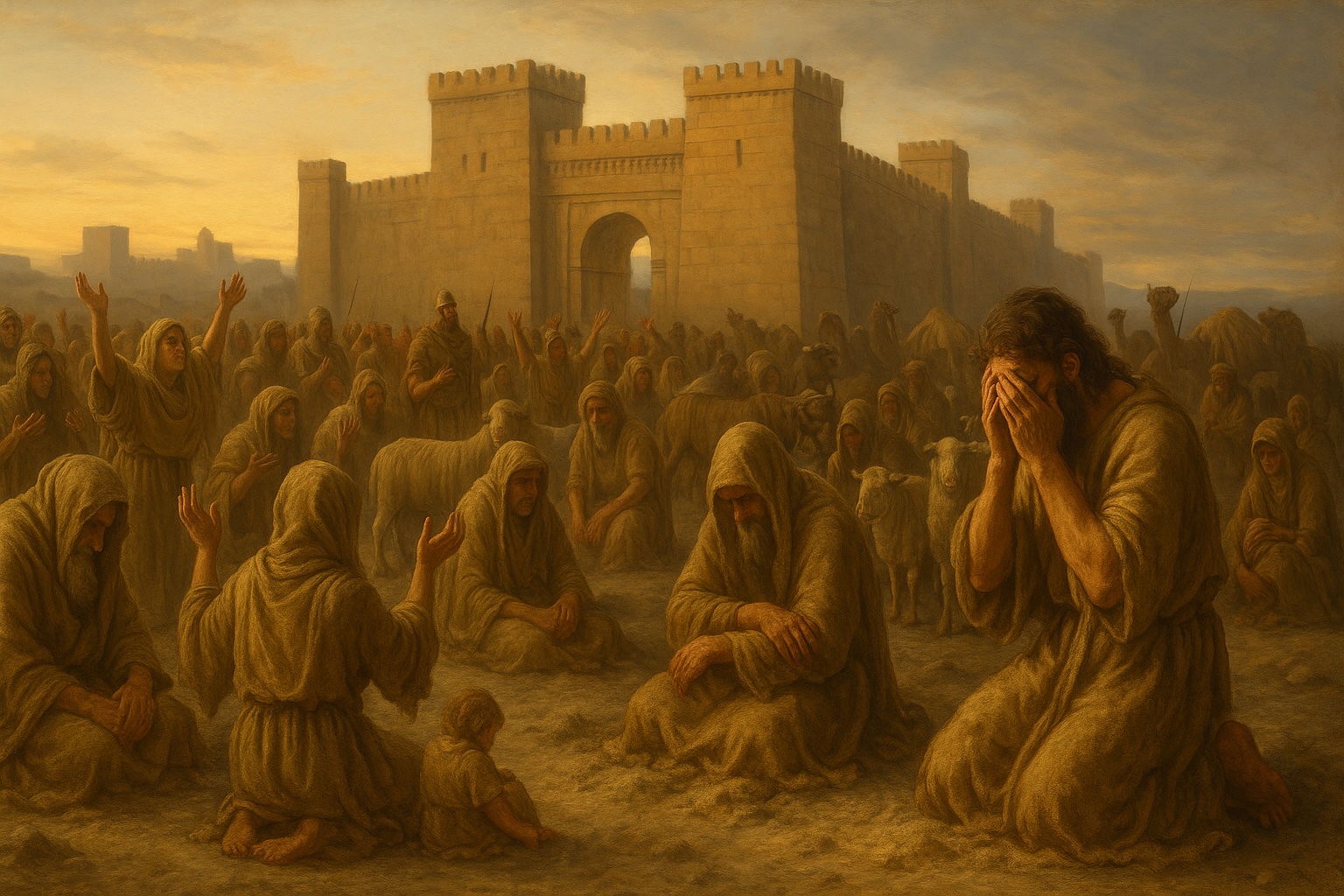
Preparation without repentance is like building a house on sand. Prepper culture stockpiles food and water, builds bunkers, and collects weapons. It ignores the condition of the heart. This is the modern version of the Tower of Babel: an attempt to save oneself without God²⁸. History demonstrates that physical preparations without spiritual renewal are futile. The walls of Jerusalem did not save it from the Babylonians, the walls of Constantinople did not stop the Ottomans, and the Maginot Line did not prevent the German invasion²⁹.
True preparation begins with repentance of the heart. "Turn ye even to me with all your heart, and with fasting, and with weeping, and with mourning: And rend your heart, and not your garments" (Joel 2:12–13, KJV)³⁰. This is precisely what human nature resists most. Repentance demands the breaking of pride, the confession of one's own guilt, the acknowledgement of dependence upon God. It is harder for a person than any physical sacrifice.
Our present civilisation is repeating the errors of all its predecessors with precision. Transhumanism promises to make man into a god, artificial intelligence is elevated to the position of an omniscient oracle, and science is exalted as absolute truth³¹. At the same time, the climate system is showing signs of fundamental instability. The slowing of jet stream currents, the breakdown of polar vortices in midwinter, and changes in the behaviour of tropical storms all point to a transition into something unprecedented³². Just as the Maya increased their sacrifices as the crisis deepened, we increase our technological "solutions" without acknowledging the real problem.
Water remembers. It remembers the wickedness of Noah's age, the sins of Sodom, the pride of Pharaoh. It remembers the blood of every child shed upon the altars of false gods. "Deep calleth unto deep at the noise of thy waterspouts" (Ps. 42:7, KJV)³³. In the depths of the waters lies a memory that surpasses human understanding. When sin fills its measure, water rises or recedes to carry out judgement.
The prophetic word of a three-and-a-half-year drought is not a scientific forecast but a spiritual warning. It recalls the drought in the days of Elijah, which lasted three and a half years because of the godlessness of Ahab and Jezebel³⁴. It points to the time of the two witnesses in the Book of Revelation, who have "power to shut heaven, that it rain not in the days of their prophecy" (Rev. 11:6, KJV)³⁵. This period is not merely a natural phenomenon but God's direct intervention in history — a moment when spiritual reality breaks through into the physical world in a way that science cannot explain and technology cannot prevent.
The lesson of history is clear: civilisations that turned against God were destroyed through the forces of nature. Those that humbled themselves and repented received mercy. Repentance has always been rare, because it demands from a person what they are least willing to give: the surrender of their own will, the breaking of their pride, the confession of their sin. It is easier to build a tower to heaven than to kneel in humility. It is easier to sacrifice a thousand lambs than one proud heart. It is easier to change the whole world than to change oneself.
Now we stand at a turning point of history. The signs are clearer than ever: the climate behaves unpredictably, societies polarise, morality collapses, and children are sacrificed on the altars of a modern Moloch. Science acknowledges its inability to explain or forecast the changes ahead. The prophetic word warns of coming judgement. History testifies that an identical situation has preceded the destruction of every great civilisation. The question is not whether judgement will come, but whether we will recognise its spiritual nature and turn in time.
"The fear of the LORD is the beginning of wisdom" (Prov. 9:10, KJV)³⁶. True preparation begins with a change of heart. History teaches that nature is always the final judge of human pride — and water is its primary instrument. Those who have ears to hear, let them hear. Time is short, and eternity is long.
Explore our new book: www.totuushypnoosista.com
References:
-
Shepherd, T.G. et al. (2018). "Storylines: an alternative approach to representing uncertainty in physical aspects of climate change". Climatic Change, 151.
-
Schele, L. & Miller, M.E. (1986). The Blood of Kings: Dynasty and Ritual in Maya Art. Kimbell Art Museum.
-
Haug, G.H. et al. (2003). "Climate and the Collapse of Maya Civilization". Science, 299(5613).
-
Fox, R.L. (1986). Pagans and Christians. Knopf Publishing.
-
Harper, K. (2017). The Fate of Rome: Climate, Disease, and the End of an Empire. Princeton University Press.
-
Büntgen, U. et al. (2016). "Cooling and societal change during the Late Antique Little Ice Age". Nature Geoscience, 9.
-
Higham, C. (2001). The Civilization of Angkor. University of California Press. pp. 289–324.
-
Buckley, B.M. et al. (2010). "Climate as a contributing factor in the demise of Angkor". Proceedings of the National Academy of Sciences, 107(15).
-
Jacobsen, T. & Adams, R.M. (1958). "Salt and Silt in Ancient Mesopotamian Agriculture". Science, 128(3334).
-
Friedrich, W.L. (2009). Santorini: Volcano, Natural History, Mythology. Aarhus University Press.
-
Giosan, L. et al. (2012). "Fluvial landscapes of the Harappan civilization". Proceedings of the National Academy of Sciences, 109(26).
-
Stager, L.E. & Greene, J.A. (2000). "Were living children sacrificed to the gods?". Biblical Archaeology Review, 26(3).
-
Manzanilla, L. (2003). "The Abandonment of Teotihuacan". The Archaeology of Settlement Abandonment.
-
Benson, L. et al. (2007). "Anasazi (Pre-Columbian Native American) Migrations During The Middle-12th and Late-13th Centuries". PNAS, 104(39).
-
Bradley, R.S. (2015). Paleoclimatology: Reconstructing Climates of the Quaternary. Academic Press.
-
Smith, P. et al. (2011). "Cemeteries, Sanctuaries and Infant Sacrifice at Carthage". Antiquity, 85(329).
-
Finnish Church Bible 1933/38. Evangelical Lutheran Church of Finland.
-
Kuhn, T.S. (1962). The Structure of Scientific Revolutions. University of Chicago Press.
-
Svensmark, H. & Friis-Christensen, E. (1997). "Variation of cosmic ray flux and global cloud coverage". Journal of Atmospheric and Solar-Terrestrial Physics, 59(11).
-
Finnish Church Bible 1933/38. Evangelical Lutheran Church of Finland.
-
Genesis 19:24. Finnish Church Bible 1933/38.
-
2 Kings 17:7–23. Finnish Church Bible 1933/38.
-
Exodus 14:26–28, Joshua 3:15–17. Finnish Church Bible 1933/38.
-
Finnish Church Bible 1933/38. Evangelical Lutheran Church of Finland.
-
Finnish Church Bible 1933/38. Evangelical Lutheran Church of Finland.
-
Jonah 3:5–10. Finnish Church Bible 1933/38.
-
Halévy, E. (1949). A History of the English People in the Nineteenth Century. Ernest Benn.
-
Genesis 11:4. Finnish Church Bible 1933/38.
-
Keegan, J. (1993). A History of Warfare. Vintage Books.
-
Finnish Church Bible 1933/38. Evangelical Lutheran Church of Finland.
-
Harari, Y.N. (2017). Homo Deus: A Brief History of Tomorrow. Harper.
-
Francis, J.A. & Vavrus, S.J. (2012). "Evidence linking Arctic amplification to extreme weather". Geophysical Research Letters, 39.
-
Finnish Church Bible 1933/38. Evangelical Lutheran Church of Finland.
-
1 Kings 17:1, James 5:17. Finnish Church Bible 1933/38.
-
Finnish Church Bible 1933/38. Evangelical Lutheran Church of Finland.
-
Finnish Church Bible 1933/38. Evangelical Lutheran Church of Finland.