Question
Given that the biblical canons were compiled by Catholics/Orthodox (and how did this actually happen? Because the Orthodox claim they were the ones who compiled them), how can we be certain they did not tamper with the truth even back then — leaving out important parts, making changes to words, just as happens now with every new translation? This thought arises because that church denomination is already rotten from within, so why would they have compiled the book in full truth back then.
Is there clear research evidence on this subject — why, despite all this, we can fully trust the Bible?
Answer
The question of the Bible's reliability — having passed through the hands of corrupt churches — is both legitimate and important. How can we trust that Catholics and Orthodox did not tamper with the truth? The answer reveals one of history's greatest ironies and the beauty of God's sovereign providence.
The Gap Between Recognising and Creating
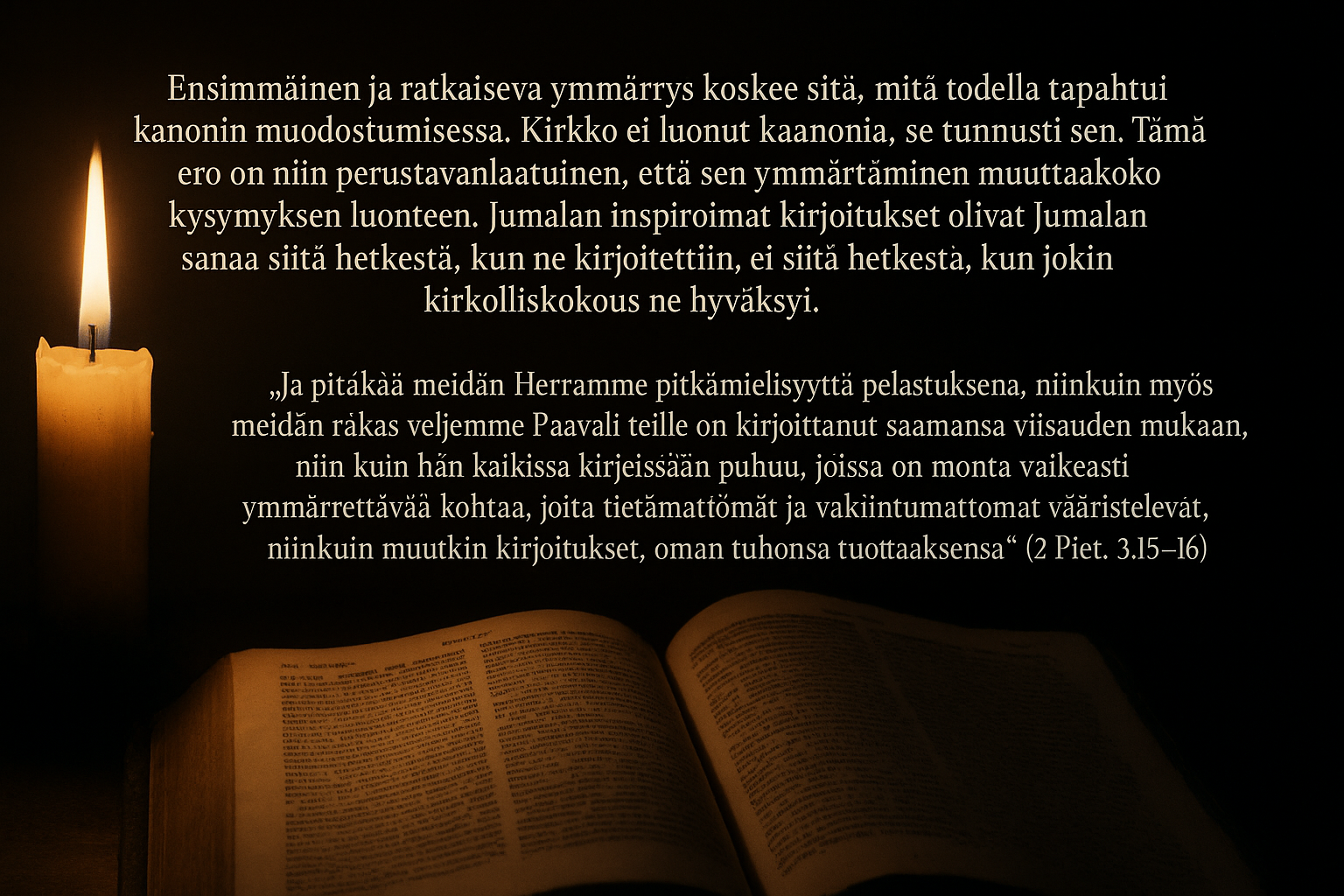
The first and decisive insight concerns what actually happened in the formation of the canon: The Church did not create the canon — it recognised it. This distinction is so fundamental that understanding it transforms the entire nature of the question. God's inspired writings were the Word of God from the moment they were written, not from the moment some church council approved them.
The early Christians immediately recognised the authority of the apostolic writings in a way that required no external legitimisation. When Peter referred to Paul's letters as Scripture while still alive, he was not creating new authority but recognising what already existed: "And account that the longsuffering of our Lord is salvation; even as our beloved brother Paul also according to the wisdom given unto him hath written unto you; As also in all his epistles, speaking in them of these things; in which are some things hard to be understood, which they that are unlearned and unstable wrest, as they do also the other scriptures, unto their own destruction" (2 Pet. 3:15–16, KJV).
Likewise, when Paul quoted the Gospel of Luke alongside Old Testament Scripture — "For the scripture saith, Thou shalt not muzzle the ox that treadeth out the corn. And, The labourer is worthy of his reward" (1 Tim. 5:18, KJV) — he was not bestowing authority upon it but recognising its already existing authority. These writings circulated among the congregations and were recognised as the Word of God spontaneously, naturally, irresistibly.
Undeniable Evidence Before the Corruption
The Muratorian Fragment, dating to around AD 170, reveals something remarkable. This ancient document lists nearly the entire New Testament as canonised already at that time — a hundred and fifty years before the Council of Nicaea and long before the institutional formation of the Catholic Church. Here is undeniable proof that the canon was essentially established in the early period, when the Church was still relatively pure.
The papyrological evidence confirms this picture in a way that makes falsification theories impossible. Papyrus 46, from around AD 200, contains Paul's letters compiled as a unified collection. Papyrus 66, from the same period, contains the Gospel of John. These manuscripts predate Constantine by over a hundred years and demonstrate that the texts were already established and circulating in standardised form before any kind of centralised control existed.
The most compelling evidence, however, comes from the Qumran textual discoveries in 1947. The Book of Isaiah from Qumran, dating to approximately 100 BC, is nearly identical to the medieval Masoretic texts. A thousand years apart, yet the text was preserved with astonishing precision. This reveals the exceptional accuracy of the Jewish copying tradition and demonstrates that the preservation of texts across vast spans of time was not only possible but actual.
Witnesses of the Pure Tradition
Before the formation and subsequent corruption of either the Catholic or Orthodox Church, there lived men who bear witness to the same texts we have today. Clement of Rome wrote in AD 96 — only sixty years after Jesus — and quoted from Matthew, Mark, Luke, and the letters of Paul. Ignatius of Antioch in AD 110 quoted from nearly all the books of the New Testament. Polycarp, a direct disciple of the Apostle John, quoted the New Testament extensively.
These men lived before the great age of apostasy, before politicised Christianity, before institutional corruption. They were connected to the apostles or to the direct disciples of the apostles. Their testimony is more precious than gold, because it comes from a time when the truth still flowed clear. They were not representatives of a corrupt institution but bearers of a living tradition.
The Unintended Testimony of Enemies
Here one of the most beautiful ironies of God's providence is revealed. He used His enemies — and even corrupt institutions — to preserve His Word in purity. The promise of Jesus that "Heaven and earth shall pass away, but my words shall not pass away" (Matt. 24:35, KJV) is not an empty promise but a fulfilled reality, visible on the pages of history with striking clarity.
Consider this paradox: the Jews, who rejected the Messiah and despised the early Christians, perfectly preserved the Hebrew prophetic writings that spoke of Jesus. They could not tamper with their own sacred heritage, even though its content condemned their rejection. Different Christian sects and churches, who later despised one another and quarrelled endlessly over doctrines, all preserved the same foundational texts. Hostile rulers tried to destroy the Bible on the pyre but failed utterly.
Gnostic teachers, who passionately hated orthodox Christianity, still quoted the same Gospels even while opposing them. Marcion in AD 144, though he rejected a large portion of the New Testament as incompatible with his own teachings, thereby testified to the existence and general acceptance of those other writings. Celsus and other early enemies of Christianity attacked precisely those texts we hold as canonical today, unintentionally confirming their authority and widespread circulation.
Geographical Dispersion as a Safeguard
The survival of the texts was also safeguarded by their wide geographical dispersion. Texts preserved in the dry sands of Egypt, in the monasteries of Syria, in the catacombs of Rome, and in the congregations of Greece are fundamentally consistent with one another. Coordinated falsification would have been practically impossible with the communication means of that era. Had corruption been systematic and centralised, the differences between texts from various regions would be enormous. Instead, we see a unity that can only be explained by the authenticity of the original texts.
The testimony of early translations into Syriac, Coptic, and Latin already in the period AD 100–200 confirms the content of the original texts. These translations were made in different parts of the empire, into different languages, in different cultures, before any centralised control or corruption. Yet they attest to the same fundamental content — something only possible if the original texts were authentic and widely recognised.
Textual-Critical Supremacy
The textual-critical evidence for the Bible is the most overwhelming in all of history: over five thousand Greek New Testament manuscripts, ten thousand Latin versions, and over nine thousand early translations in other languages form a body of evidence that cannot be compared to any other ancient text. The Church Fathers quoted the New Testament over a million times — so extensively that the entire New Testament could be reconstructed from their quotations alone.
For comparison: Homer's Iliad, considered a well-documented ancient text, survives in six hundred and forty-three manuscripts. Plato's works survive in seven manuscripts. The Bible is literally tens of times better documented than any other text from antiquity. If we doubt the authenticity of the biblical texts, we must discard all knowledge of antiquity entirely.
The Unintended Testimony of Rival Churches
Here perhaps the greatest irony of all is revealed: precisely because the different churches hated one another, they unintentionally confirmed the authenticity of the texts. Catholics, Orthodox, Copts, and Syriac churches could not agree on any doctrinal question. They bickered, denounced, and anathematised one another for centuries. Yet they all had the same foundational texts.
Had any one group attempted to falsify the texts, the others would have raised a deafening outcry. Mutual hatred and suspicion served as a more effective safeguard for textual purity than any official oversight could have. The Council of Trent in 1546 was the first official Catholic canonical decision, but it came fifteen hundred years after Jesus. Until then, the canon rested on tradition and recognition, not on official decrees.
The Sacred Precision of the Masoretes
The Jewish tradition of preserving the Old Testament reveals something remarkable about the sacredness of human devotion. The Masoretic scholars counted every letter, every word, every verse. They knew precisely which letter was the middle of each book. If even a single error was found, the entire manuscript was destroyed and the work begun anew. This almost fanatical precision endured from generation to generation, regardless of what Christians did or did not do.
The Qumran discoveries verified the effectiveness of this system in a compelling way. A thousand years, political upheavals, wars, persecutions — yet the texts survived virtually unchanged. The Jews preserved the Old Testament with sacred devotion, even though they rejected its central figure. They could not tamper with what they regarded as the Word of God, even though it condemned their choice.
The Spiritual Witness Behind the Objective Truth
Ultimately, the question rises to a spiritual level that is as objective as any historical evidence. The Holy Spirit testifies in our hearts to the truth of the Word: "But ye have an unction from the Holy One, and ye know all things" (1 John 2:20, KJV). The promise of Jesus that "My sheep hear my voice, and I know them, and they follow me" (John 10:27, KJV) is a living reality for every believer.
When you read the Bible — especially older translations such as the Finnish Church Bible of 1933 — you feel the witness of the Spirit deep within. This is not a subjective opinion but an objective spiritual fact. When reading modern liberal translations, the same Spirit raises the alarm over distortions. This is the guardianship of the Holy Spirit in action: the same Spirit who inspired the original writing also testifies to it in the reader.
The True Source of Modern Distortions
Comparing the texts reveals where today's problems actually originate. The Textus Receptus, on which Protestant translations are based; the Codex Vaticanus, used by Catholics; the Codex Sinaiticus, discovered in 1844; and the Byzantine text, followed by the Orthodox — all contain the same core doctrines. The differences are minor details, not matters of essential faith.
In the case of systematic falsification, these texts from different traditions would diverge dramatically. Instead, we see remarkable unity on the fundamentals of the faith. The problems with current translations do not stem from the original texts but from ideological translation choices that reflect the spirit of this age.
When translations begin to mirror the spirit of the world on matters of sexuality, universalism, and other contested issues of our time, the cause is not better textual criticism but an ideological agenda. The original texts remain as unchanging witnesses to the truth that human hearts wish to distort.
The Triumph of Truth Over Corruption
The final conclusion reveals one of history's most beautiful ironies. It was precisely the mutual hostility of corrupt churches that protected the texts better than any other force could have. They could agree on nothing else, yet they all had the same foundational texts. This is irrefutable proof that the texts are older than the divisions and independent of ecclesiastical politics.
God used enemies to preserve the Old Testament, rival churches to preserve the New Testament, persecutions to spread the texts far and wide, and the advance of technology to make later falsification impossible. Truth proved stronger than falsehood, light overcame darkness, and the Word of God withstood human corruption.
Trust in translations such as the Finnish Church Bible of 1933/38 is entirely justified. It is based on the Textus Receptus, which represents the majority of manuscripts and has carried the Christian faith for centuries. The problems with modern translations come from ideological choices of our own time, not from the ancient texts that have been preserved under God's providence.
"For ever, O LORD, thy word is settled in heaven" (Ps. 119:89, KJV). This is not merely a promise but a fulfilled reality that you can see on the pages of history. The truth does not fear scrutiny, because the deeper you dig, the stronger the foundation proves to be. God has preserved His Word, as He promised, and the gratitude you feel when reading the Bible is justified. In your hands is truly the Word of God — pure and unchanged despite all the human corruption that has tried to defile it.