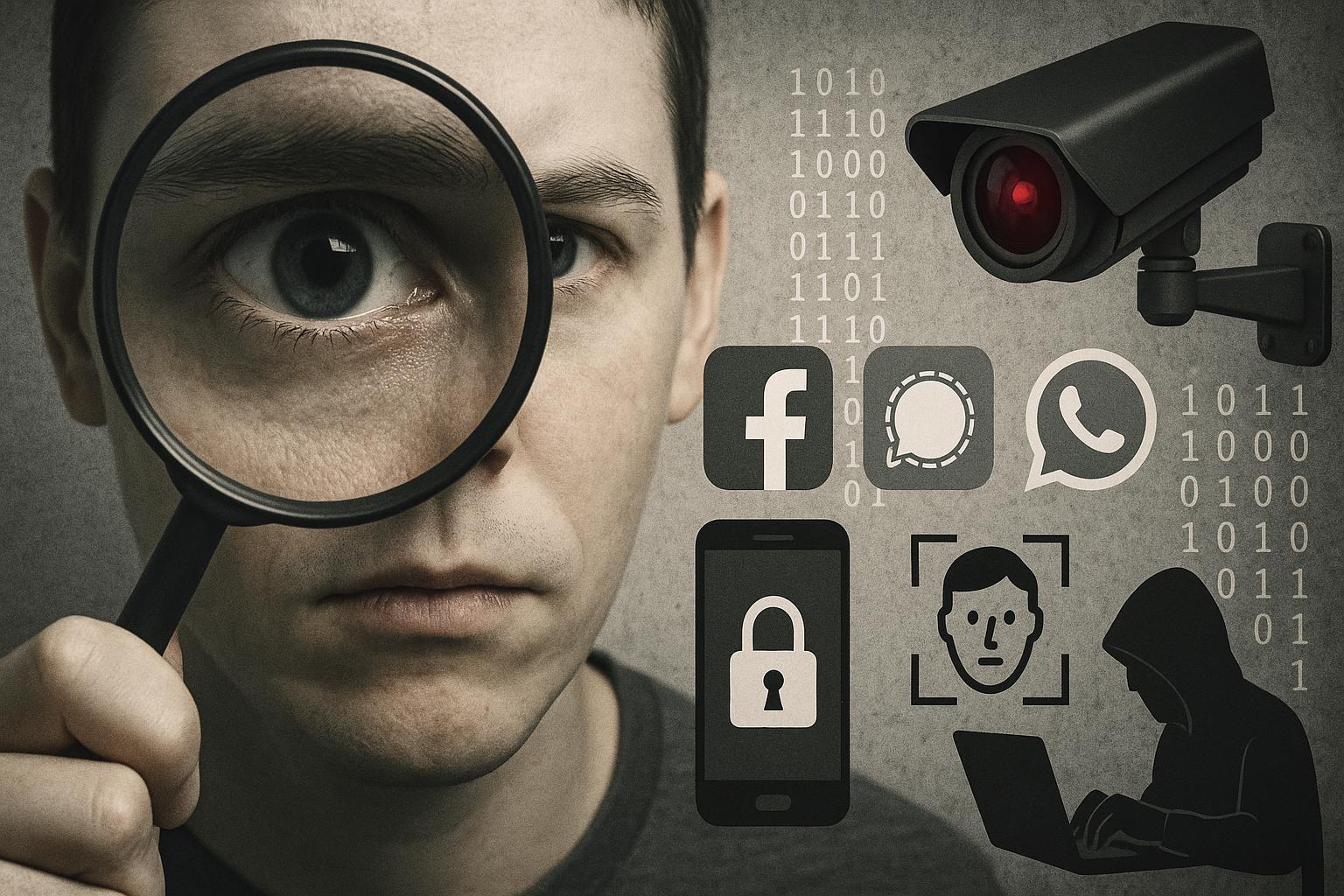
Privacy Is an Illusion
Many of us live under the delusion that there is such a thing as privacy. Well-meaning advice circulates on social media about how to better protect your WhatsApp messages by enabling additional privacy settings. These tips are like putting a plaster on a tumour: they offer psychological comfort with no real effect. The reality is far darker: every digital move we make is recorded, analysed, and profiled in ways we do not even fully comprehend.
We imagine that messaging apps like Signal or Telegram are secure, or that encrypted emails actually stay encrypted. We believe that an iPhone is safe with a sufficiently long passcode and Face ID, or that antivirus software and security tools on an Android phone will prevent spying or message interception. This belief is as naive as trusting that a lock on your door will stop a burglar from getting into your home. Former NSA Director Michael Hayden said it plainly: "We kill people based on metadata."¹ We do not even need the content of messages — simply knowing who communicates with whom is enough.
At the same time, there is talk on social media about how the EU's DSA (Digital Services Act)² and the currently pending Chat Control 2.0 initiative³ intend to begin AI-based scanning of messages across all messaging services in order to combat child pornography. In addition, to protect children from adult content, there are plans to require personal authentication on websites using, for example, bank credentials — and the same requirement is being extended to social media platforms. The real irony is that these "new" surveillance capabilities have been technically possible and in use for decades: the Five Eyes PRISM programme⁴, XKeyscore⁵, and countless other systems already collect data on a massive scale, without asking permission.
Once we understand this deeper truth, we see that the EU and other world governments now simply want to legalise what is already a technological reality: total surveillance of the individual, regardless of devices or messaging applications. A rarely discussed and certainly uncomfortable truth is that, if necessary, all your messages, browsing history, phone calls, and emails are an open book to a skilled hacker or state actor. Zero-day vulnerabilities⁶, such as the iOS exploit disclosed in September, give those in the know full access to any Apple phone in seconds. Intel Management Engine⁷ and AMD Platform Security Processor⁸ operate beneath the operating system. They are literally backdoors built directly into the processor.
Simpler backdoors into your phone include, for example, specially manufactured charging cables or chargers. A computer keyboard can simply be monitored, recording every keystroke, and screen content can be captured with surprising ease. We trust that if our computer or phone camera is being used, an indicator light will always come on — but in reality, indicator lights can be bypassed, on Android phones with surprising ease, and on computers even more so. Major security risks in home technology now range from networked dishwashers to smart televisions that analyse your viewing habits. Robot vacuums with cameras and even microphones are a goldmine for many hackers and a nightmare for security.
From experience, I can say that nearly anyone's passwords to virtually any online service can be obtained within about half an hour, assuming the attacker has sufficient skill and resources. Therefore, if you became a target, all your data, photographs, and documents would be siphoned away moments later. Privacy and security are, at the level of the ordinary citizen, a complete illusion — and no one has truly had either for a long time. The Utah Data Center⁹ has the capacity to store yottabytes of data — a number the human mind cannot even grasp. Every person's entire online activity, all preferences from adult entertainment sites, every message with anyone about any subject — in the hands of those with the skill and sufficient resources, it is all an open book.
A Faraday cage serves as a fitting metaphor for complete isolation in this electronic world, but the deeper truth is even more disturbing: algorithmic prediction models can deduce things about you from your behaviour that you do not even know about yourself. The Cambridge Analytica scandal¹⁰ revealed a stark reality: from 300 Facebook likes, an algorithm knows you better than your spouse does; from 700 likes, better than you know yourself. These models do not merely predict your behaviour — they steer it in ways we do not even notice ourselves. Social media feeds, search engine results, even news streams are tailored to your psychological profile in ways that invisibly guide your decisions. What does your Google news feed say right now?
The true power of surveillance lies not in what is seen, but in how the awareness of being seen changes behaviour. Jeremy Bentham's panopticon prison principle¹¹ — the possibility of constant surveillance causes people to police themselves — is now the digital reality before us. People censor their thoughts before writing them down, reshape their opinions to be socially acceptable or to attract more likes. This self-censorship and calculation is the most effective component of the surveillance system: we do not need Orwell's Thought Police, because we have become our own thought police, conditioned like Pavlov's famous dog.
Technology has advanced faster than its safeguards, and this is no accident. The intelligence services of major nations have systematically arranged numerous backdoors for themselves. Edward Snowden's revelations¹² showed that the NSA paid RSA $10 million to deliberately weaken encryption¹³. The Dual_EC_DRBG scandal¹⁴ revealed how random number generators had been intentionally compromised. SS7 protocol vulnerabilities¹⁵ make it possible to intercept phone calls and text messages from anywhere in the world — and this does not even require special technology. Mere access to telecom networks is enough, and that access is easily obtained because the number of insecure nodes is vast.
From a spiritual perspective, this development is not surprising. The Book of Revelation's description of a mark without which no one can buy or sell feels technologically feasible in a way that was previously inconceivable. Digital identity, biometric identifiers, and central bank digital currencies mean, in practice, that all the pieces are in place to build a system of total control. The only safe place in today's society is your own memory — not any piece of paper, let alone a digital device. The only way to prevent yourself from being tracked or "eavesdropped on" is to lock yourself inside a Faraday cage — a room with not a single electrical device and no access from the outside — because even today's energy-saving smart bulbs can be used for "listening" through the electromagnetic interference they produce.
My intention is not to frighten, but to expose the reality that an individual's privacy can be breached at will, regardless of that individual's wishes. At the same time, we must be honest about the fact that the vast majority of people's affairs never cross the threshold that would cause those with the capability to breach privacy to activate against ordinary citizens. This, too, is a matter of pure mathematics and resource management: generally speaking, the world does not care who is having an affair with whom at which workplace, or what turns up in someone's browser history.
Ordinary citizens can therefore be relatively at ease — so unless you are planning a terrorist attack, working as a state-level spy, or committing crimes of sufficient magnitude, you will be left in peace. Crime prevention and the state resources allocated to it are grounded purely in mathematics, and resources are directed where the apparent return on investment is greatest: that is, where the media visibility best serves a given country's propaganda machine. Resources are ultimately not directed where they are truly needed, as we see in Finland, for example, where eradicating the flourishing structural corruption would require enormous resources. Rooting out corruption from state administration and dismantling old boys' networks would, in practice, largely mean replacing the entire existing bureaucratic mafia — and in many countries, overhauling the entire state apparatus from rank-and-file employees to presidents.
The issue, then, is not that corruption does not exist, but that the current system is built solely to maintain a particular Status Quo in a way that keeps both the people and the "decision-makers" within these invisible boundaries. For most people, it is enough to be allowed to complain about corruption, about politicians favouring their friends and family — and years of experience show that change never comes, because in reality it is never allowed to happen.
We must therefore accept what we, as humanity, ordered for ourselves in ancient times, for history repeats itself with astonishing precision:
"Nevertheless the people refused to obey the voice of Samuel; and they said, Nay; but we will have a king over us; That we also may be like all the nations; and that our king may judge us, and go out before us, and fight our battles." (1 Sam. 8:19–20, KJV)¹⁶
The people of Israel rejected God's direct guidance and demanded a king "like all the other nations." Samuel warned them of what a king would take from them: their sons, their daughters, their fields, their vineyards, and ultimately their freedom. Yet the people wanted to be like everyone else. This same pattern now repeats in the digital age with astonishing similarity.
We voluntarily surrender our privacy, our data, and ultimately our autonomy to technology giants, because "everyone else uses them too." We accept surveillance because we want to be part of the digital community. We trade freedom for the illusion of security, just as Israel traded God's protection for the tyranny of an earthly king. The paradox is the same after millennia: when we ask for human-made security and control, we receive slavery. The digital king — whether it is the state, a technology corporation, or an algorithm — takes from us more than we ever agreed to give.
The truth is that we ourselves have built this digital Tower of Babel, where every person is transparent to power, but power itself remains invisible — because it truly is invisible. The earthly "kings" we have chosen — nations, heads of state, and corporations: Google, Meta, Apple, Microsoft, to name but a few — know more about us than we know about ourselves. They do not merely record your history; they shape your future through algorithmic decisions you will never see or understand.
The only true freedom is found in acknowledging the truth and living by it — and that truth is Jesus Christ.
Sources
-
Hayden, M. (2014). Johns Hopkins Foreign Affairs Symposium. Baltimore, Maryland. Documented in multiple sources, including The Intercept and The Guardian.
-
European Parliament and Council (2022). Digital Services Act (DSA) - Regulation (EU) 2022/2065. EUR-Lex.
-
European Commission (2022–2024). Proposal for a Regulation laying down rules to prevent and combat child sexual abuse. COM(2022) 209 final.
-
Greenwald, G. (2013). NSA Prism program taps in to user data of Apple, Google and others. The Guardian, 7.6.2013.
-
Greenwald, G. (2013). XKeyscore: NSA tool collects 'nearly everything a user does on the internet'. The Guardian, 31.7.2013.
-
Citizen Lab (2023). BLASTPASS: NSA Exploits Used to Silently Break into iPhones. University of Toronto, Munk School.
-
Sklyarov, D. & Ermolov, M. (2017). Intel Management Engine: Security hazards, public tools and forensic capabilities. Positive Technologies Research.
-
Garrett, M. (2018). AMD Platform Security Processor Analysis. Independent Security Research.
-
Bamford, J. (2012). The NSA Is Building the Country's Biggest Spy Center. Wired Magazine, 15.3.2012.
-
Kosinski, M., Stillwell, D. & Graepel, T. (2013). Private traits and attributes are predictable from digital records of human behavior. Proceedings of the National Academy of Sciences, 110(15), 5802–5805.
-
Bentham, J. (1791). Panopticon: or, The Inspection-House. T. Payne, London.
-
Greenwald, G. (2014). No Place to Hide: Edward Snowden, the NSA, and the U.S. Surveillance State. Metropolitan Books.
-
Menn, J. (2013). Exclusive: Secret contract tied NSA and security industry pioneer. Reuters, 20.12.2013.
-
Bernstein, D.J. et al. (2015). Dual EC: A Standardized Backdoor. Journal of Cryptographic Engineering, 5(2), 65–74.
-
Engel, T. (2014). SS7: Locate. Track. Manipulate. Chaos Communication Congress, Hamburg.
-
The Holy Bible, King James Version. First Book of Samuel 8:19–20.