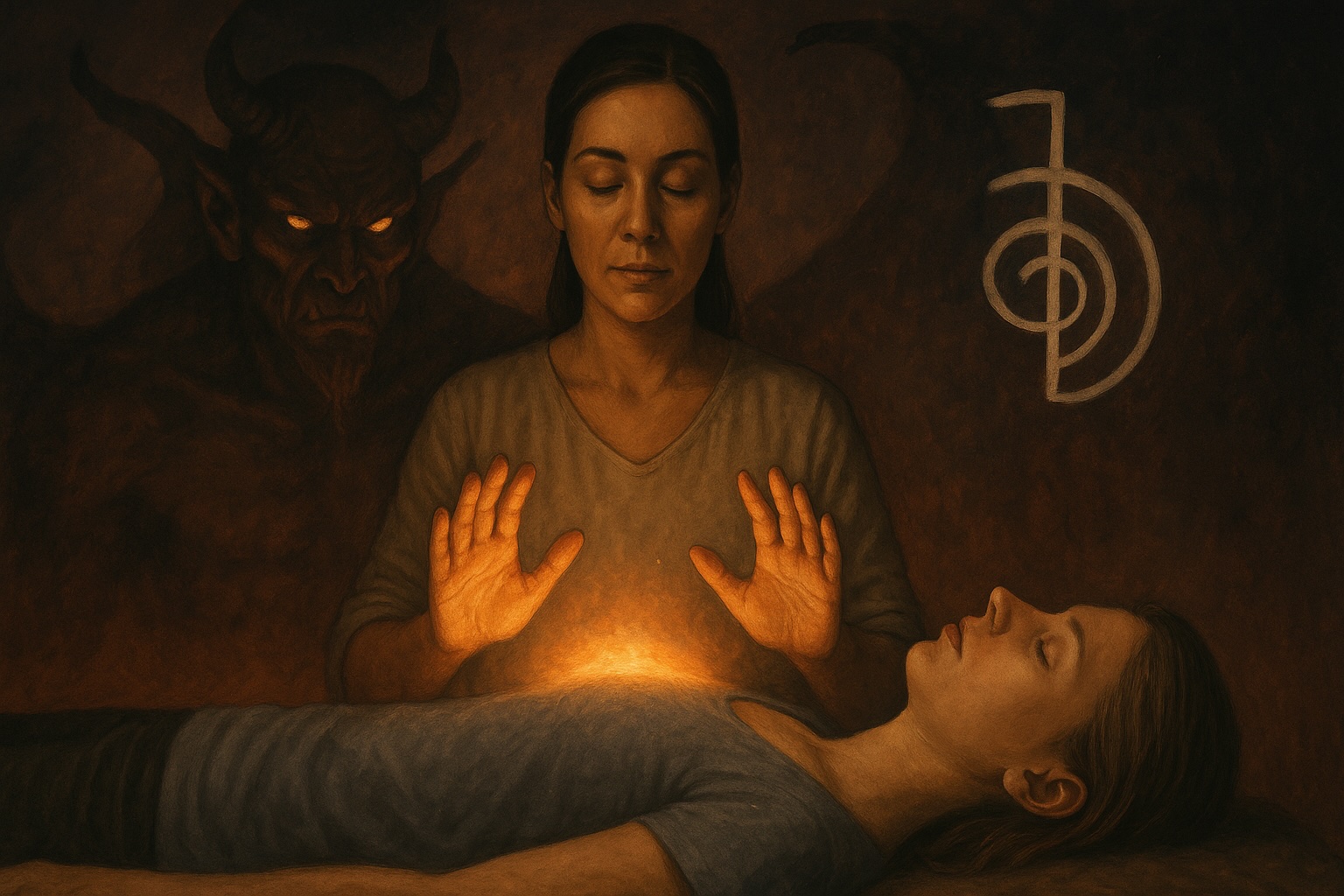
Reiki and Its Variations (Including Karuna Reiki)
Reiki, an energy healing modality of Japanese origin, has spread into a global phenomenon promising to channel universal life energy through simple hand positions and symbols. The system allegedly received by Mikao Usui in 1922 has morphed into countless variations, each claiming to be the original, the more powerful, or the higher form — creating a tangled web of competing schools, certificates, and price tiers. In Finland, there are thousands of reiki practitioners, courses run weekly, and even occupational healthcare may offer reiki treatments for stress management, despite the fact that the method's purported mechanisms are scientifically impossible and its true origins remain shrouded in obscurity.
The Legend and Reality of Mikao Usui
The official reiki story tells of Mikao Usui, a Japanese Buddhist who in March 1922 retreated to Mount Kurama near Kyoto for 21 days of fasting and meditation. According to the story, on the final day a powerful light struck his forehead and he received the reiki symbols, mantras, and the gift of healing directly from the universe. As he descended the mountain, he injured his toe, but when he placed his hands over it, the wound healed instantly. Thus reiki was born — a system of universal life energy.
The reality is far more complex and far less mystical. Historical documents show that Usui was a businessman who became interested in esoteric practices after financial difficulties. He studied several Japanese spiritual traditions, including Shintoism, Buddhism, Shugendo (mountain asceticism), and kiko (Japanese qigong). His system was not a unique revelation but a syncretic combination of existing techniques that he systematised and simplified.
Usui's original method, Usui Reiki Ryoho, was considerably more complex than modern Western reiki. It included meditation, breathing exercises, the recitation of poems, and ethical principles — the gokai, or five principles. Healing with hands was only one part of a broader system of spiritual development. Usui taught for only a few years before his death in 1926, and his students took the system in different directions.
Chujiro Hayashi, one of Usui's students and a former naval officer, systematised reiki into a more medically oriented system. He developed standardised hand positions, an anatomical approach, and a clinical treatment protocol. Hayashi also simplified the initiation process and created a tiered system that enabled reiki to spread more widely. His changes were pragmatic — designed to make reiki easier to learn and to market.
Hawayo Takata and the Western Transformation
Hawayo Takata, a Japanese-American woman from Hawaii, is a central figure in the Western history of reiki. She received treatment at Hayashi's clinic in Tokyo in 1935 for a serious illness and claimed to have been completely cured. Hayashi initiated her as a reiki master in 1938, and Takata brought reiki to Hawaii and later to the American mainland.
Takata radically reshaped the reiki narrative to make it more palatable to a Western audience in post-World War II America. She claimed that Usui had been a Christian doctor of theology searching for the healing method of Jesus. She stripped out the Buddhist and Shinto elements, simplified the techniques even further, and created a strict hierarchy in which mastership cost thousands of dollars. Takata's version of reiki was more her own creation than Usui's original system.
After Takata's death in 1980, reiki fractured into numerous competing schools. Her granddaughter Phyllis Furumoto founded the Reiki Alliance, claiming to be the sole rightful heir. Meanwhile, Barbara Ray founded the Radiance Technique, claiming to possess the true seven-level system. These organisations and dozens of others began fighting over authenticity, rights, and market share.
Reiki's Purported Mechanisms and Techniques
The fundamental premise of reiki is that universal life energy — rei-ki, or spiritual energy — flows through all things, and that through initiation a person can become a channel for this energy. Reiki practitioners claim they do not use their own energy but serve as a conduit through which universal energy flows into the client. This energy supposedly goes automatically wherever it is needed, healing physical, emotional, mental, and spiritual problems.
In practice, a reiki treatment involves placing the hands lightly on or slightly above the client at standardised positions. A traditional treatment covers 12–20 different points from head to feet, each held for 3–5 minutes. The practitioner may feel warmth, cold, tingling, or other sensations said to indicate energy flow. The client typically lies clothed on a treatment table while relaxation music plays in the background and scented candles burn.
Symbols are reiki's most central and mysterious element. No symbols are taught at the first level. At the second level, three are introduced: Cho Ku Rei (the power symbol), Sei He Ki (the mental-emotional symbol), and Hon Sha Ze Sho Nen (the distance healing symbol). At the master level, Dai Ko Myo (the master symbol) is taught. These symbols are drawn in the air or visualised, and they are claimed to amplify and direct energy. In reality, they are a combination of Japanese kanji characters and Buddhist symbols with no actual mystical power.
Attunements are rituals in which a reiki master purportedly opens the student's energy channels and connects them to universal reiki energy. The process involves drawing symbols in the student's aura, breathing rituals, and hand placements. It is claimed that after an attunement, the person is permanently connected to reiki energy and can immediately begin giving treatments. Attunement prices range from tens to thousands of euros depending on the level and the teacher.
Karuna Reiki and Other Major Variations
William Lee Rand, an American reiki master, developed Karuna Reiki in the 1990s, claiming it to be a higher and more effective system. Karuna means compassion in Sanskrit, and Rand claims the system operates at a higher vibrational level than traditional reiki. Karuna Reiki includes eight additional symbols that Rand claims to have received through meditation and channelling. In reality, many of these symbols have been borrowed from other energy healing systems and Hindu tradition.
Karuna Reiki training is even more expensive than traditional reiki, with the master course costing thousands of euros. Rand has created the International Center for Reiki Training, which tightly controls Karuna Reiki instruction and certification. The system is a textbook example of how original reiki has been commercialised and monopolised by creating ever higher and more expensive levels.
Usui/Tibetan Reiki is another popular variation, claiming to combine Usui's original system with Tibetan techniques. In reality, there is no evidence of any Tibetan connection — it is a Western invention that adds exoticism and mystique. This variation includes additional symbols, techniques, and initiation rituals, each carrying its own price tag.
Kundalini Reiki claims to combine reiki with kundalini energy awakening. Rainbow Reiki adds crystals, angels, and shamanic power animals. Celtic Reiki uses Celtic symbols to channel the energies of trees and plants. Angelic Reiki claims that angels perform the treatments through the practitioner. Each variation has its own training programme, certificates, and price tag.
The Spread of Reiki to Finland and Its Current Status
Reiki arrived in Finland in the late 1980s, when the first Finns received training abroad and began teaching at home. In the 1990s, reiki experienced explosive growth — courses were held everywhere and the media reported on the phenomenon with fascination. Today, Finland is estimated to have thousands of reiki practitioners and dozens of masters who teach regularly.
The Finnish reiki scene is fragmented, with no central organisation or unified standards. Anyone can call themselves a reiki master without oversight or accountability. Prices vary wildly: a first-level course can cost 50–500 euros, a master course 500–5,000 euros. Treatment prices range between 30 and 150 euros. Many practitioners combine reiki with other methods such as crystal healing, aura reading, or angel therapy to drive up prices.
What is particularly alarming is reiki's infiltration into official healthcare. Some hospitals offer reiki as a complementary treatment, nurses are being trained as reiki practitioners, and insurance companies may reimburse reiki treatments. This creates an impression of medical endorsement even though scientific evidence is entirely absent. Reiki has achieved what many pseudosciences aspire to: it has infiltrated legitimate institutions.
Scientific Research and the Absence of Evidence
Numerous scientific studies have attempted to demonstrate the efficacy of reiki, but the results have been consistently negative. When studies are properly controlled for the placebo effect, reiki produces no effect beyond placebo. Systematic reviews and meta-analyses have repeatedly concluded that there is no credible evidence for the efficacy of reiki in treating any condition.
Particularly revealing are studies in which reiki practitioners attempt to detect energy fields. Emily Rosa's classic study demonstrated that Therapeutic Touch practitioners could not identify the presence of a hand within an energy field any better than chance. Similar results have been obtained with reiki practitioners: they cannot distinguish living tissue from inanimate objects, sick from healthy, or even detect whether a client is present or not when visual contact is blocked.
Reiki proponents often appeal to quantum physics, biophoton emission, or electromagnetic fields. These explanations betray a deep misunderstanding of physics. Quantum effects do not operate at the macroscopic level at body temperature, biophotons are too weak to carry information, and the electromagnetic fields produced by the body are far too weak to influence biological processes at arm's length.
Psychological Mechanisms and Placebo
The reported benefits of reiki are entirely explained by psychological mechanisms. The placebo effect is powerful: mere belief in a treatment can activate the body's own healing mechanisms. The relaxation produced by a calm environment and gentle touch reduces stress hormones and can alleviate stress-related symptoms. The attention and care the client receives during a treatment session can improve mood and foster hope.
Confirmation bias causes people to notice and remember positive changes while forgetting negative or neutral experiences. Regression to the mean means that many symptoms improve on their own over time regardless of treatment. The post hoc fallacy leads people to believe that because recovery followed treatment, the treatment caused the recovery. Cognitive dissonance drives people to rationalise the benefits of an expensive treatment because it is difficult to admit having wasted money.
Reiki practitioners themselves experience ideomotor phenomena — involuntary muscle movements that are interpreted as energy flow. Suggestion and expectation create sensations of warmth, cold, or tingling. Group dynamics during courses reinforce beliefs as everyone reports similar experiences. Appeal to authority leads students to accept a master's explanations uncritically.
Financial Exploitation and Pyramid Structure
Reiki is structurally a classic pyramid scheme, even if it is not legally classified as one. The higher you climb in the hierarchy, the more you can charge for teaching. A Reiki I practitioner can give treatments; a Reiki II practitioner can give distance treatments at a higher price; a reiki master can teach and initiate new practitioners. Karuna Reiki, Lightarian Reiki, and other advanced levels promise ever-greater powers and justify ever-higher prices.
In Finland, a reiki master can earn thousands of euros over a weekend by running a course for ten students. Material costs are minimal: copies of a manual and a certificate. The real product being sold is the illusion of power and status. Many practitioners end up in financial difficulty trying to make a living from reiki, while the masters grow wealthy from courses.
Particularly problematic is the pressure to advance to higher levels. Practitioners are told that true healing requires completing all levels, that energy channels only fully open at the master level, that karmic cleansing happens only through the most expensive courses. This creates dependency and financial exploitation, especially among vulnerable people.
The Spiritual Dimension and Its Dangers
The true danger of reiki is not financial but spiritual. Initiation rituals are spiritual initiations that open gateways to demonic influences. Many reiki practitioners report the appearance of spirit guides after initiation, hearing voices, seeing visions. These are not signs of spiritual development but of demonic influence.
The use of symbols is particularly dangerous. They are not neutral geometric shapes but occult symbols that carry spiritual power. Drawing and chanting them is an invocation of demons, even when the practitioner believes they are channelling universal love. The use of the Hon Sha Ze Sho Nen symbol in distance healing is especially dangerous because it claims to transcend the limits of time and space, opening spiritual gateways without physical contact.
Many former reiki practitioners have reported serious spiritual problems: nightmares, depression, anxiety, personality changes, intrusive thoughts, suicidal ideation. These symptoms often begin after initiation and worsen as practice continues. The reiki community explains these away as cleansing reactions or spiritual growth, but in reality they are demonic oppression.
Cult-Like Characteristics
Reiki communities display many hallmarks of cults. Criticism is dismissed as negative energy; doubt is a sign of spiritual immaturity; the use of reason is ego resistance. Masters are shown blind reverence — their word is absolute truth. Group pressure is intense: if you do not feel the energy, the fault lies with you; you are not open or pure enough.
The love-and-light culture forbids negative emotions and experiences. Everything is love and light, everything happens for a reason, everything is a learning experience. This emotional suppression leads to deeper psychological problems. Real trauma, grief, and anger are forbidden, which prevents genuine healing. Spiritual bypassing replaces real psychological work with shallow positivity.
Dependency on reiki and the community grows over time. Practitioners begin to see everything through the lens of energy: illnesses are energy blockages, relationship problems are energy incompatibilities, financial difficulties are a lack of abundance energy. They lose the capacity for rational thought and normal social interaction. Their entire identity is built around the role of reiki practitioner.
Conclusion
Reiki is a paradigmatic example of the modern New Age movement: exotic origins, pseudoscientific explanations, hierarchical structure, financial exploitation, and spiritual danger woven together into an attractive package. It promises power, healing, and spiritual development, but delivers illusion, dependency, and spiritual bondage. Millions of people around the world have wandered into reiki's false reality, believing they are manipulating universal energy, when in truth they are opening themselves to demonic influences.
The real tragedy of reiki is that it replaces genuine healing with illusion. People who need medical treatment, psychotherapy, or spiritual help waste their time and money on energy treatments that produce no real benefit. They become trapped in a system that deepens their problems while promising solutions.
A Christian Perspective
Many Christians are led astray regarding reiki because it appears to be a harmless relaxation technique. Some even claim to practise "Christian reiki," replacing the Japanese symbols with Christian ones and the mantras with prayers. This is a dangerous deception. Reiki is fundamentally an occult system that cannot be Christianised by swapping out the symbols.
The Bible clearly forbids energy manipulation and the use of occult techniques. "There shall not be found among you any one that maketh his son or his daughter to pass through the fire, or that useth divination, or an observer of times, or an enchanter, or a witch" (Deut. 18:10, KJV). Reiki is the manipulation of energy — that is, spiritual powers — even when it disguises itself as healing.
The laying on of hands in the Bible is an entirely different matter from reiki. The apostles healed in the name and power of Jesus, not by manipulating universal energy. "Then Peter said, Silver and gold have I none; but such as I have give I thee: In the name of Jesus Christ of Nazareth rise up and walk" (Acts 3:6, KJV). Healing came from God, not from cosmic energy or techniques.
For a Christian, practising or receiving reiki is clearly forbidden when viewed through the lens of Scripture. It is participation in the occult, no matter how harmless it may appear. "Beloved, believe not every spirit, but try the spirits whether they are of God" (1 John 4:1, KJV). The spirit of reiki is not the Holy Spirit but a deceiving spirit that masquerades as an angel of light.
True healing for a Christian comes from God through prayer, not from energy manipulation. "Is any sick among you? let him call for the elders of the church; and let them pray over him, anointing him with oil in the name of the Lord" (James 5:14, KJV). This is the biblical model: prayer in the name of Jesus — not the channelling of universal energy.
Christ is the only mediator between God and man. "For there is one God, and one mediator between God and men, the man Christ Jesus" (1 Tim. 2:5, KJV). We do not need reiki masters, attunements, or symbols to access God's healing power. In Christ, we have everything we need.
For Reflection
Why do people pay hundreds of euros to learn a technique that is supposedly a natural ability everyone is born with?
Can something be both ancient Japanese tradition and simultaneously universal and religiously neutral?
What does it say about a system that its effectiveness correlates perfectly with the price paid — the more you pay, the more powerful you become?
Sources:
- Jonker, Jojan (2016). Reiki: The Transmigration of a Japanese Spiritual Healing Practice. University of Heidelberg Press.
- Lee, M.S. et al. (2008). Effects of Reiki in clinical practice: a systematic review of randomised clinical trials. International Journal of Clinical Practice.
- McManus, David (2017). Reiki Is Better Than Placebo and Has Broad Potential as a Complementary Health Therapy. Journal of Evidence-Based Complementary & Alternative Medicine.
- Miles, Pamela & True, Gala (2003). Reiki - Review of a Biofield Therapy: History, Theory, Practice, and Research. Alternative Therapies in Health and Medicine.
- Petter, Frank Arjava (2012). This Is Reiki: Transformation of Body, Mind and Soul. Lotus Press.
- Rosa, Emily et al. (1998). A Close Look at Therapeutic Touch. Journal of the American Medical Association.
- Stein, Diane (1995). Essential Reiki: A Complete Guide to an Ancient Healing Art. Crossing Press.
- Stiene, Bronwen & Frans (2003). The Reiki Sourcebook. O Books.
- Vandervaart, S. et al. (2009). A systematic review of the therapeutic effects of Reiki. Journal of Alternative and Complementary Medicine.
- Wilson, Judith (2010). Reiki: A Comprehensive Analysis. Integral University Press.