
From the Red Palace to Puu-Käpylä: The Ideological Legacy of Nasima Razmyar
When SDP Vice Chair Nasima Razmyar stepped up to the parliamentary podium to oppose a border law that would allow Finland to suspend the reception of asylum applications at its border, her arguments were familiar: "30,000 asylum seekers have been managed," she stated, demanding "more detailed information" on the authorities' capacity¹. When President Stubb announced that Russia could move over a thousand migrants to the border within hours, Razmyar challenged even this security assessment².
Her consistent opposition to all measures restricting immigration has prompted critics like Wille Rydman to claim that she "systematically supports everything that is harmful to Finns"³.
Rydman's claim may be somewhat simplified, but beneath it lies a deeper truth. To understand Razmyar's political positions, we must examine her personal history: a journey that begins in the blood-soaked corridors of Afghanistan's communist regime and ends at the summit of Finland's political elite. This is not merely the story of one family, but a narrative about how ideologies are inherited and transformed across generations, and how the shadows of the past reach into the present.
Nasima Razmyar was born in Kabul in September 1984, at a time when her father, Mohammed Daud Razmyar, had risen to the highest echelons of Afghanistan's communist party, the PDPA. This was no ordinary political ascent: the PDPA was the party whose seizure of power in April 1978 unleashed one of the bloodiest periods in Afghan history. The Saur Revolution, as it was called, was not a popular uprising but the violent coup of a small, Soviet-trained elite, in which President Mohammed Daoud Khan and his family were brutally murdered⁴.
Mohammed Daud Razmyar's path to the top of the communist party began in the 1960s, when he joined the PDPA at the age of 18. The party's secret constitution of 1965 declared its objective to be "the expansion and strengthening of friendly relations between Afghanistan and the Soviet Union"⁵. In a 1978 party pamphlet, the PDPA described itself as "the vanguard of the working class" and General Secretary Taraki as "an experienced Marxist-Leninist"⁶. Having graduated from the economics faculty of Moscow University in 1977, Razmyar was part of a Soviet-educated elite that saw the world through the lens of Marxist-Leninist ideology⁷.
The PDPA's reign from 1978 to 1992 is one of history's most thoroughly documented examples of where ideological blindness can lead. The intelligence service AGSA, created by President Taraki, launched systematic arrests and executions. Taraki himself set the tone by declaring in March 1979: "Those who plot against us in the dark shall vanish into the dark"⁸. Pul-e-Charkhi prison became especially notorious, where an estimated 5,000 to 27,000 people were executed during 1978–1979 alone⁹. Political researcher Olivier Roy estimated that 50,000 to 100,000 people disappeared during this period¹⁰.
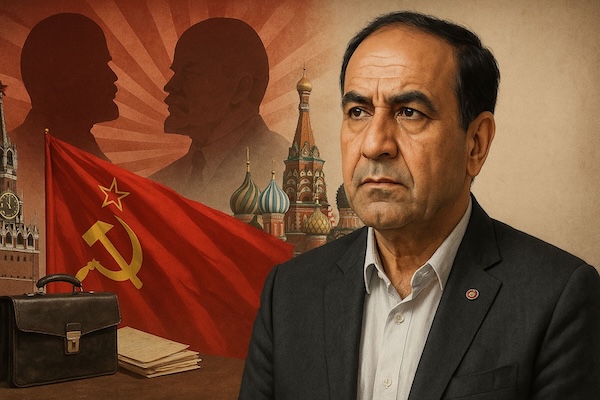
Mohammed Daud Razmyar rose to the party leadership precisely within this bloody context. Ironically, his own brother Nasim was among the disappeared and apparently killed — his fate was never determined¹¹. This personal tragedy, however, did not prevent Razmyar from continuing his ascent through the party hierarchy. In the early 1980s he served as deputy chair of the PDPA Central Committee's economic department, eventually rising to the party's highest leadership as a member of the Politburo¹².
In December 1979, Soviet tanks rolled into Afghanistan and the country became entirely dependent on Moscow. Razmyar's career continued seamlessly across successive administrations. His rise culminated in February 1989, when Soviet forces withdrew and he served as First Secretary of the party council governing Kabul — in practice, the supreme leader of the capital¹³. President Mohammad Najibullah, whom Razmyar had known since the age of 19, appointed him to the 20-member Supreme Council for the Defence of the Homeland, which governed the country. Razmyar also served as Minister of Defence and Security¹⁴.
In 1989, Razmyar was appointed Afghanistan's Ambassador to the Soviet Union in Moscow — a posting that proved to be his salvation.
When the Soviet Union collapsed in 1991 and Najibullah's regime fell in 1992, Razmyar was safe in Moscow. From there, the road led to Finland, where the family arrived in October 1993¹⁵.
Notably, Razmyar had already spent four months in Finland in the autumn of 1979, staying at Hotel Aurora at the very time of the Soviet invasion¹⁶.
Having settled in Puu-Käpylä, Helsinki, Mohammed Daud Razmyar did not remain idle. He still serves as chair of the European division of the People's Party of Afghanistan¹⁷, though in practice the activities of the 79-year-old are largely symbolic. A 2012 Helsingin Sanomat article titled "The Kabulite of Käpylä runs his party by phone" described how he maintains contacts with former party comrades. It is worth noting that after decades of living in Finland, his command of Finnish reportedly remains poor¹⁸ — a detail suggesting that his gaze has remained fixed on the past and on his homeland.
In this context, Nasima Razmyar's childhood takes on new meaning. She spent her first years in Kabul at the heart of the communist elite, and from 1989 to 1992 in Moscow as an ambassador's daughter.
The family's life has been described as "lavish," complete with daycare, cooks, and constant shopping trips¹⁹ — a stark contrast with the reality facing ordinary Afghans in a war-ravaged country where an estimated 1.24 million people had died by 1988 and five million had fled²⁰.
Though Mohammed Daud Razmyar is now an elderly man with no real political influence, the ideological heritage in which Nasima grew up has left its mark: it is visible in her tendency to prioritise international obligations over national security.
Nasima Razmyar's integration into Finnish society has been a success story. She completed upper secondary school at Töölön yhteiskoulu in 2004, earned a degree in community education, worked at the Mannerheim League for Child Welfare and the Monika Multicultural Women's Association, and transitioned into a role as a political aide for the SDP²¹. In 2010, she was named Refugee Woman of the Year; in 2012, she was elected to the Helsinki City Council; in 2015, she entered Parliament as Finland's first MP with a refugee background; and in 2017, she became Deputy Mayor of Helsinki at just 33²². She currently serves as the SDP's First Vice Chair.
Behind this success story, however, lies another, less told dimension. According to public records, Razmyar has held a significant role in reception centre operations²³. She served on the board of Viittakivi Oy at least during 2015–2017²⁴. Viittakivi is a company wholly owned by the Finnish Settlement Movement (Setlementtiliitto), and Razmyar also served on the Federation Board of Setlementtiliitto²⁵. In 2015, Viittakivi Oy received €2,790,255 in taxpayer funds for reception centre operations²⁶. Setlementtiliitto, in turn, received a total of €2.197 million in grants from RAY (Finland's Slot Machine Association) in 2016²⁷. Viittakivi Oy has since been dissolved.
Razmyar also served on the board of the Monika Multicultural Women's Association²⁸. The organisation received €770,000 in RAY grants in 2016 and was the largest recipient of the Ministry of the Interior's EU Integration Fund up to 2012²⁹. These connections already created a clear conflict of interest at the time: Razmyar was sitting at the table where immigration policy was decided while simultaneously holding significant roles in organisations that financially benefited from immigration³⁰.
This conflict of interest is concretely reflected in her political stances. She opposed the closure of Helsinki's reception centres in 2020³¹, has submitted parliamentary initiatives to increase funding for organisations that educate immigrants³², and has consistently opposed all measures that would reduce the number of asylum seekers³³. Her vote against the border law even after the SDP's group decision³⁴ demonstrates that personal convictions — or interests — override party discipline.
Also worth noting is the glaring inconsistency in Razmyar's voting record. In 2016, she voted in favour of a legislative amendment that removed humanitarian grounds as a basis for a residence permit — a decision that significantly worsened the position of asylum seekers and contradicted her own refugee background. Eight years later, however, she voted against the border law, citing precisely humanitarian reasons.
This contradiction reveals an opportunistic and populist pattern: when the political climate was tense after the refugee crisis, Razmyar voted for restrictions. Once the situation calmed and her position within the party strengthened, she publicly returned to a more liberal line and her original agenda.
This raises a fundamental question: are Razmyar's decisions truly guided by principles, or by political calculation?
At a level deeper than financial ties, Razmyar's positions reflect an ideological heritage rooted in her father's world. The PDPA's internationalist worldview — in which national borders and security were always subordinated to the demands of "international solidarity" — lives on in a new form in the daughter's politics. Where Mohammed Daud Razmyar spoke of "proletarian internationalism," Nasima speaks of "human rights" and "international obligations"³⁵. The terminology has changed, but the core idea remains the same: national borders and identities are obstacles to be overcome in the name of a universal ideology.
This ideological continuity is crystal clear when we compare the political positions of two generations.
Both Razmyars represent an elite-centred approach to politics. Mohammed Daud was part of a small Soviet-educated elite that attempted to impose its ideology on millions of Afghans. Nasima, having swiftly risen into Finland's political elite, represents a new cosmopolitan elite that views nationalism and security concerns as "populism" and "racism"³⁶.
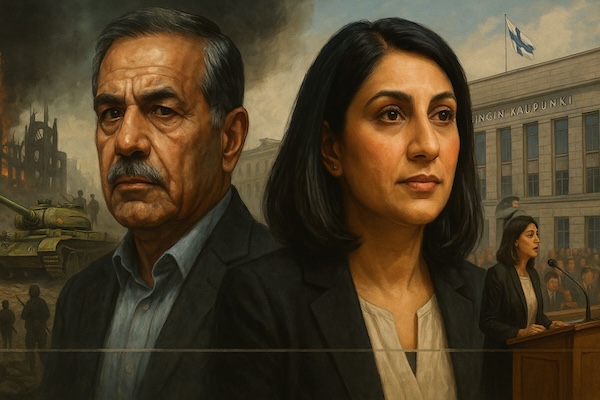
In both cases, we also see ideological blindness to reality. The PDPA refused to acknowledge that its policies were driving Afghanistan into chaos. Similarly, Nasima Razmyar appears to refuse to acknowledge the connection between liberal immigration policy and security problems. When Afghans resisted the PDPA's reforms, they were accused of being reactionaries. When Finns express concern about immigration, Razmyar and her political allies accuse them of racism³⁷.
Particularly revealing is Razmyar's own statement: "I entered Parliament in 2015 as Finland's first MP with a refugee background"³⁸.
This emphasis on her refugee background is understandable as political capital, but it obscures the fact that her family were not ordinary refugees but part of the very elite whose policies drove millions of Afghans into exile. Her father served in the highest leadership of the very regime responsible for Afghanistan's destruction.
In 2025, the Afghanistan Analysts Network reported that "various groups with roots in or affinity to the PDPA remain active in the diaspora"³⁹. These networks are not mere nostalgia clubs but active political actors that maintain and transmit ideological heritage to new generations. Mohammed Daud Razmyar's role as the European leader of the People's Party of Afghanistan is part of this broader phenomenon⁴⁰.
The Razmyar story is not unique. Across Europe, descendants of former communist dictatorships' elites have risen to prominent positions in their new home countries. This raises important questions about the functioning of our democracies. To what extent should democratic societies allow individuals whose ideological background is fundamentally at odds with the host country's values to access positions of power? How do we reckon with the fact that many who arrived as refugees were themselves complicit in the systems that produced the displacement?
The next time Nasima Razmyar rises to speak of "international solidarity" or to criticise "populist" security measures, we would do well to remember where these ideas truly originate. Her father served a system that sacrificed Afghanistan's national sovereignty and security on the altar of ideology. The daughter appears ready to repeat the same mistake — this time at Finland's expense.
This does not mean that Nasima Razmyar is a communist or that she endorses her father's deeds, but her consistent opposition to national security measures, her prioritisation of international obligations over national interests, and her unwillingness to acknowledge the challenges of immigration all reflect an ideological heritage that has caused immeasurable suffering.
Mohammed Daud Razmyar's journey from the PDPA Politburo to Käpylä, Helsinki, is a reminder that history moves in cycles. It is also a warning of how ideological blindness can lead to horrific acts — and how the perpetrators of those acts can ultimately find refuge in the very countries whose values they once scorned. When ideologies do not die but adapt, and when yesterday's totalitarianism dresses itself in today's humanitarianism, democracy must remain vigilant.
Finns should ask themselves: can we truly understand current political debates without understanding the ideological roots of their actors? And when a politician consistently places abstract "human rights" above concrete national security, is it not worth asking whose interests she truly serves — and where her worldview truly originates?
In light of Nasima's history and the facts, Rydman's comment about Nasima seems positively restrained — so perhaps Razmyar should file a criminal complaint, and then all these backgrounds would be thoroughly investigated once and for all.
Sources
- Yle Uutiset. "Eduskunta hyväksyi kiisteltyyn rajaturvallisuuslakiin jatkoajan – yksi lipesi hallituspuolueista." 12.7.2024. The article documents Razmyar's vote against the border law and her justification: "30,000 asylum seekers have been managed."
- Iltalehti. "SDP:n Razmyar epäilee presidentin turvallisuusarviota: 'Tarvitaan tarkempaa tietoa'." 15.6.2024. Razmyar questioned President Stubb's statement about Russia's ability to move over a thousand migrants to the border within hours.
- Rydman, Wille. Twitter/X post. 18.7.2024. "Razmyar systematically supports everything that is harmful to Finns." @WilleRydman.
- Ruttig, Thomas. "An April Day That Changed Afghanistan 3: The legacy of the Saur Revolution's war crimes." Afghanistan Analysts Network, 9.3.2020. Documents PDPA atrocities, specifically Taraki's statement: "Those who plot against us in the dark shall vanish into the dark."
- Van Bijlert, Martine and Ruttig, Thomas. "Between Reform and Repression: The 60th anniversary of the PDPA." Afghanistan Analysts Network, 3.1.2025. Analysis of the founding of the PDPA and its secret constitution of 1965.
- Van Bijlert, Martine and Ruttig, Thomas. "Between Reform and Repression: The 60th anniversary of the PDPA." Afghanistan Analysts Network, 3.1.2025. The PDPA's self-description as "the vanguard of the working class" and of Taraki as a "Marxist-Leninist."
- Wikipedia. "Mohammed Daud Razmyar." Finnish Wikipedia, updated 17.4.2025. Basic biographical data: born 1945, graduated from Moscow University in 1977.
- Ruttig, Thomas. "An April Day That Changed Afghanistan 3: The legacy of the Saur Revolution's war crimes." Afghanistan Analysts Network, 9.3.2020. Taraki's March 1979 statement on the enemies of the revolution.
- European Union Agency for Asylum. "Country Guidance: Afghanistan - Past conflicts (1979-2001)." Updated January 2025. Estimates of Pul-e-Charkhi prison victims: 5,000–27,000 executed.
- Ruttig, Thomas. "An April Day That Changed Afghanistan 3: The legacy of the Saur Revolution's war crimes." Afghanistan Analysts Network, 9.3.2020. Olivier Roy's estimate of 50,000–100,000 disappeared during the Taraki-Amin period.
- Wikipedia. "Mohammed Daud Razmyar." Finnish Wikipedia, updated 17.4.2025. Mention of brother Nasim Razmyar, who disappeared during internal party purges.
- People Pill. "About Mohammed Daud Razmyar: Afghan politician and diplomat (1945-)." Biographical database, accessed 2025. Razmyar's rise to the PDPA Central Committee and Politburo membership.
- People Pill. "About Mohammed Daud Razmyar: Afghan politician and diplomat (1945-)." Biographical database, accessed 2025. Service as First Secretary of the Kabul party council in February 1989.
- People Pill. "About Mohammed Daud Razmyar: Afghan politician and diplomat (1945-)." Biographical database, accessed 2025. Appointment to the Supreme Council for the Defence of the Homeland and as Minister of Defence.
- Wikipedia. "Nasima Razmyar." English Wikipedia, accessed 2025. The family's arrival in Finland in October 1992 from Moscow.
- Matkamiehen Mietteitä blog. "Nasima Razmyarin isäpappa - kommunistijohtajan menneisyys." October 2015. Mohammed Daud's visit to Finland in 1979, four months at Hotel Aurora.
- NykySuomi. "Afganistanin entinen kommunistieliitti hamuaa korkeita virkoja Suomessa." 10.6.2017. Author: Janus Putkonen. Razmyar's role as chair of the European division of the People's Party of Afghanistan.
- Helsingin Sanomat, Monthly Supplement. "Käpylän kabulilainen pyörittää puoluetta puhelimitse." February 2012. Description of Razmyar's poor command of Finnish and political activity from Finland.
- Anna magazine. "Nasima Razmyar: 'Oli vaikeaa kasvaa naiseksi kahden kulttuurin välissä'." 25.6.2024. Reporter: Mari Pöyhtäri. Description of the family's "lavish" life in Moscow.
- Human Rights Watch. "Afghanistan: The Forgotten War - Human Rights Abuses and Violations of the Laws of War since the Soviet Withdrawal." February 1991. Estimate of 1.24 million dead by 1988.
- Wikipedia. "Nasima Razmyar." Finnish Wikipedia, accessed 2025. Education and work history: upper secondary school diploma from Töölön yhteiskoulu in 2004.
- Wikipedia. "Nasima Razmyar." Finnish Wikipedia, accessed 2025. Political career: elected to city council 2012, Parliament 2015, Deputy Mayor 2017.
- MV-lehti. "Nasima Razmyar ja vastaanottokeskusbisnes - SDP:n kansanedustajan kytkökset Viittakivi Oy:hyn." 15.3.2016. Author: Ilja Janitskin. Documents Razmyar's board membership at Viittakivi Oy.
- MV-lehti. "Nasima Razmyar ja vastaanottokeskusbisnes - SDP:n kansanedustajan kytkökset Viittakivi Oy:hyn." 15.3.2016. Exact period of board membership: at least 2015–2017.
- The International Federation of Settlements (IFS). "Meet Our Esteemed Speakers: Nasima Razmyar." Conference introduction, June 2023. Confirms Razmyar's role on the Federation Board of Setlementtiliitto.
- MV-lehti. "Nasima Razmyar ja vastaanottokeskusbisnes - SDP:n kansanedustajan kytkökset Viittakivi Oy:hyn." 15.3.2016. Viittakivi Oy's revenue from reception centre operations in 2015: €2,790,255.
- The International Federation of Settlements (IFS). "Annual Report 2016." Setlementtiliitto's RAY grants in 2016: €2.197 million.
- Uusi Suomi Puheenvuoro. "Turvapaikanhakijabisneksen siipiveikot." 20.2.2016. Author: Rainer Salejärvi. The board of Monika Multicultural Women's Association and RAY funding.
- Uusi Suomi Puheenvuoro. "Turvapaikanhakijabisneksen siipiveikot." 20.2.2016. Monika Multicultural Women's Association RAY grants 2016: €770,000; largest recipient of the EU Integration Fund.
- MV-lehti. "Kommentti: Razmyarin selvä eturistiriita maahanmuuttopolitiikassa." 20.3.2016. Analysis of the connection between financial interests and political decision-making.
- MV-lehti. "Razmyar vastustaa Helsingin vastaanottokeskusten sulkemista." 12.10.2020. Razmyar's statement opposing the closure of the Malmi and Puistola centres.
- Eduskunta. "Kirjallinen kysymys KK 234/2017 vp - Kansanopistojen maahanmuuttajakoulutuksen rahoituksen lisääminen." 15.5.2017. Razmyar's initiative to increase organisational funding.
- Iltalehti. "SDP hajoaa rajalakikysymyksessä - Razmyar: 'En voi tukea perusoikeuksien rajoittamista'." 10.7.2024. Reporter: Juha Ristamäki.
- Eduskunta. "Äänestys 89/2024 vp - Laki rajaturvallisuudesta annetun lain jatkamisesta." 12.7.2024. Official vote result: 168 in favour, 29 against. Razmyar voted against.
- STT Info. "SDP:n Nasima Razmyar: Vaikka kysymyksessä on kansallinen turvallisuus, valitsevat perussuomalaiset silti populistisen linjan." 18.4.2024. Press release of Razmyar's criticism of the government's immigration policy.
- Razmyar, Nasima. Twitter/X post. 15.8.2016. "Racism is not an opinion but a crime." Cited on the Suomi24 discussion forum in reference to Razmyar's views.
- Suomi24 Keskustelut. "Nasima Razmyar - taustoja ja kantoja." 13.8.2016. Discussion thread analysing Razmyar's political positions and background.
- Wikipedia. "Nasima Razmyar." Finnish Wikipedia, accessed 2025. Razmyar's own statement: "I entered Parliament in 2015 as Finland's first MP with a refugee background."
- Van Bijlert, Martine and Ruttig, Thomas. "Between Reform and Repression: The 60th anniversary of the PDPA." Afghanistan Analysts Network, 3.1.2025. The persistence of PDPA networks in the diaspora: "various groups remain active."
- Foschini, Fabrizio. "An April Day That Changed Afghanistan 4: The evolution of the PDPA and its relations with the Soviet Union." Afghanistan Analysts Network, 16.3.2020. Analysis of the PDPA's ideological legacy and networks after the collapse of the Soviet Union.