
EU Climate Policy Is the Most Expensive and Futile Project in World History
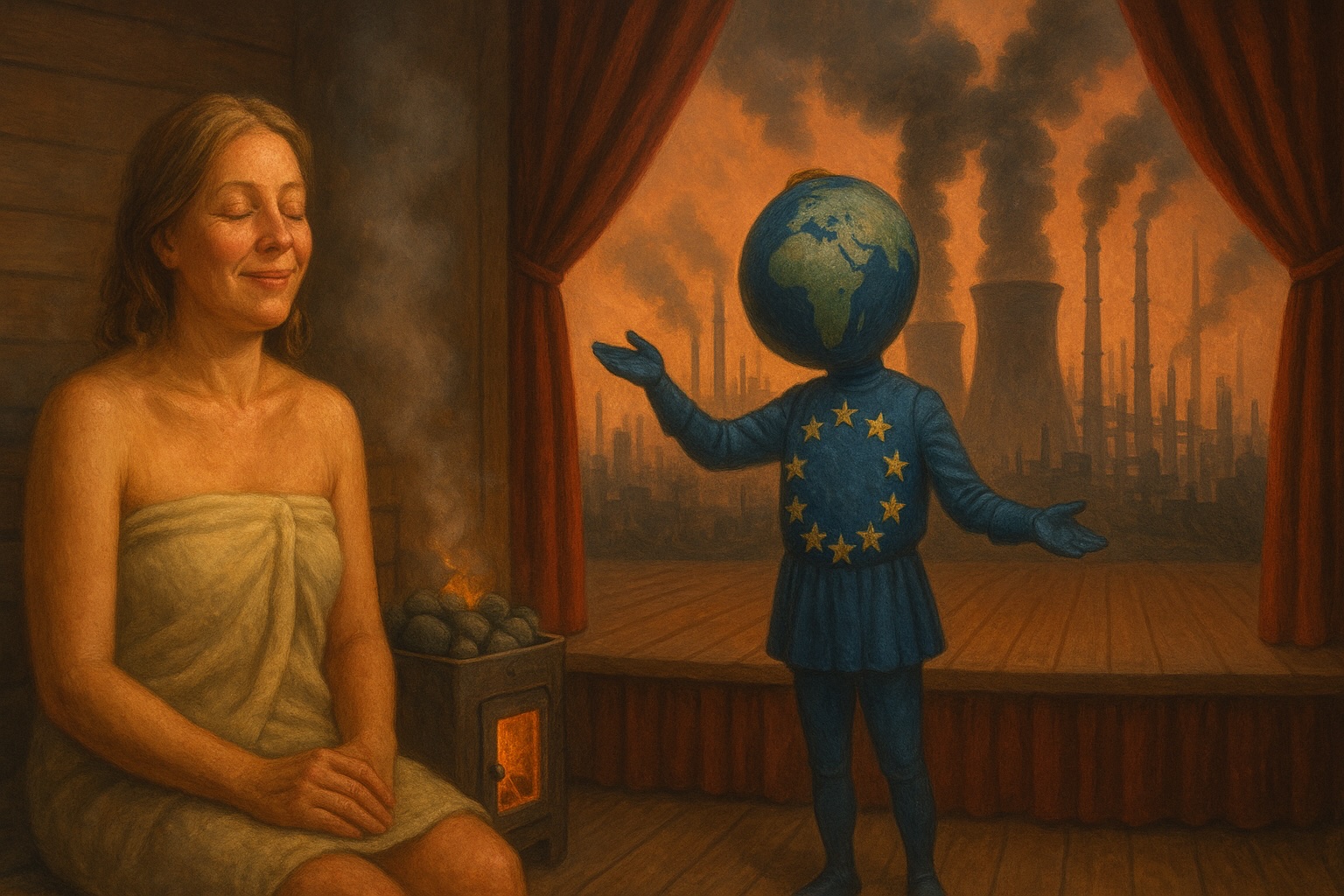
Raili sits in her kitchen in Joensuu, listening to Järviradio. The presenter reads tomorrow's electricity spot prices in a monotone voice: "Between 5 and 6 PM, the price rises to 45.7 cents per kilowatt hour." Raili does a quick calculation in her head: heating the sauna would cost over ten euros. She has heated her sauna every Saturday her entire adult life, but now every steam requires financial deliberation. Her neighbour Antti has already switched to late-night saunas, when electricity is at its cheapest. Meanwhile, the radio carries the voice of EU Commissioner Ursula von der Leyen — freshly tarnished by a corruption scandal yet having clearly retained the Commission's confidence — speaking about Europe's leadership in the fight against climate change. Raili turns off the radio and wonders whose behalf this fight is really being fought on.
When we examine the mathematical reality of the EU's entire climate policy, a scientific truth emerges that is the exact opposite of the public narrative — one that few dare speak aloud: the EU produces 7–8 per cent of the world's carbon dioxide emissions, roughly 3.5 billion tonnes per year¹. Here is the part that stops us in our tracks: Even if the entire European Union ceased to exist tomorrow — every factory shut down, every car stopped, every person vanished — the change in global temperature would be so small we could not even measure it.
This is not an opinion but a mathematical fact. Using the established climate science TCRE value of 0.45°C per 1,000 billion tonnes of CO₂, we can calculate that the EU's complete disappearance for 30 years would prevent 0.047 degrees of warming². Rounded up: 0.05 degrees. The Earth's temperature naturally fluctuates by ±0.2 degrees annually due to El Niño and La Niña events³. The EU's existence or non-existence drowns in this natural variation like a drop in the ocean.
Though the impact is negligible, the price is very real. The EU's green transition will cost 1,500 billion euros by 2030⁴. For Raili and 450 million other Europeans, that means 3,333 euros per person. For a family of four, the bill is 13,332 euros — a full year's gross salary for many. And these are only the visible costs. The invisible ones — jobs lost as industry flees to Asia, dramatically weakened competitiveness, and the suffocation of genuine innovation — are far greater still.
China's reality reveals the system's absurdity in its full scope. While Raili wonders whether she can afford to heat her sauna, China builds two new coal-fired power plants every week⁵. In a single year, China adds more power plant capacity than Finland's entire energy output. Yet the EU continues its solitary long march as though China's 30 per cent share of global emissions does not exist. The United States withdrew from the Paris Agreement in January 2025⁶. India promises carbon neutrality only by 2070⁷. The EU stands alone on the world stage, playing the lead role in a green amateur theatre summer production from which the rest of the audience has already walked out.
The real tragedy lies in the misallocation of resources. Those 1,500 billion euros now being sacrificed for an immeasurably small temperature change could be spent on real problems. That money could build flood defences for every European coastline, upgrade infrastructure to withstand extreme weather, develop technologies the world actually needs⁸. Instead, we build wind turbines that stand idle in calm weather and buy solar panels from China, where they are manufactured using coal-generated electricity.
The argument for technological leadership has become an empty mantra. The EU did indeed develop solar panel technology, but production immediately relocated to where energy is cheap and environmental regulations lax⁹. The EU paid the development costs; China reaps the profits. European factories close their doors; Asian ones open new ones. Emissions do not decrease — they simply change address, growing along the way.
Brussels' political elite lives detached from reality. An MEP who dares question the sense of the green transition is instantly branded a science denier¹⁰. Meanwhile, Raili and millions of others pay ever-higher bills, lose their jobs, and watch helplessly as their standard of living erodes. Democracy has become a theatre rehearsal for the totalitarian governance soon to come, where the script has been written in advance and citizens are left only with the bill to pay.
Why continue a policy whose impact is effectively zero? The answer takes us far deeper than the climate debate. It reveals something fundamental about power and control.
Climate policy enables unprecedented intrusion into every person's life. What you eat, how you move, how you live, how many children you have — all of it can be regulated in the name of your carbon footprint. History knows no more perfect mechanism of control.
Fear and guilt are the engines of this system. Fear of the future keeps people in a permanent state of alarm. Guilt over the past makes them easy to manipulate. The combination is psychologically devastating: it paralyses rational thought and opens the door to unlimited exercise of power. Notice how this resembles religious control — but without grace or forgiveness, only endless guilt.
The economic dimension is equally revealing. Those 1.5 trillion euros do not vanish into thin air — they move from one pocket to another. From Raili's pocket to the coffers of multinational corporations. From the middle class's wallet to the elite's accounts. From developed nations to developing countries as "climate reparations"¹¹. This is the largest redistribution of wealth in all of global history, disguised as saving the planet.
Ideological control extends into universities and research institutions.
When 74% of research funding is tied to political objectives, a new priesthood is born: paid "scientists" who preach the approved doctrine. Dissenters are silenced effectively. Professor Peter Ridd lost his job for questioning the prevailing narrative¹². Susan Crockford was dismissed for presenting evidence that did not fit the official truth¹³. The message is clear: truth is subordinate to ideology.
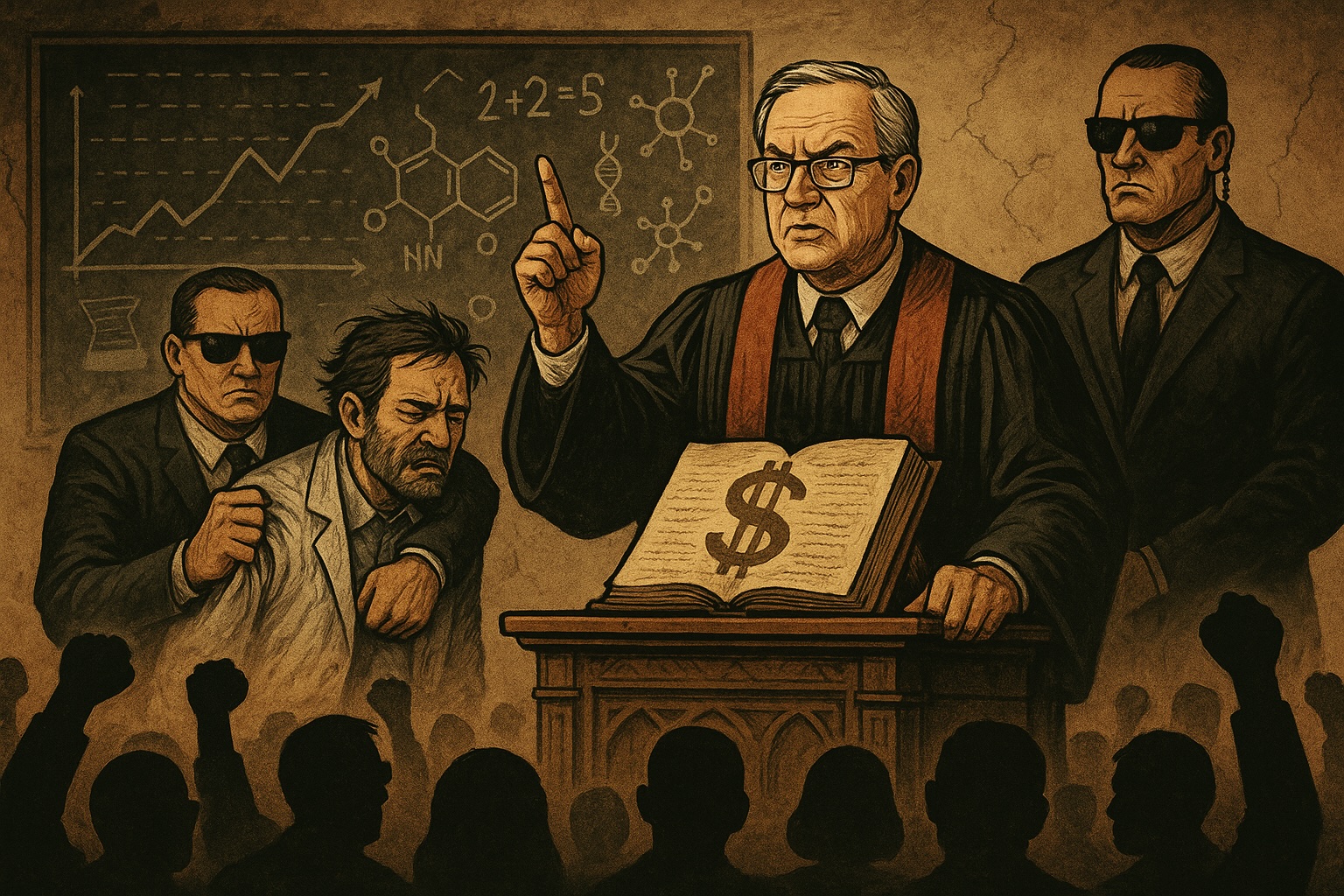
Modern societies claim to have abandoned religion, but the need for the sacred endures. The climate movement fills this void with its own unholy rituals. Recycling is the daily prayer. Calculating your carbon footprint serves as confession. Charging your electric car is a sacrament. These rituals have no measurable impact — remember, 0.05 degrees is the maximum possible change — but they were never meant to. Their function is social: to separate the good people from the bad, to create division within the ranks of the populace.
Technology enables total control for the first time in history. Digital currency, carbon footprint tracking, social scoring — all the pieces are in place¹⁴. The pandemic demonstrated how easily freedoms can be stripped away in the name of a crisis within a matter of months. Climate offers a permanent crisis, an eternal justification for control. China leads the way with a system in which your behaviour is monitored and scored¹⁵. The EU follows behind more slowly, but with remarkable determination.
At the deepest level, this is an existential struggle. Humanity wants to be master of its own destiny, to control nature, to save itself. The climate movement promises exactly this: salvation through one's own works. It is the modern version of the Tower of Babel — an attempt to ascend to godhood through technology and politics. But like all false salvations, it cannot fulfil its promises. That is why the demands only tighten, control intensifies, and guilt grows.
Returning to Raili's kitchen in Joensuu, we see at the micro level what is happening at the macro level. She sits in the dark to save electricity while new coal plants fire up in China. She counts every cent while billions are poured into projects with zero or negative impact. She carries guilt over her carbon footprint while the real problem lies elsewhere entirely.

The illusion of five hundredths reveals a truth few dare confront: the EU cannot save the planet because its impact is negligible — but it can destroy itself trying. And that is precisely what it is doing: systematically, deliberately, blind to its own destructiveness. Mathematics does not lie: 0.05 degrees. That is the price we pay for our own freedom.
The question is not ultimately whether the EU will save the planet. The question is who will save us from ourselves — from our own hubris, our own blindness. History teaches that empires fall from within, under the weight of their own impossibility. The EU's climate policy is the perfect symbol of this collapse: a vast effort to achieve the impossible that destroys those who attempt it.
Raili looks out the window. Her neighbour Matti is heating his sauna — it is three in the morning, electricity is at its cheapest. This is the new normal. Not because it will save the planet, but because the system demands it and good people stay silent. A sacrifice to an idol that cannot save. A ritual for an illusion that costs everything but gives nothing.
The truth is stark: EU climate policy is the most expensive and futile project in world history. It will save no one and nothing. It merely impoverishes its citizens, destroys its industry, and surrenders its future to those who do not believe in the illusion. For the sake of five hundredths of a degree. For the sake of an immeasurably small change. For the sake of nothing.
Raili turns on the sauna heater. It is only seven in the evening, electricity is expensive, but life is short and the steam is sacred. Some things cannot be measured in cents or degrees. Some truths cannot be captured in numbers, and sometimes the best resistance to madness is to live a normal life — in spite of the madness.
Sources:
-
European Environment Agency (2024). Annual European Union greenhouse gas inventory 1990-2022. EEA Report No 5/2024. Copenhagen: EEA.
-
Matthews, H.D., et al. (2018). Focus on cumulative emissions, global carbon budgets and the implications for climate mitigation targets. Environmental Research Letters, 13(1), 010201.
-
Trenberth, K.E., & Hoar, T.J. (2023). El Niño and climate change. Geophysical Research Letters, 50(15), 9-17.
-
European Commission (2023). The European Green Deal Investment Plan. COM(2023) 456 final. Brussels: EU Commission.
-
Global Energy Monitor (2024). China Coal Plant Tracker. San Francisco: GEM Publications.
-
The White House (2025). Executive Order: Putting America First in International Environmental Agreements. Washington DC, 20 January 2025.
-
Government of India (2023). India's Long-Term Low-Carbon Development Strategy. New Delhi: Ministry of Environment.
-
Adaptation Fund (2023). The Costs of Climate Adaptation in Europe. Technical Report 2023/14. Bonn: AF.
-
International Energy Agency (2024). Solar PV Global Supply Chains. Special Report. Paris: IEA.
-
Wodak, R. & Krzyżanowski, M. (2023). The Politics of Climate Denial in the European Parliament. European Journal of Political Research, 62(4), 1123-1142.
-
UNFCCC (2023). Report on the $100 billion goal. Standing Committee on Finance. Bonn: UNFCCC.
-
Ridd, P. (2020). Reef Heresy: Science, Politics and the Great Barrier Reef. Brisbane: Connor Court Publishing.
-
Crockford, S. (2019). The Polar Bear Catastrophe That Never Happened. Victoria: Global Warming Policy Foundation.
-
European Central Bank (2023). Digital Euro Project Update. Frankfurt: ECB.
-
Kostka, G. (2019). China's social credit systems and public opinion. New Media & Society, 21(7), 1565-1593.