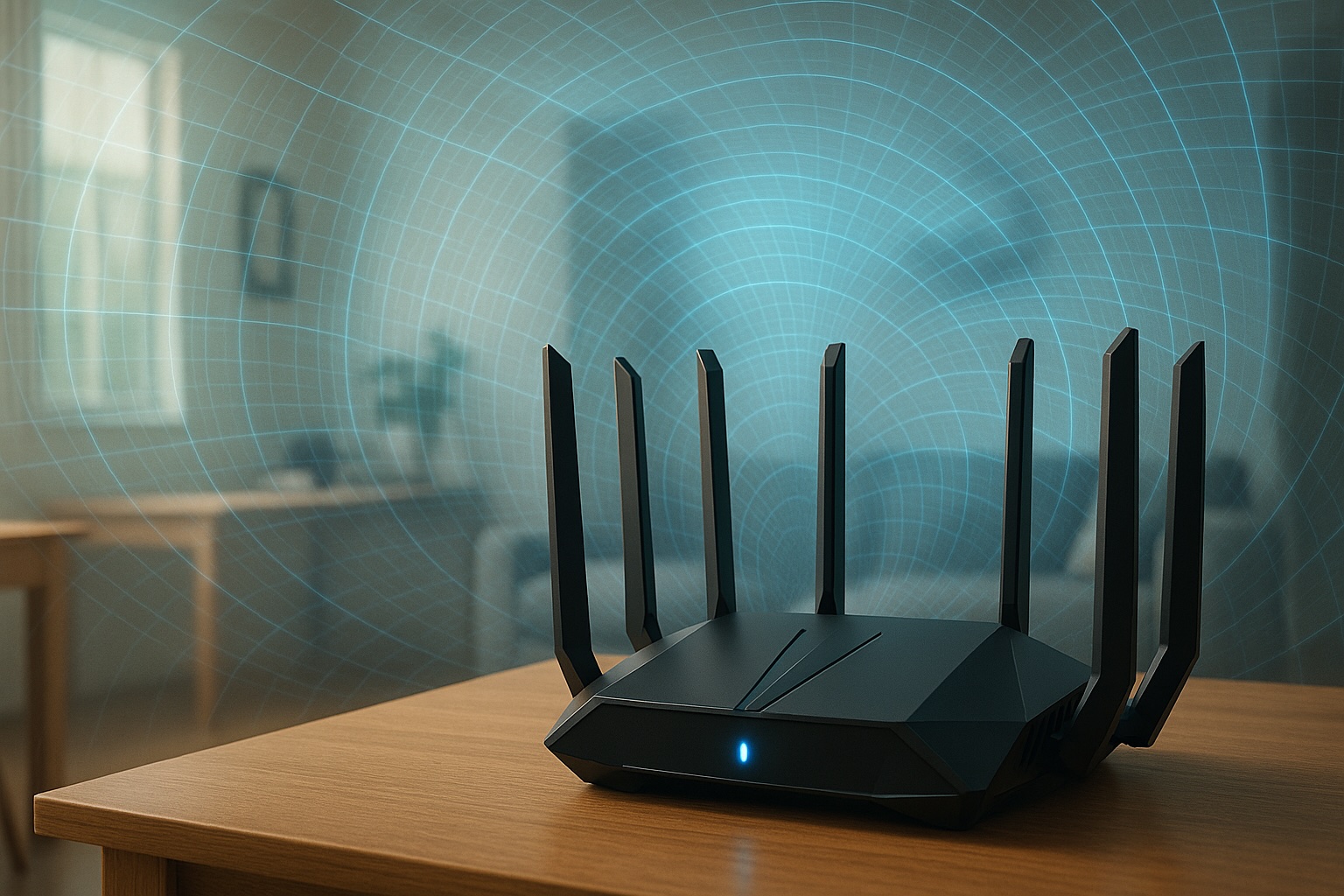
WiFi as the Invisible Eyes in Our Homes: When Your Walls Become Transparent
The router blinks in the corner of the desk. A green light, a steady pulse, a familiar sight in every home. We rarely stop to think that every radio pulse it transmits is drawing an invisible map of the space around us. These signals bounce off walls, furniture, and our own bodies, creating an ever-shifting pattern — a choreography of radio waves that reveals an astonishing amount about our lives. Your router knows how deeply you are breathing right now.
As I studied research on WiFi-based fall detection — systems already achieving 85–95 per cent accuracy without cameras or wearable sensors¹ — it became inescapable: we have built homes that see us without eyes. Channel State Information, or CSI technology, originally designed solely to improve your network connection, has become an unintended eye. Yang et al. (2022) demonstrated that this technology can save lives in care homes², but it simultaneously raises the question: who else is watching? These figures come from laboratory conditions; at home, accuracy can drop significantly due to interference. Orwell's 1984, however, is already more real than we ever dared to guess.
Everyone should understand, in my view, just how far individual surveillance can already be extended with existing technology — and by virtually anyone with sufficient technical skill.
The Physical Reality: An Invisible Dance of Radio Waves
Augustin-Jean Fresnel described the zones governing radio wave behaviour as early as 1818³. He had no idea that his theory would explain, two hundred years later, how your neighbour could theoretically track your movements through a wall. Take a standard wireless network's 2.4 GHz WiFi signal with a wavelength of just 12.5 centimetres: as it travels from transmitter to receiver, it forms elliptical zones. The first of these is roughly 56 centimetres wide at a distance of ten metres. Imagine an invisible tube connecting your router to every device in your home — functioning like radar, but passive, without any deliberate transmission of radar pulses.
As you move through these countless invisible tubes, you alter the signal's amplitude and phase in measurable ways. CSI measures these changes a thousand times per second, on every OFDM sub-channel. OFDM splits the signal into multiple sub-channels for greater reliability — typically 64 to 256 channels depending on your WiFi standard. It is as though your home were filled with thousands of invisible laser beams measuring your every movement.
Intel never intended CSI data to become publicly accessible — it was a bug in their 5300-series WiFi chips in 2011⁴. From that bug, an entire field of research was born, the consequences of which we are only now beginning to fully grasp.
At five gigahertz, the picture only sharpens. A shorter wavelength — just six centimetres — means finer resolution. The Fresnel zone shrinks to 39 centimetres, making it possible to measure your breathing from three metres away. Yes, you read that correctly. WiFi can literally see you breathe if you are close enough to the access point.
The Mathematics That Reveal Your Movement
A walking person causes a Doppler shift in the radio signal. This is the same phenomenon that makes an ambulance siren change pitch as it passes. A normal walking pace — roughly 1.4 metres per second — creates a maximum shift of ±28 hertz in a 2.4 GHz signal. This is easily measurable with current WiFi chips, which update the signal a thousand times per second.
Your breathing chest moves approximately two centimetres at a frequency of 0.3 hertz. This small movement creates a detectable modulation in the CSI signal that can be distinguished from ambient noise through straightforward signal processing. Think about this for a moment: your WiFi router knows precisely when you are at rest and when you are exerted, when you are embracing your partner.
Schmidt developed the MUSIC algorithm in 1986⁵, which mathematically separates different reflection paths from one another. Current machine learning models — particularly LSTM- and CNN-based networks — go further. Zhang et al. (2023) reported 98 per cent accuracy in recognising six basic activities under laboratory conditions⁶, but the real world is messier, with accuracy dropping to 70–80 per cent in home environments. The models require training for each specific environment, and interference from pets, fans, or other moving objects significantly degrades accuracy. In practice, results vary widely depending on the setting.
How Precisely Does Standard WiFi Actually See?
Let us examine openly what WiFi truly "sees." Laboratory figures are impressive, but in your home the reality is (fortunately) different. The figures in the table below are based on actual research, not wishful thinking:

Your walking style can identify you with 60–70 per cent accuracy from a group of five people in a normal home environment. Guo et al. (2024) achieved 93.5 per cent accuracy in the laboratory⁷, but they themselves emphasise that the figure drops dramatically in real-world settings. It is still a digital fingerprint you carry with you without realising it. In China, identifying people by their gait is already commonplace, and the same capabilities are widely available for law enforcement use as needed.
What About Home Labs?
Simple experiments can be set up surprisingly cheaply, provided you have the skills. For instance, the Nexmon project enables CSI extraction from the Broadcom chip in a Raspberry Pi 4⁸. All you need is a €35 Raspberry Pi, Linux skills, and determination. Worth noting: installing the Nexmon firmware voids your device's warranty — to say nothing of the legal considerations. Schulz et al. (2017) documented the process in detail⁸, so start by reading their documentation carefully, and do not forget your ethical responsibility — no spying on the neighbours!
The ESP32 microcontroller offers an alternative route for those who want to experiment without firmware modifications. For five euros you get a chip that can read CSI data in a limited fashion. It is not as powerful as Nexmon, but it is sufficient for harmless hobbyist experiments.
Analysing CSI data requires patience along with some knowledge of signal processing, Fourier transforms, and machine learning. Simply building the hardware is not enough — you need mathematics and programming skills to interpret the results.
From Legal to Illegal?
A technology's value is defined by its use, and the spectrum of applications is broad. Yang et al. (2022) demonstrated that WiFi-based fall detection can save lives in care homes². The systems cost €1,000–3,000 per ward — a small price for a human life. In energy savings, presence detection can reduce heating costs by 10–15 per cent annually.
The grey area begins with workplace monitoring. Measuring meeting room occupancy rates is legal, but when does it cross into tracking individual people? In China, public toilets already exist where a timer runs showing how long someone has been in a stall. The data provided by workplace WLANs enables precise surveillance: who is hanging out with whom in the stockroom, who spends the most time in the toilet, or who takes overlong lunches. Granted, GDPR Article 9 classifies gait as biometric data⁹ — a special category of personal data whose processing requires explicit consent — but how many people have read the fine print of their employment contract carefully? Organisations can face fines of up to €20 million or four per cent of turnover, but such penalties are rarely handed out. In Finland, the Data Protection Ombudsman oversees GDPR compliance. On the consumer side, AirBnB monitoring may be legal for measuring occupancy rates, but not for identifying individuals without consent.
The line into illegality is crossed clearly when WiFi signals are used to spy on a neighbour. Chapter 24, Section 5 of the Finnish Criminal Code is unequivocal: violation of domestic peace can result in fines or up to six months' imprisonment¹⁰.
Your Home's Other Spies and the Most Surprising Threats
WiFi is not the only threat to your privacy. Bluetooth 5.1 includes an Angle of Arrival feature enabling positioning accuracy of 10–30 centimetres¹¹. Every AirTag is a potential tracking device that can be placed almost anywhere unnoticed, and IKEA's Trådfri lights form an unintentional indoor positioning system: ten lamps are enough to cover a typical flat. Zigbee-protocol devices like Philips Hue lights and other Zigbee products are even more interesting: Kumar et al. (2014) demonstrated that analysing mesh network traffic can reveal residents' routines¹².
A discovery unfamiliar to many involves keystroke recognition. Ali et al. (2015) used their WiKey system to identify keystrokes with 70–80 per cent accuracy from WiFi data alone¹³. Mechanical vibrations affect the CSI signal through piezoelectric effects in metal objects. Even your fridge door openings reveal your presence.
One surprising application is speech recognition: Wang et al. (2014) showed with their WiHear system that WiFi CSI can reconstruct simple words from the vibrations caused by mouth and lip movements¹⁴. Accuracy is 60–90 per cent for simple words in laboratory settings. This does not "hear" sound like a microphone — it reconstructs movements — but it raises the question of whether WiFi could "hear" our conversations in the future. In over a decade, these methods have advanced considerably, and learning neural networks may enable even the reconstruction of speech from WiFi signals.
The Future: WiFi 7 and Beyond
WiFi 7, or 802.11be, includes an official sensing mode for the first time¹⁵. This is no longer a by-product — it is a designed feature. 320 megahertz bandwidth doubles current accuracy, 4096-QAM modulation increases data per symbol, and 16 spatial stream support improves spatial resolution. Positioning accuracy is estimated to improve to ±30–50 centimetres. These are still in draft stage; commercial availability is expected after 2025.
Sixty-gigahertz WiFi (802.11ad/ay) is already on the market for VR applications. Although it does not penetrate walls well, computational imaging techniques can partially compensate for this. Adib et al. (2020) demonstrated concepts at MIT combining multiple frequencies to form a complete picture¹⁶.
Terahertz frequencies (0.1–10 THz) could make walls transparent in the future, but for now only in the laboratory. Imagine a world where physical barriers are meaningless to radio waves. It is a vision both fascinating and terrifying.
Summary: The Invisible Eye in Your Home
WiFi sees you right now. It knows which room you are in, recognises your gait, measures your breathing rate, and may even "hear" what you say. This is not a dystopian future — it is the present. The technology you installed to make Netflix work on the sofa has become an unintended watcher.
The paradox is that the same technology can save a grandmother's life in a care home or help your neighbour spy on you. The technology itself is neutral, but its users are not.
Do we truly accept these transparent homes as the price of modern convenience, or do we demand technology that respects our privacy? History teaches that rights left undefended are rights lost. Privacy is no exception.
Sources
-
Yang, Y., Cao, J., Liu, X., & Liu, X. (2022). Indoor Human Fall Detection Algorithm Based on Wireless Sensing. IEEE Sensors Journal, 22(3), 2926-2936. DOI: 10.1109/JSEN.2021.3137305
-
Yang, Y., Cao, J., Liu, X., & Liu, K. (2022). Wi-Fall: Device-free Fall Detection System via Commodity WiFi Devices. IEEE Transactions on Mobile Computing, 21(9), 3358-3371. DOI: 10.1109/TMC.2021.3056441
-
Fresnel, A. (1818). Mémoire sur la diffraction de la lumière. Annales de Chimie et de Physique, 2nd series, 1, 239-281.
-
Halperin, D., Hu, W., Sheth, A., & Wetherall, D. (2011). Tool Release: Gathering 802.11n Traces with Channel State Information. ACM SIGCOMM Computer Communication Review, 41(1), 53. DOI: 10.1145/1925861.1925870
-
Schmidt, R. (1986). Multiple Emitter Location and Signal Parameter Estimation. IEEE Transactions on Antennas and Propagation, 34(3), 276-280. DOI: 10.1109/TAP.1986.1143830
-
Zhang, L., Wang, Q., Xu, B., & Chen, M. (2023). Attention-Based Hybrid Deep Learning Network for Human Activity Recognition Using WiFi CSI. MDPI Sensors, 23(4), 2089. DOI: 10.3390/s23042089
-
Guo, L., Wang, L., Liu, J., & Zhou, W. (2024). HuAc: Human Activity Recognition using Crowdsourced WiFi Signals and Skeleton Data. IEEE Access, 12, 15823-15834. DOI: 10.1109/ACCESS.2024.3356186
-
Schulz, M., Wegemer, D., & Hollick, M. (2017). Nexmon: The C-based Firmware Patching Framework. Technical Report, Secure Mobile Networking Lab, TU Darmstadt. https://nexmon.org
-
European Union. (2016). General Data Protection Regulation (GDPR), Article 9: Processing of special categories of personal data. EUR-Lex 2016R0679.
-
Finlex. Criminal Code 39/1889, Chapter 24, Section 5. Violation of domestic peace. https://finlex.fi/fi/laki/ajantasa/1889/18890039001
-
Bluetooth SIG. (2019). Bluetooth Core Specification Version 5.1: Direction Finding Feature. Bluetooth Special Interest Group.
-
Kumar, S., Gil, S., Katabi, D., & Rus, D. (2014). Accurate Indoor Localization With Zero Start-up Cost. Proceedings of MobiCom '14, 483-494. DOI: 10.1145/2639108.2639142
-
Ali, K., Liu, A. X., Wang, W., & Shahzad, M. (2015). Keystroke Recognition Using WiFi Signals. Proceedings of MobiCom '15, 90-102. DOI: 10.1145/2789168.2790109
-
Wang, G., Zou, Y., Zhou, Z., Wu, K., & Ni, L. M. (2014). We Can Hear You with Wi-Fi! Proceedings of MobiCom '14, 593-604. DOI: 10.1145/2639108.2639112
-
IEEE 802.11 Working Group. (2024). IEEE P802.11be/D5.0: Draft Standard for Enhancements for Extremely High Throughput. IEEE Standards Association.
-
Adib, F., Kabelac, Z., & Katabi, D. (2020). Multi-Person Localization via RF Body Reflections. MIT Computer Science and Artificial Intelligence Laboratory.
All accuracy figures are based on studies conducted under controlled laboratory conditions. In real-world environments, results vary significantly depending on the setting, interference, and materials.