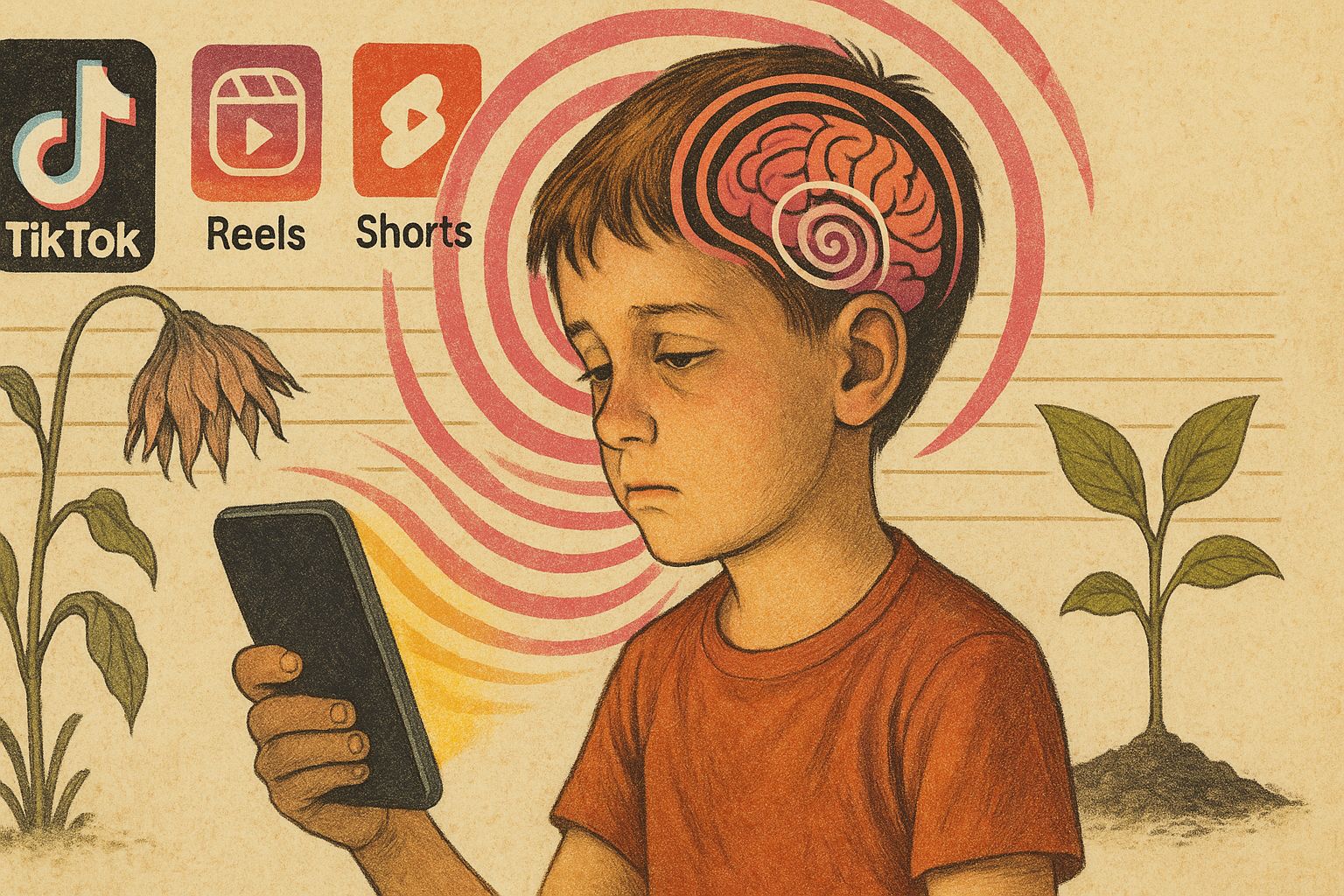
Digital Heroin: How Smartphones Are Hijacking Our Children's Minds
The Anatomy of a Mind-Control Machine
Think back to a moment when your child's eyes lit up with genuine wonder. Perhaps they discovered a ladybird on a leaf, or a butterfly resting on its surface, saw the biggest ice cream of their life, or consciously heard birdsong for the very first time. These moments are becoming ever rarer. A smartphone is not merely a communication device or an information tool. It is a carefully engineered neurobiological system that targets developing brains specifically — like an invisible hand that gently but inexorably steers a child's attention away from the living world.
Algorithms are built to create dopamine hooks that override the brain's natural reward system. Science tells us that normal activity produces 50–100 units of dopamine. A smartphone session drives that level to 200–400 units — like an artificial sunrise in the middle of the night. The brain adapts to this overstimulation by downregulating its receptors. The result: ordinary life turns grey, anhedonic, stripped of the capacity to feel joy from natural things. The child needs ever-stronger stimulation just to feel alive — like someone so starved that ordinary food has lost all taste.
As dopamine levels spike, attention spans shrink to seconds. The hypnotic, endless stream of TikTok, Reels and Shorts trains the brain into eight-second cycles — like fragmented sleep from which you never wake refreshed. True learning, that slow maturing which demands sustained focus and deep thought, becomes impossible. Impulse control is destroyed, replaced by a neurochemistry wired for instant gratification. The child's mind becomes a garden where nothing ever ripens.
The Four Stages of Capture
The Theft of Innocence
First contact often happens between the ages of two and five — when a child's eyes still search for a parent's gaze, seeking safety. "Innocent" YouTube Kids videos and "educational" games step in like a bright light in a dark room. Colour-saturated hyperstimulation overwhelms the developing brain's processing capacity. The Cocomelon phenomenon — stroboscopic editing that cuts every one to two seconds — teaches the brain that the normal world, a parent's voice, sitting in someone's lap, is boring. The child learns that silence holds nothing.
The Dopamine Cradle
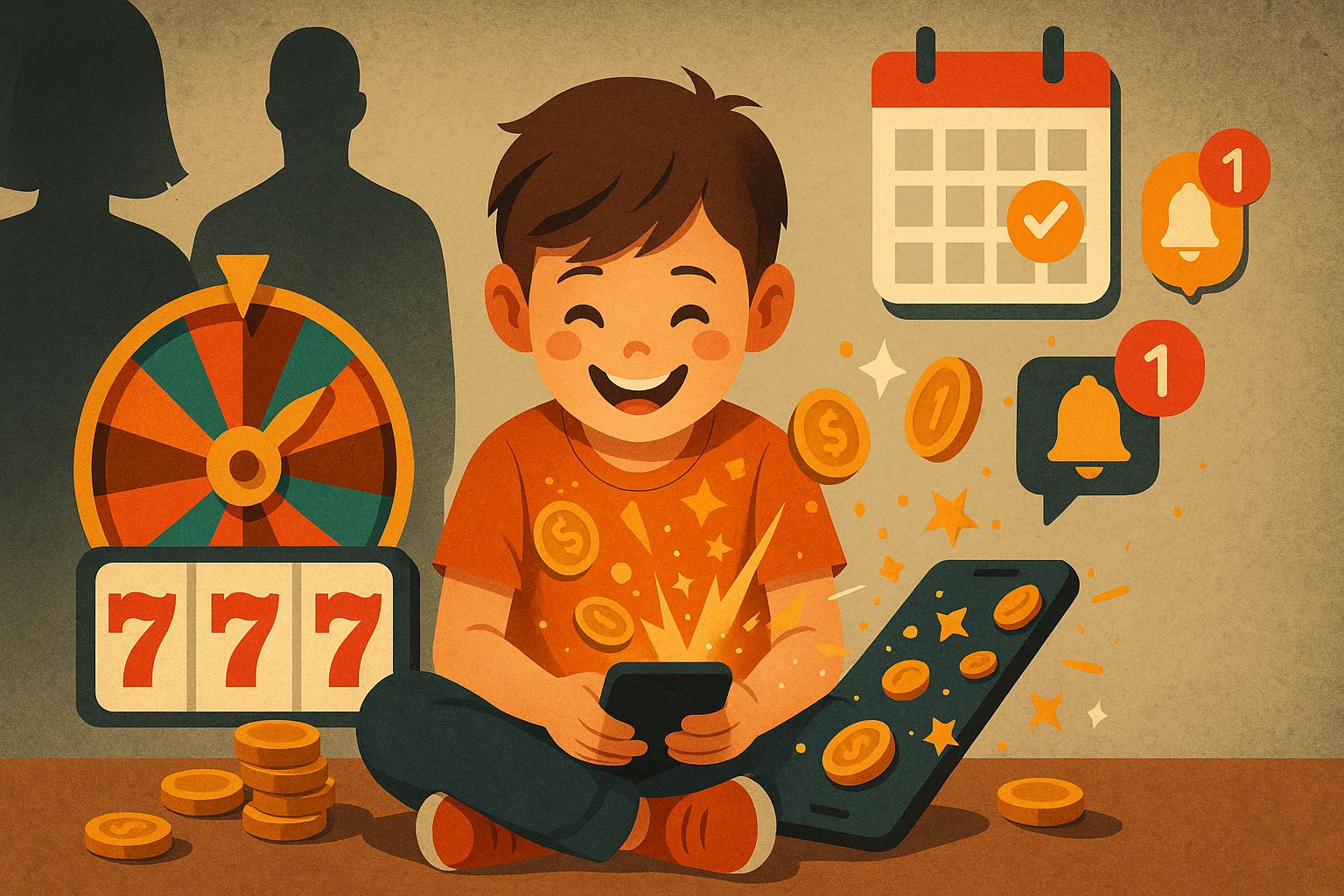
Next, a dopamine loop is constructed through game mechanics. This employs the principle of variable reinforcement — the same mechanism used in slot machines — creating an unpredictable reward pattern. It is like a fish swimming deeper into the net, mistaking every movement for freedom. Daily "streaks" build a fear of loss. That fear is a more powerful motivator than the joy of achievement — like a child who cries harder over a lost toy than they ever rejoiced over a new one. Push notifications function like Pavlov's bell, conditioning an immediate response. "Just five more minutes" turns into hours — like a dream you never want to wake from.
The Social Bond
Between the ages of seven and twelve comes social capture. "Everyone else is on there" is not just peer pressure. It is a child's deep need to belong, to be loved and accepted. FOMO (Fear Of Missing Out — the dread of being left outside something important) embeds itself in the child's psyche like an invisible tattoo. Digital status begins to equal real-world worth. Algorithms identify a child's insecurities with ruthless precision. They feed exactly the content that reinforces dependency — like a friend who always knows what you want to hear, but never what you need to hear.
The Surrender of Identity
By adolescence, the takeover is complete. The algorithm knows the child better than the parents do — better than the child knows themselves. It is a mirror that only shows the viewer what they want to see. The bubble effect feeds only reinforcing content, preventing critical thinking from ever developing. Sexual awakening is captured through pornography. Identity algorithms detect the natural confusion of puberty — that tender moment when a young person is searching for who they are — and steer it toward ever more radical directions.
The Dark Side of Design
Manipulative design techniques have been developed by elite psychologists and neuroscientists. These are not accidents. They are precise calculations. Infinite scroll removes the natural stopping point — a road that leads nowhere. Autoplay ensures the child never makes a conscious decision to continue. It is a current that carries you along without you ever choosing to swim. Haptic feedback delivers a physical "reward" for every touch — a small vibration that whispers: you are alive, you exist. Dark patterns make stopping difficult or impossible — a labyrinth where the exit is hidden.
The neurological impact runs deep. The prefrontal cortex — the region of the brain responsible for planning, decision-making and self-control — does not develop normally. It is like a tree whose branches were pruned too early. Dopamine receptors adapt to overstimulation. What emerges could be called digital autism: an inability to be truly present and to engage in genuine interaction. The child is physically there but mentally absent.
Silicon Valley's Quiet Confession
The most revealing evidence is the behaviour of tech leaders themselves. It is like a tobacco executive who does not smoke. Steve Jobs did not let his children use iPads. Silicon Valley's elite send their children to Waldorf schools where no technology is used at all. They build digital palaces for others but house their own children in analogue fortresses. They know exactly what they have built — and they shield their own children from it, like a chef who refuses to eat the food he has poisoned.
The Quiet Struggle of Parents
Parents seek medical statements about "separation anxiety" to justify a twelve-year-old's phone use at school. Separation anxiety is a normal developmental phase in small children, between eight and twenty-four months of age. It should resolve by the age of three at the latest — like losing baby teeth. A teenager's "separation anxiety" reveals something far more serious: a parent's own projected anxiety, or the child's digital withdrawal symptoms.
Bowlby's attachment theory has been misunderstood — like an old map read upside down. Secure attachment means the child dares to separate from the parent, to go out and explore the world, and to return. It does not mean a permanent digital umbilical cord. Anxious attachment, where a parent cannot let go, creates a pathological symbiosis — like two trees growing into each other, suffocating both.
A child's "anxiety" without a phone is the body's honest message. Cortisol levels rise, dopamine levels crash, and the brain is literally screaming for the substance it has been taught to need. The child has never learned to be alone with their own thoughts. Internal dialogue has been replaced by external stimulation. Silence feels like death — like breathing underwater.
The real motives behind giving a child a phone are understandable. A digital babysitter, however, does not ease guilt, and the illusion of control through GPS tracking is not genuine safety — it reveals nothing about what is actually happening to the child. Social pressure and the fear of a child being left out are real, but the paradox is this: the child becomes estranged from themselves, from reality, and from their parents — and that should matter more than a place in the crowd.
The Spiritual Dimension
This is not merely a technological or psychological question. It touches the deepest part of who we are. A void is created that only technology can fill — a thirst no water can quench. The voice of God, the quiet whisper of our Creator that speaks in silence, is replaced by the voice of the algorithm.
"But whoso shall offend one of these little ones which believe in me, it were better for him that a millstone were hanged about his neck" (Matt. 18:6, KJV).
This is what has now been done. The words of Jesus are a warning — and every parent still has time to answer it.
Parents give their child digital "peace" and wonder why the child is anxious without it.
It is like feeding a hungry child nothing but sugar and wondering why they are unwell.
The real question is this: do we love our children enough to endure their momentary anger as we rescue them from far greater suffering? Do you believe, mother or father, that real connection is worth more than "digital independence"? Are you willing to walk with your child on the hard road back to the living world — where ladybirds and butterflies still fly? Where silence holds much that is beautiful and healing, as we walk together through the anxiety and the fears.