SUPO Claims, Research Refutes: The Reality of Homeschooling by the Numbers
When narrative and facts don't align: An analysis of SUPO's claims in light of the research evidence
A Serious Claim on Questionable Grounds
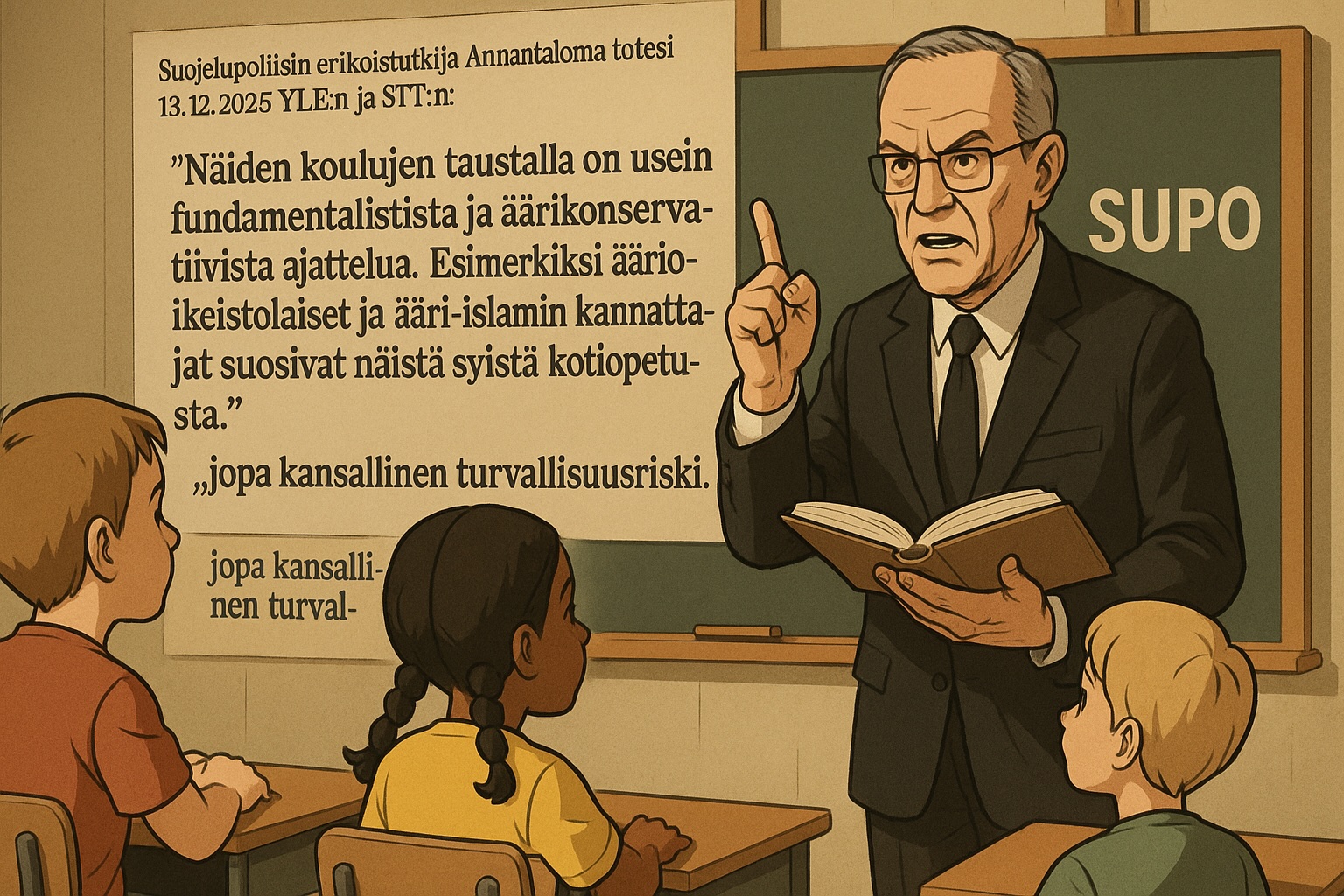
SUPO's senior specialist Anna Santaholma stated on 13 December 2025 in an article published by YLE and STT:
"Behind these schools there is often fundamentalist and ultra-conservative thinking. For example, far-right groups and supporters of radical Islam favour homeschooling for these reasons."
According to SUPO, private schools operating without a basic education licence could, in the long term, be "even a national security risk."
These are serious claims. They link homeschooling — a lawful form of education protected as a fundamental right in many countries — to extremist movements and national security threats. The claims were published in Finland's largest media outlet without critical scrutiny.
Around the same time, the Ministry of the Interior announced that it would transfer SUPO directly under the Permanent Secretary's authority from the beginning of 2026. The justification was "Finland's deteriorating security environment" and the need to ensure that "the governance of the security police continues to be carried out with high quality."
A question arises: could one reason for the deteriorating security environment lie within SUPO itself? At the very least, the article demonising home schools offers a telling indication.
When a security authority publishes claims in mainstream media for which no concrete research evidence exists — and which international research flatly refutes — it is worth asking: is this intelligence analysis or an opinion piece in the style of Pravda?
The difference between a propaganda bureau and a security police service is that the latter bases its public statements on facts. If SUPO wishes to preserve what remains of its credibility, it would do well to consult the research evidence before branding a marginal, demonstrably high-performing form of education a "national security risk."
The people of Finland — and children in particular — deserve a security authority that protects them from real threats, not one that manufactures threat narratives for political reasons.
This analysis examines SUPO's claims in light of peer-reviewed international research. We ask:
- What does the research say about homeschooling outcomes?
- Is there evidence linking homeschooling to radicalisation?
- Where does child maltreatment actually occur?
- Does stricter regulation improve child safety?
- Why do SUPO's claims and the research evidence not align?
Part I: What Does the Research Actually Say About Homeschooling?
1. Academic Outcomes
Let us start with the facts. The international peer-reviewed evidence on homeschooling academic outcomes is consistent:
| Metric | Homeschooling Result |
|---|---|
| Standardised tests | 65th–80th percentile (average is 50th) |
| SAT scores (USA) | 1190 (national average 1060) |
| University graduation | 67% |
A systematic review by the National Home Education Research Institute (NHERI) shows that 78 per cent of peer-reviewed studies report that homeschooled children perform statistically significantly better academically than their peers in institutional schools (Ray, 2017).
2. Social and Psychological Outcomes
The socialisation concern is the most common justification for regulating homeschooling. It is argued that children need the peer group that school provides in order to develop socially.
What does the research say?
NHERI's analysis of 45 peer-reviewed studies on social, emotional, and psychological development:
| Share of Studies | Result |
|---|---|
| 87% | Homeschooled children perform better or equally well |
| 13% | Mixed or negative results |
Professor Richard Medlin (Stetson University) concluded in his comprehensive review:
"The alarmist view of homeschooling receives no support from empirical research."
3. The Harvard Longitudinal Study (2021)
Harvard T.H. Chan School of Public Health published an extensive study in 2021 that followed the development of over 12,000 young people from 1999 to 2010. The study was published in the peer-reviewed journal PLOS ONE.
Key findings for homeschooled individuals compared to public school students:
| Metric | Difference |
|---|---|
| Volunteering as adults | 33% more likely to be active |
| Forgiveness | 31% higher levels |
| Sense of purpose | Significantly higher |
| Marijuana use | Lower risk |
| Risk behaviour | Less |
The researchers concluded: "Homeschooled children generally develop into well-adjusted, responsible, and socially engaged young adults."
4. More Diverse Social Networks
One of the most critical findings, routinely overlooked in public debate:
Homeschooled children typically interact with a broader and more diverse social network than public school students.
Public school students spend the majority of their time with children born within 12 months of them. Homeschooled children, by contrast, regularly interact with people of different ages: siblings, parents, adult acquaintances, and both younger and older children through activities and community involvement.
According to NHERI's research, homeschooled children participate in an average of 15.5 activities per month that are unrelated to church. These include scouts, sports clubs, volunteer work, and community events.
The social model of public schooling — where children spend 6–8 hours a day almost exclusively in the company of same-age peers — is historically anomalous. It does not reflect the real-world social structures of workplaces, families, or communities.
Part II: Radicalisation and Homeschooling — Is There Evidence?
SUPO's Claim
SUPO's senior specialist claims that homeschooling schools are "often" backed by "fundamentalist and ultra-conservative thinking" and that "far-right groups and supporters of radical Islam favour homeschooling."
The Scientific Reality
A critical observation: No peer-reviewed research exists demonstrating a statistical link between homeschooling and radicalisation.
An extensive literature search of radicalisation research — including the databases of the NIJ (National Institute of Justice), NATO's VERE database, and European research institutions — yields no results linking homeschooling to radicalisation.
Radicalisation research focuses on:
- Experiences of marginalisation and social exclusion
- Trauma backgrounds and maltreatment
- Online radicalisation through social media and closed forums
- Authoritarian parenting styles, which are not tied to any particular schooling model
- Prison radicalisation
A study published in Frontiers in Psychology (2022) notes that the school environment can be both a risk factor and a protective factor against radicalisation. No study identifies homeschooling as a specific risk factor.
Critical Questions for SUPO
- What statistical data or research are these claims based on?
- How many documented cases exist in Finland?
- What is the proportion of radicalised individuals among homeschooling families?
- Is this about homeschooling or unlicensed private schools?
The YLE article provides none of these answers. Neither does SUPO.
Part III: Child Safety — Where Does Maltreatment Actually Occur?
The safety argument is the most serious justification for regulating homeschooling. It is argued that homeschooling enables the concealment of abuse because children are not in daily contact with adults who are mandated reporters.
A Nationally Representative Study (Ray & Shakeel, 2022)
A study published in Journal of School Choice surveying 1,253 adults who had been either homeschooled or conventionally schooled:
"Cross-tabular findings indicate that the school sector is not a significant factor, after demographic factors are accounted for, in child maltreatment."
A critical finding: Cases of maltreatment and neglect among homeschooled children are statistically significant only in community or school settings, not at home within the family.
Fatality Study (Williams, 2017)
A study based on ten years of data:
"Legally homeschooled students are 40 per cent less likely to die from child maltreatment or neglect than the average student nationally."
Safety in Public Schools: The Unspoken Reality
This is research evidence that is seldom raised in public debate.
Professor Charol Shakeshaft (Virginia Commonwealth University) studied sexual misconduct perpetrated by school staff:
| Statistic | Source |
|---|---|
| 9.6 per cent of students (grades 8–11) report sexual misconduct by staff | Shakeshaft, 2021 |
| An estimated 5.6 million students experience sexual misconduct by staff during K-12 | Shakeshaft, 2021 |
| 19 per cent of middle and high school students report bullying | CDC |
A U.S. Department of Education report (2004) found:
"More than 4.5 million students (10 per cent) experience sexual misconduct by a school employee at some point from kindergarten through 12th grade."
Shakeshaft also stated:
"Sexual abuse in the public schools is likely more than 100 times the rate of abuse by priests."
More recent studies confirm the situation:
| Year | Study | Finding |
|---|---|---|
| 2022 | Jeglic et al. | 11.7 per cent of students report |
| 2023 | Grant et al. | 17.4 per cent of students affected |
| 2010 | GAO | A single offending teacher averages 73 victims |
The Government Accountability Office (2010) documented the so-called "pass the trash" phenomenon: schools permit or even encourage employees who have committed sexual misconduct to resign — often providing them with positive references and non-disclosure agreements.
Part IV: The Impact of Regulation — Does Oversight Improve Outcomes?
Across Europe, homeschooling regulation varies significantly:
| Level of Regulation | Example Countries |
|---|---|
| Permitted, minimal regulation | United Kingdom, Ireland |
| Permitted, moderate regulation | France, Austria, Denmark, Finland |
| Permitted, strict regulation | Belgium, Italy |
| Effectively banned | Germany, Sweden, Netherlands |
The Relationship Between Regulation and Outcomes
NHERI has studied the correlation between the level of regulation and learning outcomes:
Finding: There is no correlation between the level of state control and regulation and the academic outcomes of homeschooled students.
Results are similar in both heavily regulated and freely operating states. Stricter regulation does not produce better learning outcomes.
The Relationship Between Regulation and Safety
Professor Angela Dills (Western Carolina University) studied regulation and child safety:
"The overall picture is that homeschool-related rights have little or no impact on child safety."
There is no clear evidence that reported maltreatment cases increase in states that move toward laws recognising and permitting broader homeschooling freedom.
The Reality of European Oversight
A European comparative study of 14 countries (Blok & Karsten, 2011) identified a significant gap:
"Most countries do not have data on the effectiveness of homeschool supervision."
European countries regulate homeschooling without empirical evidence of the benefits of regulation.
Part V: ADHD and Medication — The System's Blind Spot
This is the most alarming area of research. The evidence suggests that the school environment itself is a significant factor in ADHD diagnoses and the need for medication.
The Age Effect in Diagnoses
Harvard researchers discovered a striking correlation:
In states where the school enrolment cut-off date is 1 September:
- Children born in August, who have just turned 5: 30 per cent more likely to receive an ADHD diagnosis
- Children born in September, who are nearly 6: comparison group
The youngest children in a class are nearly twice as likely to be regular users of ADHD medication as their older classmates.
Conclusion: Immaturity, not pathology, is the real factor.
A Norwegian Population Study (N = 698,364)
A large-scale Norwegian register study (birth cohorts 1990–2002) examined the impact of the school environment on ADHD medication:
Finding: A positive and organised school environment reduced the likelihood of ADHD medication use by 12 per cent among 14–16-year-olds.
Homeschooling and Children with ADHD
A Walden University study of homeschooled students with ADHD symptoms found:
- Most students thrive in a structured but flexible environment
- Individualised learning practices that would not be possible in a traditional school
- The need for medication decreases when the environment adapts to the child rather than the other way around
One ADHD researcher stated in Scientific American:
"I have a big problem with the word 'disorder.' The school system is disordered. Not the children."
Part VI: Why Do Finnish Families Choose Homeschooling?
Finnish Research
Outi Myllymäki's (2017) Master's thesis at the University of Tampere and Joanna Hartman's (2019, 2021) research at the University of Helsinki provide a picture of the Finnish reality.
The most common reasons for transitioning to homeschooling in Finland:
| Reason | Description |
|---|---|
| The child's own wish | The child wants to study at home |
| Individual progression | The opportunity to progress at one's own pace |
| School bullying | Bullying that the school has failed to resolve |
| Indoor air quality problems | Mould or indoor air issues in the school building |
| The child's special needs | The child's needs are better met at home |
| Family circumstances | Travelling family, living abroad |
International studies support these findings. The single greatest reason for homeschooling globally is concern over school safety: violence, drugs, and an unsafe environment.
The Finnish Home School Association (Suomen Kotikouluyhdistys ry) emphasises: "Homeschoolers do not represent any uniform group. Homeschooling does not in itself expose a child to neglect or increase a child's risk of social exclusion."
Part VII: A Terminological Fallacy — Homeschooling vs. Unlicensed Private Schools
SUPO's concern targets "homeschooling schools operating without a licence," which are not homeschooling but unlicensed private schools. These two phenomena are conflated in public debate.
| Homeschooling | Unlicensed "Homeschool" |
|---|---|
| Parents teach their own child | An external party teaches a group |
| Typically 1–3 children | Dozens of students |
| Individualised instruction | Group instruction |
| Under parental supervision | Under the control of an external party |
The Finnish National Agency for Education (2024) defines: "Group-based study in which the party responsible for delivering the instruction does not hold a government-granted licence to provide instruction under the Basic Education Act is also classified as homeschooling."
This legal definition merges two entirely distinct phenomena and enables their conflation in public debate.
Finland's Proportions
- Approximately 950 children in homeschooling (September 2024)
- Total students in basic education: 561,000
- Homeschooling's share: approximately 0.17 per cent
SUPO's concern thus targets a fraction of an already tiny group.
Part VIII: Political Analysis — Why Is Homeschooling Being Demonised?
A Question of Power and Control
Homeschooling challenges the state's monopoly on upbringing.
Public school is not merely a place of learning. It is a tool of socialisation through which the state determines:
- What children learn (curriculum)
- How children think (values, worldview)
- With whom children spend their time (peer group)
- Around what schedule a family organises its life (timetables)
When a family chooses homeschooling, it reclaims these decisions for itself. This is a transfer of power from the state to the family.
The Ideological Background
In Europe — particularly in the Nordic countries and Germany — there prevails an ideology according to which children belong primarily to society, and parents are "educational partners" alongside the state.
Germany's justification for banning homeschooling: the school's role is to "integrate children into society" and "expose them to diverse viewpoints."
But who decides which viewpoints are the "right" ones?
Diverting Attention from the Real Problems
When SUPO links homeschooling to radicalisation, it shifts attention away from:
- Failures of immigration policy — such as who enters the country and how integration functions
- Problems within public schools — such as bullying, violence, indoor air quality issues, and staff misconduct
- Online radicalisation — which occurs regardless of schooling model
- Prison radicalisation — a documented and significant problem
It is politically easier to point the finger at a marginal group than to address systemic failures in immigration or education policy.
The Double Standard
If Islamist radicalisation is a security problem in Finland, its root causes lie in immigration and integration policy — not in homeschooling.
If Christian families choose homeschooling, it is "fundamentalism."
If Muslim families choose homeschooling, it is a "security risk."
If the state cannot integrate immigrants, the fault lies with... home schools?
This is not logical. This is political.
Part IX: Proportionality — Does the Narrative Serve the Protection of Children?
A Comparison
| Phenomenon | Scale | Attention from Media and Authorities |
|---|---|---|
| Homeschooling "radicalisation risk" | No documented evidence | High (YLE, SUPO) |
| Sexual misconduct within schools | 10–17 per cent of students | Low |
| School bullying | 19 per cent of students | Moderate |
| Maltreatment in foster care | approx. 33 per cent of children | Low |
| Online radicalisation | Significant, growing | Moderate |
SUPO's and the media's focus on a few dozen "homeschool schools" — while sexual misconduct within schools affects, according to research, 10–17 per cent of students — raises a question:
Does this narrative serve the protection of children, or political objectives?
Conclusions: When Claims Are Held Up to the Light of Research
SUPO's Claims vs. Research Evidence
| SUPO's Claim or Implication | Research Evidence |
|---|---|
| Homeschooling exposes children to radicalisation | No peer-reviewed evidence of a link |
| Homeschooling is a security risk | School sector is not a significant factor in maltreatment |
| Homeschooled children become socially isolated | 87 per cent of studies show the opposite |
| Stricter regulation would improve the situation | No evidence of a link between regulation and outcomes or safety |
| Public school is safer | 10–17 per cent of students experience sexual misconduct by staff |
What the Research Shows
-
Academic outcomes: Homeschooled children typically perform better than or at least as well as their peers in institutional schools.
-
Social skills: 87 per cent of studies show positive or neutral outcomes. Homeschooled children typically interact with a broader and more diverse social network.
-
Child safety: School sector is not a statistically significant factor in maltreatment after demographic factors are accounted for.
-
Regulation: No evidence that stricter regulation improves outcomes or safety.
-
Radicalisation: No scientific evidence of a link between homeschooling and radicalisation.
-
Misconduct within schools: Affects, according to research, 10–17 per cent of students. A problem impacting millions of children, yet sidelined in the debate.
A Journalistic Assessment of the YLE Article
The YLE and STT article published SUPO's claims without critical scrutiny:
- No research evidence was requested to support the claims
- No opposing perspectives from experts were presented
- No international research evidence was cited
- The claims were not placed in proportion
- The terminological confusion between homeschooling and unlicensed private schools was left unaddressed
The comment from the Vice Chair of the Finnish Home School Association was added to the article only two days after publication (edited 15 December 2025).
Final Word
This analysis does not claim that every homeschooling family is perfect or that unlicensed private schools should not be addressed. It does claim that:
- SUPO's claims are not based on peer-reviewed research
- Public schools are not free from the very risks attributed to homeschooling
- The demonisation of homeschooling is a political choice, not a scientific conclusion
- Parents have the right to know what the research actually says
When a security authority makes serious claims about a marginal group without research evidence, and mainstream media publishes them uncritically, what we are witnessing is an exercise of power — not the protection of children.
We expect better from the Permanent Secretary's governance.
"And ye shall know the truth, and the truth shall make you free." (John 8:32, KJV)
Sources
Homeschooling Outcomes
- Ray, B.D. (2017). A systematic review of the empirical research on selected aspects of homeschooling as a school choice. Journal of School Choice, 11(4), 604-621.
- Chen, Y., Hinton, C. & VanderWeele, T.J. (2021). School types in adolescence and subsequent health and well-being in young adulthood. PLOS ONE, 16(11).
- Medlin, R.G. (2013). Homeschooling and the question of socialization revisited. Peabody Journal of Education, 88(3).
European Regulation
- Blok, H. & Karsten, S. (2011). Inspection of Home Education in European Countries. European Journal of Education, 46(1).
- European Commission/EACEA/Eurydice (2018). Home Education Policies in Europe.
Child Safety and Maltreatment
- Ray, B.D. & Shakeel, M.D. (2022). Demographics are predictive of child abuse and neglect but homeschool versus conventional school is a nonissue. Journal of School Choice, 17(2).
- Williams (2017). Child fatality study. Homeschooling Backgrounder.
- Dills, A. (2022). Homeschooling and child safety: Are kids safer at home? Journal of School Choice.
Misconduct Within Schools
- Shakeshaft, C. (2004). Educator sexual misconduct: A synthesis of existing literature. U.S. Department of Education.
- Shakeshaft, C. (2021/2025). Educator Sexual Misconduct. Virginia Commonwealth University / Harvard Education Press.
- Jeglic, E.L. et al. (2022). The Nature and Scope of Educator Misconduct in K-12. Sexual Abuse, 35(2).
- Government Accountability Office (2010). K-12 Education: Selected Cases of Public and Private Schools That Hired or Retained Individuals with Histories of Sexual Misconduct.
ADHD and the School Environment
- Borgen, N.T. et al. (2021). Impact of the School Environment on Medical Treatment of ADHD. Child Development, 92(5).
- Morgan, P.L., Woods, A.D., & Wang, Y. (2022). Sociodemographic Disparities in ADHD Overdiagnosis and Overtreatment. Journal of Learning Disabilities.
Finnish Research
- Myllymäki, O. (2017). Kyselytutkimus vanhempien perusteluista valita lapselleen kotikoulu. Pro gradu -tutkielma, Tampereen yliopisto.
- Hartman, J. & Huttunen, R. (2021). The legality and justifiability of the methods used for monitoring the progress of home-educated children in Finland. Policy Futures in Education.
Radicalisation Research
- Fjelldal et al. (2022). Resilience against radicalization and extremism in schools: Development of a psychometric scale. Frontiers in Psychology.
- National Institute of Justice (2023). Domestic Radicalization and Violent Extremism.
Institutional Sources
- National Home Education Research Institute (NHERI)
- Coalition for Responsible Home Education (CRHE)
- Centers for Disease Control and Prevention (CDC)
- Opetushallitus (2024)
- Suomen Kotikouluyhdistys ry
This article is part of a series examining homeschooling in light of the research evidence.