Self-Denial — The Order Established by God
Every morning is a new opportunity
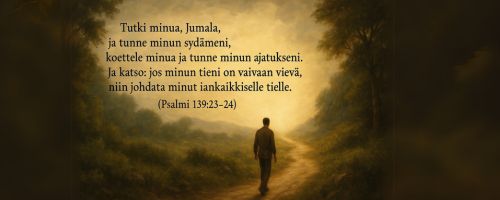
When each morning begins with prayer, the first step opens toward hearing God's will and seeing it fulfilled in our lives. God speaks to everyone who desires to listen to Him. This speech of God is rightly called guidance.
"Search me, O God, and know my heart: try me, and know my thoughts: And see if there be any wicked way in me, and lead me in the way everlasting." (Psalm 139:23-24)
How beautiful is this prayer, asking our God to guide us toward Him. Yet God does not guide us unless we ourselves actively seek it. We must always first seek the Kingdom of God, and only then turn our eyes to the world — once we have received guidance on the direction we are to look today.
Seeking the Kingdom of God — the beginning of a personal journey
Jesus urged us to "seek ye first the kingdom of God, and his righteousness; and all these things shall be added unto you. Take therefore no thought for the morrow: for the morrow shall take thought for the things of itself. Sufficient unto the day is the evil thereof." (Matt. 6:33-34)
There is a deep truth in these verses. To follow Jesus with all our hearts and to confess His Lordship, we must also acknowledge the truth of His teachings. His teachings are the Way we are to walk every day. As we walk the path He has laid out in Truth, we receive Life.
When we confess Jesus as Lord, we understand that merely speaking His name is only the first step of our journey into Truth and Life in Christ Jesus. The Lordship and Truth of Jesus is an active state of being in Him. Jesus did not call us to passivity, but literally to take up our cross and follow Him. This call summons every believer to deeds led by the Lord — not to withdrawal or retreat from this world.
The fear of the Lord — an encounter with God
It is also true that sufficient unto the day is the evil thereof. This is the truth of this life, and everyone who walks in faith should accept it as a sign of love. Jesus Himself said that every day carries its burden. "In sorrow shalt thou eat of it all the days of thy life." (Gen. 3:17) This is the truth Jesus referred to.
The path God offers us calls us to toil and to bear our cross. The path the enemy offers is always the opposite — promising ease, an effortless life, abundance, and happiness. Does following Jesus then mean daily hardship, struggle, pain, aching, anguish, exhaustion, and weariness?
Yes and no.
This is something that must be lived out. As we walk with God, the things that are heavy and unbearable to a person remain heavy and draining. Yet in the midst of all that strain, the Spirit of God within us gives each moment its strength, endurance, understanding, and wisdom to carry us through the hardship. This is one of Christ's gifts to us — His sending of the Advocate to stand by our side.
"The fear of the LORD is the beginning of wisdom: and the knowledge of the holy is understanding." (Prov. 9:10)
Yirah, the original Hebrew word, describes the fear of the Lord with layered meaning:
1. Reverential fear — not the fear of terror or flight, but deep respect and esteem
2. Holy reverence — an awareness of God's majesty and holiness
3. Wonder and awe — a response before the greatness of God
4. Humility — recognising one's true position in relation to God
5. Obedient reverence — a desire to follow God's will
Living in the spirit of the Fear of the Lord is not living in fear. Rather, this is what Jesus asked of us first: "Seek ye first the kingdom of God."
The order of spiritual growth established by God
Seeking the Kingdom of God is active self-denial and the asking that the Spirit of God would replace our own will. But how does this happen in practice? How can we live each day in the will of God?
For this, God has established a clear order. By following it, Christ is truly able to live in us:
1. Seeking the Kingdom of God
"But seek ye first the kingdom of God, and his righteousness." (Matt. 6:33)
This is the foundational starting point for all spiritual growth. It is the decision to turn our gaze toward God, the decision to seek His will before all else. This seeking is active, not passive waiting.
2. The fear of the Lord
"The fear of the LORD is the beginning of wisdom." (Prov. 9:10)
Our seeking leads us to encounter the holiness and majesty of God. In this encounter, the fear of the Lord is born — a deep reverence, wonder, and humility before God. This is not terror, but the right posture toward the Creator of all things.
As Isaiah experienced when he saw the Lord in the temple: "Woe is me! for I am undone; because I am a man of unclean lips, and I dwell in the midst of a people of unclean lips: for mine eyes have seen the King, the LORD of hosts." (Isa. 6:5)
3. Acknowledging our weakness
"He shall see of the travail of his soul, and shall be satisfied." (Isa. 53:11)
Encountering the holiness of God inevitably exposes our own weakness and limitations. We see ourselves as we truly are — imperfect, inclined to sin, in need of God's grace. This is not merely a theoretical thought, but a profound experience of our own inability.
This acknowledgement is not despair — it is the confrontation with truth. It is like Peter's experience: "Depart from me; for I am a sinful man, O Lord." (Luke 5:8)
4. Self-denial
"If any man will come after me, let him deny himself, and take up his cross, and follow me." (Matt. 16:24)
Recognising our weakness leads naturally to self-denial. This is not self-torture, but the wise relinquishing of our own will, which has proven itself limited and imperfect. It is a conscious decision: "No longer I, but Christ in me."
This is wisdom made practical — not forced submission. It is the natural response when we have seen the greatness of God and the smallness of ourselves. As Paul testified: "I am crucified with Christ: nevertheless I live; yet not I, but Christ liveth in me: and the life which I now live in the flesh I live by the faith of the Son of God, who loved me, and gave himself for me." (Gal. 2:20)
5. Guidance
"I will instruct thee and teach thee in the way which thou shalt go: I will guide thee with mine eye." (Psalm 32:8)
Only after denying ourselves can we truly receive God's guidance. When we have emptied ourselves of our own plans, desires, and ambitions, God's will is free to flow within us. God's voice becomes clear when our own voice has fallen silent.
This guidance is concrete and practical. It touches everyday choices, relationships, work, service — everything we do. It is God's wisdom for every situation.
6. Serving
"Whosoever will be great among you, let him be your minister; and whosoever will be chief among you, let him be your servant." (Matt. 20:26-27)
Receiving guidance leads to service. We no longer live for ourselves, but for God and for others. This service, however, does not arise from our own strength or desires — it is God's work through us.
This is the heart of the apostolic life. It is not self-exaltation or the demanding of privileges, but humble and selfless service to others in the power of God.
7. The power of Christ
"My strength is made perfect in weakness." (2 Cor. 12:9)
As we serve under God's guidance, the power of Christ is manifested through our deeds. Our actions and our words bear witness to who our Lord is and what kind of fruit we bring into the world.
This power, made manifest through fruit, is not ours but God's, working through us. It is a supernatural ability to endure, to love, to serve, and to proclaim the Gospel in a way that surpasses our human limits.
This power is not a theoretical concept, but the practical presence of God that transforms us and works through us to affect others. It is power made visible in weakness, not in human wisdom or displays of force. It is power that belongs to God alone and is never at the disposal of human will — never to be transferred or bestowed by one person upon another.
The apostolic example
This order of spiritual growth is not merely a theoretical model — it is seen concretely in the lives of the apostles, particularly in the example of Paul. His way of living and serving perfectly embodies this order established by God.
The Apostle Paul writes in his letter to the Thessalonians about his work, reflecting this very order:
"For yourselves know how ye ought to follow us: for we behaved not ourselves disorderly among you; Neither did we eat any man's bread for nought; but wrought with labour and travail night and day, that we might not be chargeable to any of you: Not because we have not power, but to make ourselves an ensample unto you to follow us." (2 Thess. 3:7-9)
"For even when we were with you, this we commanded you, that if any would not work, neither should he eat. For we hear that there are some which walk among you disorderly, working not at all, but are busybodies. Now them that are such we command and exhort by our Lord Jesus Christ, that with quietness they work, and eat their own bread." (2 Thess. 3:10-12)
How is it possible that Paul, who had every right to earn his living from the Gospel, chose to work "night and day"? This is a direct result of the order of spiritual growth he had walked through.
Paul first sought the Kingdom of God, encountered the fear of the Lord on the road to Damascus, acknowledged his weakness and inability, denied himself completely, received God's guidance, began to serve others, and ultimately the power of Christ was made manifest in his life.
As a result of this process, Paul could not have acted otherwise. He had to be an example, not a burden. He could not demand his rights, because he had denied himself. He could not live at others' expense, because he had received God's guidance — and that guidance led to selfless service.
The misuse of the apostolic calling
Scripture acknowledges the right of those who speak the Word to earn their living from it:
"Do ye not know that they which minister about holy things live of the things of the temple? and they which wait at the altar are partakers with the altar? Even so hath the Lord ordained that they which preach the gospel should live of the gospel." (1 Cor. 9:13-14)
But Paul did not exercise this right, because he had walked through the order of spiritual growth. He understood that the true apostolic calling is always about serving, never about taking.
Likewise, Jesus rebuked the Pharisees who used their religious position for personal gain:
"Woe unto you, scribes and Pharisees, hypocrites! for ye devour widows' houses, and for a pretence make long prayer: therefore ye shall receive the greater damnation." (Matt. 23:14)
"No servant can serve two masters: for either he will hate the one, and love the other; or else he will hold to the one, and despise the other. Ye cannot serve God and mammon. And the Pharisees also, who were covetous, heard all these things: and they derided him." (Luke 16:13-14)
These examples reveal what happens when the spiritual order is broken — when one attempts to serve without self-denial and God's guidance. Religious position then becomes a tool for personal gain, not for the advancement of the Kingdom of God.
The responsibility of the leader of the congregation
Jesus Christ has established the order of creation and the order for the entire congregation. The head of the household church is the husband, as Jesus has ordained. The wife is the weaker vessel, just as children are given to us to care for and nurture.
The head of the congregation must serve and lead his congregation in the same way that Christ served His congregation, in the same way that Paul served his congregation. Because God does not contradict Himself, if a man is married, has a family, and feels called to serve God by spreading the Gospel, he must first take care of his family:
"A bishop then must be blameless, the husband of one wife, vigilant, sober, of good behaviour, given to hospitality, apt to teach; Not given to wine, no striker, not greedy of filthy lucre; but patient, not a brawler, not covetous; One that ruleth well his own house, having his children in subjection with all gravity; (For if a man know not how to rule his own house, how shall he take care of the church of God?)" (1 Tim. 3:2-5)
The work of the Gospel, serving as a shepherd, an apostolic or prophetic calling — none of these can ever lead to a situation where one's own household suffers. The same rule applies to those who serve the congregation, in modern terms, deacons:
"Let the deacons be the husbands of one wife, ruling their children and their own houses well." (1 Tim. 3:12)
These instructions are not isolated rules — they are a direct consequence of the order of spiritual growth. When a person has genuinely walked through this order, they cannot behave otherwise. They cannot neglect their family in the name of "God's work," because they have received God's guidance, which encompasses family life as well.
From weakness to strength — the apostolic model of service
Understanding the fear of the Lord is a call to weakness before God, so that Christ in us may act — and we no longer through our own flesh. When we are weak in the flesh, we are strong in Christ. When we are weak in our own will, we are strong in the will of God.
"And he said unto me, My grace is sufficient for thee: for my strength is made perfect in weakness. Most gladly therefore will I rather glory in my infirmities, that the power of Christ may rest upon me. Therefore I take pleasure in infirmities, in reproaches, in necessities, in persecutions, in distresses for Christ's sake: for when I am weak, then am I strong." (2 Cor. 12:9-10)
This is the heart of the apostolic model of service: weakness that makes room for the power of God. This model stands in complete opposition to the model of the world, which pursues power, authority, status, and privilege.
The true apostolic calling always follows the order of spiritual growth, where self-denial leads to guidance, service, and the power of Christ. This is seen concretely in the life of Paul, who worked "night and day" to be an example, not a burden.
True service of Christ
These principles are not given to us as a burden or a hardship, but so that when we finally speak of Jesus, our lives — after repentance — would be a living example of the transforming and healing power of Christ Jesus.
When we have first sought the Kingdom of God, walked in the fear of the Lord, acknowledged our weakness, denied ourselves, received guidance, and begun to serve in the power of Christ, the inevitable result is this: everything we need to speak of Jesus Christ has already been given to us. Christ in us is free to speak the mystery of the Gospel in its purity.
It is only human that in the burning fire of our first love, we may in our zeal forget all the responsibility that speaking the Word of God carries with it. When we say that Jesus is Lord, when we become servants of the Lord, we also accept everything the Lord has given in His Word.
The path is narrow, difficult, rocky, and utterly impossible without the grace Jesus has given us. As God's servants, we exist first and foremost for our congregation — not the congregation for us.
And so the words of Jesus ring true here as well:
"Father, forgive them; for they know not what they do." (Luke 23:34)
A call to true apostolic service
The order of spiritual growth established by God calls each of us back to the original, genuine apostolic service. It is not only for pastors or leaders, but for every believer.
This order challenges us to ask:
- Have I truly sought the Kingdom of God first, or my own interests?
- Have I encountered the fear of the Lord, the presence of God's holiness?
- Have I acknowledged my own weakness and inability?
- Have I denied myself so that Christ might live in me?
- Have I grown still to receive God's guidance?
- Am I serving others in accordance with God's guidance?
- Is the power of Christ visible in my life, especially in my weakness?
If the answer to these questions is yes, we cannot act in any other way than according to the apostolic example — serving, not taking; giving, not demanding; being an example, not a burden.
Are you willing to pay the price that truly walking with Jesus brings? The price is your entire life. But the reward is Christ in us, the hope of glory — surpassing every advantage the world has to offer.
"I am crucified with Christ: nevertheless I live; yet not I, but Christ liveth in me: and the life which I now live in the flesh I live by the faith of the Son of God, who loved me, and gave himself for me." (Gal. 2:20)