
The Peace Deal Agreed for Ukraine and Why the EU Does Not Oppose It, but Accepts Everything (While Lamenting)
(This article was originally written on 17 February 2025 for x.com and has been transferred to yirah.fi as-is.)
On 17 February 2025, the media in Finland and the EU woke up to a reality in which peace is coming to Ukraine — a peace where the USA and Russia define the terms between themselves, and Ukraine has no choice but to accept, as do the EU member states. Finnish TV broadcasts seem mostly preoccupied with explaining why the EU was not included in the negotiations and how Ukraine must be supported to ensure its future.
This is unfortunately nothing but rhetoric and propaganda, through which the EU is trying to maintain its last shreds of credibility as somehow believable — and failing.
Likewise, President Zelenskyy acts as though he has some say in the outcome of the negotiations, but in reality he has been invited merely to hear the final terms of the settlement, which Ukraine will accept, while EU member states pressure Ukraine behind the scenes to do just that.
In this article, we lay out concisely what the war in Ukraine and the peace now being brokered are really about, why the EU was thrown out, which single individual stands to benefit most from the coming peace, and what this means for the future of the EU.
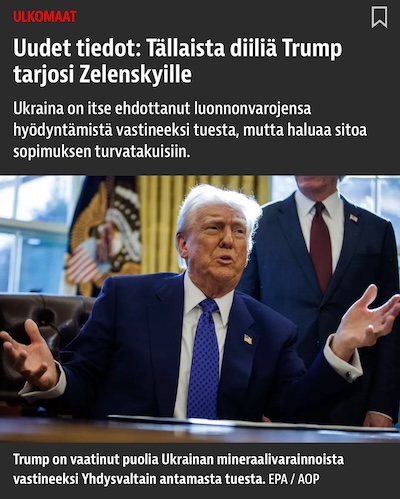
To the horror of every EU member state, Trump immediately put the truth behind the entire war on the table and, as the most powerful party at the table, began quite literally calling in Ukraine's debts.
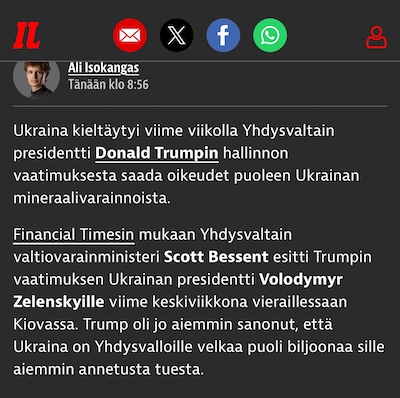
For many, it is still surprising that "support" for Ukraine is not free — it is a loan that must be repaid. Loans come with collateral and repayment terms.
Since the start of the war, Ukraine has received approximately 66 billion dollars in military aid and 50 billion in economic support from the United States. Status as of 02/2025 (source: Iltalehti).
EU Support
The EU and EU member states' "support" for Ukraine is likewise not free — it too must be repaid.
The "emergency meeting" convened by a handful of EU member states stems from the fact that the United States put its own debts into collection ahead of the EU states, which deservedly raised alarm. EU member states have supported Ukraine with roughly the same total sum as the USA, approximately 120–130 billion euros.
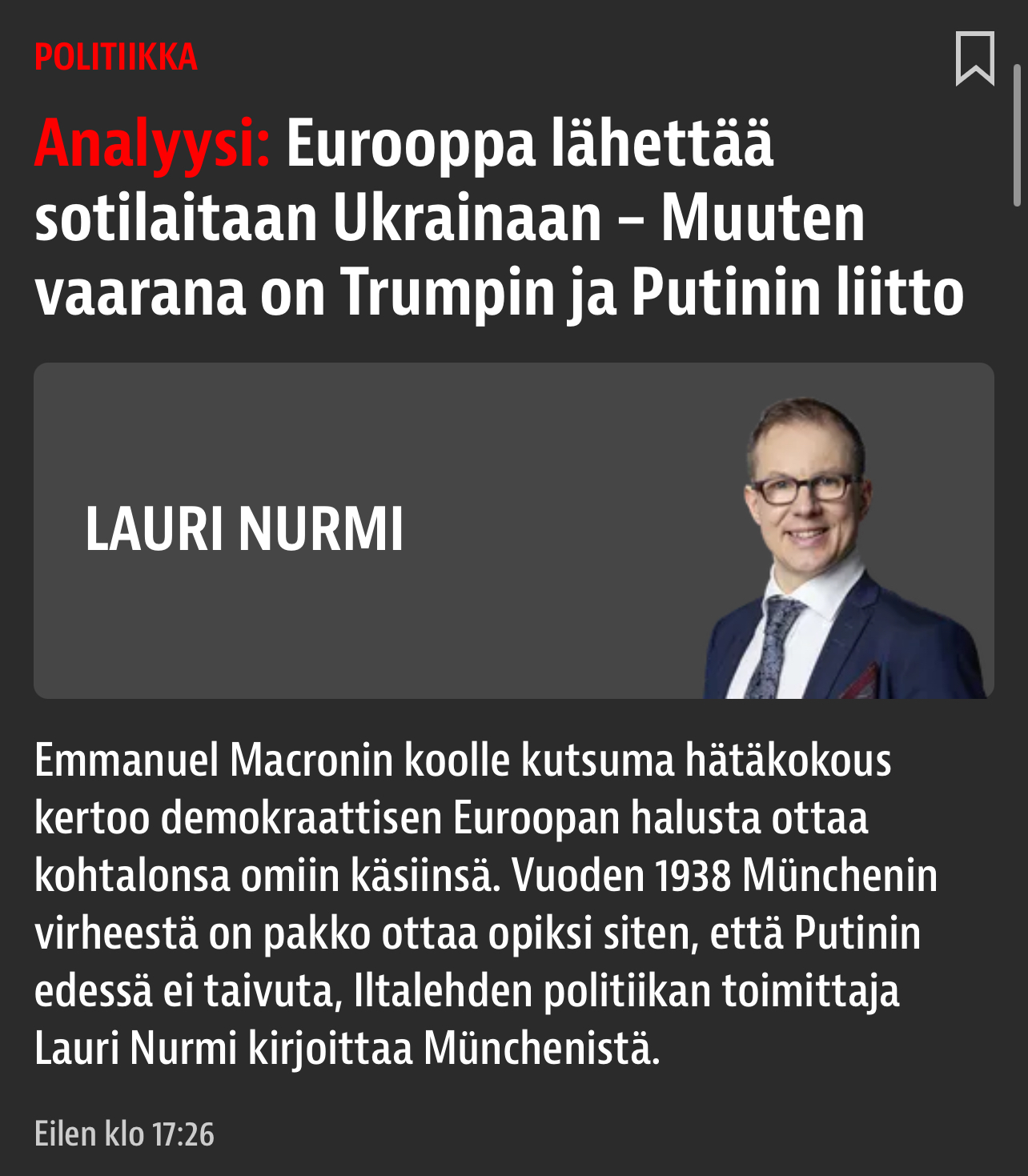
Unsurprisingly, the states convening in emergency are precisely those that have lent the most to Ukraine, and the reaction of these and all other EU member states confirms the real — including financial — reasons behind the war:
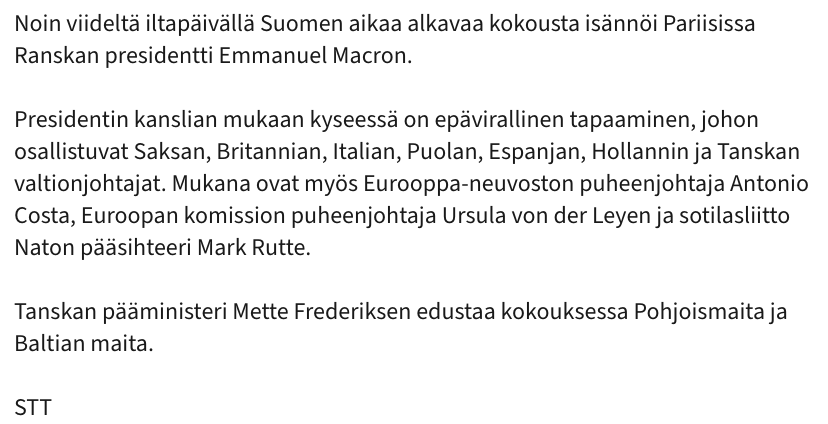
- Germany has provided approximately 17.7 billion euros in support
- The United Kingdom has provided approximately 15.8 billion euros
- Poland has provided approximately 11.5 billion euros
- France has provided approximately 7.5 billion euros
- Italy has provided approximately 5.5 billion euros
- The Netherlands has provided approximately 4.8 billion euros
- Spain approximately 2.5 billion euros
In plain terms: Emergency meeting = creditors' meeting
Mineral Reserves and Why They Are Being Discussed
How large are Ukraine's mineral reserves and what do they consist of?
Strategically most important minerals:
💰Lithium: The largest reserves in Europe, estimated at 1.5 million tonnes: Value 70–90 billion USD
💰Rare earth metals: Total value 40–50 billion USD
💰Iron ore: The world's 6th largest reserves, approximately 6.5 billion tonnes: Value 280–320 billion USD
💰Manganese: The world's 2nd largest reserves: Value 150–180 billion USD
💰Titanium: The largest reserves in Europe: Value 40–50 billion USD
The total estimated value of exploitable mineral reserves in Ukraine (excluding Russian-occupied territories) is approximately 400–500 billion dollars.
A 50% share of these reserves would be worth significantly more than the support the United States has provided to date. This raises the question of what the true nature and terms of that support really are — and the question: Who benefits the most?
So let us follow the money and see where the data leads us.
The USA and Lithium
The USA's lithium situation represents a significant strategic challenge for its industry. The USA currently produces only about 1% of the world's lithium, despite holding substantial reserves (9.1 million tonnes). This is due to several factors:
💰Slow environmental permitting processes
💰High production costs
💰Technological challenges
💰Local community opposition
This situation explains the USA's strong interest in Ukraine's lithium reserves, because:
💰Scaling up domestic production is slow
💰Dependence on China's refining capacity is a strategic risk
💰Growth in electric vehicles and the battery industry continuously increases lithium demand
The USA and Titanium
Total US titanium reserves amount to approximately 7.1 million tonnes, of which roughly 3.5–4 million tonnes are exploitable. This is significantly less than the country's long-term annual industrial demand.
For comparison:
- Ukraine's titanium reserves are approximately 15 million tonnes (more than double)
- Russia holds the world's second-largest titanium reserves, approximately 25 million tonnes
- China controls approximately 30% of the world's titanium reserves
Ukraine's titanium reserves are of interest because US domestic production is insufficient to cover strategic demand, particularly in the defence industry and aerospace.
Russian-Controlled Areas and Ukraine's Natural Resources (Minerals)
Rare Earth Metals
constitute the most significant category of minerals in Russian-held territory, as Russia now controls 45–50% of Ukraine's deposits. Their value is approximately 18–25 billion dollars.
This is critically important for Russia, because rare earth metals are essential for military electronics, missile systems, and modern communications technology. Russia's own deposits are more difficult to exploit.
Lithium
of which Russia now controls 30–35% of Ukraine's reserves, is valued at 24–31.5 billion dollars. This is strategically significant as Russia seeks to develop its own battery industry and reduce its dependence on foreign technology.
Manganese
of which Russia controls 25–30%, is valued at 37.5–54 billion dollars. This is important for Russia because its own manganese reserves are of inferior quality. Manganese is essential for the production of high-grade steel.
Titanium
of which Russia now controls 20% of Ukraine's reserves (valued at 8–10 billion dollars), is critical particularly for the aircraft industry and space technology. Although the percentage is smaller, these deposits are of excellent quality.
In total, the mineral resources under Russian control amount to 199.5–248.5 billion dollars.
These form a strategic whole for Russia that is more valuable than the monetary figure alone suggests, because control of these minerals:
- Supports Russia's technological self-sufficiency
- Reduces dependence on Western supply chains
- Enables the maintenance and development of its military industry
- Secures industrial raw material supply far into the future
In this light, Lavrov's comment below from 17 February 2025 confirms the truth that the mineral reserves underscore:
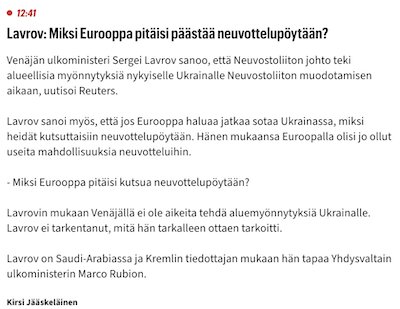
Europe has no seat at the table, because the EU has nothing to offer: no military deterrent and no real influence in the great power game. Russia understands only one thing at the negotiating table: strength.
Accordingly, peace is being brokered between the USA and Russia, and roughly three quarters of Ukraine's natural resources are being divided between these two parties.
Peace Negotiations
Ukraine's natural resources have effectively served as collateral for war debts, and now the USA is redeeming that collateral and forcing Ukraine into peace, over the EU's head. Zelenskyy has been included as a representative of the debtor, but the role is nominal, because no EU member state — and no other country — is going to do anything, regardless of the rhetoric. The EU's submission has been visible throughout the day in the news, as the EU has been promised a share in Ukraine's reconstruction, while the USA and Russia skim the cream off the top.
The EU media could already acknowledge that Zelenskyy, because of Ukraine's debts, has absolutely no say in the outcome of the peace, and that for all parties involved this is simply a notification from the USA and Russia.
What Is the Essential Content of the Peace Agreement?
- Ukraine permanently loses all territories currently held by Russia.
- NATO promises not to expand into Ukraine.
- The USA secures the minerals it needs (it wants the same share as Russia).
- The EU is given the opportunity to participate in the clean-up — a redundant peacekeeping project and a necessary reconstruction project. Ultimately, the costs will fall entirely on Ukraine and the EU.
Outside the agreement, Zelenskyy will quickly retire — deservedly — and go down in history as "the president who accepted the peace."
Why would peacekeepers not be needed at all? After this division of territory and minerals, there is no longer any economic incentive to attack Ukraine, as Russia's war costs would exceed the gains. This is also why Russia has barely moved the front line beyond its occupied territories, instead focusing on holding what it has: the return-on-investment ratio at the current front lines is quite optimal, giving Russia valuable minerals while creating a corridor to the Crimean peninsula and additional buffer zone.
The war in Ukraine has never been about anything other than great power politics, in which Ukraine was knowingly driven into war, and once both parties have achieved their objectives, the remaining resources are divided among the victors (USA + Russia).
Sound familiar?
It should, because the United States and Russia are using the exact same strategy as they did the last time they divided Europe down the middle. Perhaps we Finns should consider how the USA and Russia would divide Finland in an equivalent scenario, because Finland's natural resources are worth even more in monetary terms than Ukraine's... From this perspective, NATO is not so much a security guarantee for Finland as it is a bargaining chip for the great powers — one in which the USA can, at any time it chooses, hand over half of Finland to Russia, having first sold Finland NATO-controlled fighter jets that will not fly a single metre if "a bit gets flipped in the computer."
Although technology and the world have changed, certain strategic interests and geographical realities have remained strikingly similar across the decades — in great power politics as well — and Finland's position is still disturbingly similar to what it was at the end of the Second World War.
Let Us Briefly Examine Finland's Fate Purely from the Self-Interested Perspective of Great Power Benefit Maximisation
Russia has in all likelihood already drawn a line on its own maps of Finland, running roughly along:
Kouvola → Mikkeli → Kuopio → Kajaani → Kuusamo → Sodankylä → Inari
This line is based purely on the strategic significance of Finland's natural resources, with particular attention to those resources that Russia needs for its own industry and strategic purposes.
This "rational" border from Russia's perspective would mean that approximately 35–40% of Finland's current land area would pass into Russian control, but this area would contain an estimated 55–60% of Finland's strategically most important natural resources.
Realistic exploitable value of the natural resources in this area:
- Metals and minerals: 116–134 billion euros
- Forest resources: 110–120 billion euros
- Water resources: 65–75 billion euros
- Other natural resources: 27–32 billion euros
Total value: 318–361 billion euros.
In the face of this sum, alarm bells should be ringing, because it is nearly double what Russia stands to gain from its territorial conquests in Ukraine. It is well-founded to say that Russia's gaze is turning toward Finland (and has already turned).
Let Us Return to Ukraine and the Question of Why the EU Does Nothing While the USA and Russia Negotiate Peace
The USA's economic power over the EU rests on several interconnected factors:
The dollar's status as the world's reserve currency gives the USA a unique advantage. Although the USA owes more to EU member states than the other way around, the USA can effectively print more dollars to pay its debts. This does not lead to immediate inflation because the dollar is such a strong and trusted currency.
Second, the banking systems of EU member states are deeply integrated into the US financial system. The majority of international trade is conducted in dollars, and EU banks need access to the dollar system in order to operate. The USA can restrict that access at will, as it has done in the context of sanctions.
Third, the economies of EU member states are dependent on US markets. Although the EU theoretically holds more US treasury bonds, the value of those bonds would collapse if the US economy suffered significantly. This creates a situation in which the EU must support the US economy to protect its own investments.
Fourth, US military protection through NATO is linked to economic relations. EU member states cannot make significant decisions contrary to US interests without jeopardising their own security position.
In the case of Ukraine, the EU's dependence on the USA manifests as follows:
- The USA can demand that EU member states support Ukraine, because EU states cannot risk their relationship with the USA
- EU member states must yield to US demands regarding mineral reserves, because their economic system is dependent on the USA
- The EU cannot significantly oppose US strategic decisions, even when they run counter to the EU's own immediate interests
This mechanism is particularly effective because:
- It is built into the international financial system
- It is supported by both economic and military structures
- EU member states have invested enormously in this system
- Alternative systems (such as a China-led one) are still seen as riskier
In practice, this means that although EU member states hold more US treasury bonds, they cannot use this as leverage against the USA, because doing so would harm them more than it would harm the USA.
The USA, in turn, can use its economic power to steer EU decision-making, even though its debt position is weaker relative to the EU. This explains why the EU supports the US line on Ukraine, even though the economic costs of the conflict are considerably greater for the EU than for the USA.
The EU grumbles publicly, but behind the scenes the peace has already been accepted and everyone is now waiting for the "announcement." As a consolation prize, the EU gets to carry out Ukraine's reconstruction for a while.
The Single Greatest Beneficiary? (Pictured on the left)
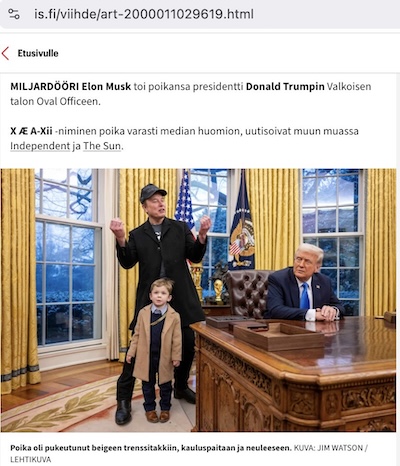
Musk's companies consume up to 28% of all US strategic minerals.
This is an exceptionally large share for companies controlled by a single individual, and it reveals a conflict of interest of such magnitude that it has brought even the EU to its knees.
Musk is a transhumanist, a businessman, and this entire arena of world politics is just one negotiation among many.
Absolute power and money always corrupt, and this unfortunately appears to be driving the Trump administration toward the implementation of a meritocracy in which the weak are trampled underfoot.
The Truth About Elon Musk's Companies' Mineral Consumption
Tesla and SpaceX are truly significant mineral consumers in the USA, and Elon Musk's companies use approximately 23–28% of the total US consumption of all valuable minerals. Below is a breakdown of consumption by Musk's companies, sorted by mineral.
Lithium:
- Tesla is by far the largest lithium consumer in the USA
- Tesla uses approximately 35–40% of annual US lithium
- SpaceX adds approximately 2–3% to this
In total, Musk's companies use approximately 37–43% of US lithium
Titanium:
Musk's companies' titanium consumption is significant:
- SpaceX uses approximately 8–10% of US titanium
- Tesla uses approximately 4–5% for specialised structures and components
A combined total of approximately 12–15% of US titanium consumption
Manganese:
- Tesla (battery production) uses approximately 15–18% of US manganese
- SpaceX uses approximately 3–4% for specialised steels
A combined total of approximately 18–22% of US manganese consumption
Rare Earth Metals:
- Tesla uses approximately 20–25% of US rare earth metal consumption (magnets, electronics)
- SpaceX adds approximately 5–7% to this
In total, Musk's companies use approximately 25–32% of US rare earth metal consumption
This tells the truth about why Ukraine's mineral reserves are so strategically significant for the USA — they secure the raw material supply for critical industries (the military-industrial complex + Elon Musk's empire) far into the future.
In Closing: Who Pays the Bill?
Answer: The EU and Ukraine
And What Does the Future Hold for the EU and the Rest of the World?
The unity of EU member states has been systematically undermined for decades through the implementation of far-reaching great power programmes emanating particularly from the USA, Russia, and China, ensuring that the EU is not a genuinely united people but rather a deeply weak and indebted federation without a purpose of its own.
A major part of this weakening has been the UN-orchestrated population replacement policy, which EU member states have swallowed wholesale. And so we see in near real-time how nation rises against nation — but since this is still rhetoric, the time has not yet come.
The weakness of the EU is particularly evident in the historically classic signs of increasing censorship, using hate speech, disinformation, and the "protection" of children as pretexts.
In reality, all collapsing empires have historically operated in the same way, attempting to suppress the free flow of information by whatever means and justifications available.
This is not genuinely about protecting anyone — it is about protecting the EU federation's truly fragile state and its bureaucrats.
Ultimately, Ukraine's new situation will very quickly lead to a weakening of the collective economy of EU member states, while at the same time, in order to secure defence guarantees, every NATO member state will bend to Trump's demands for increased defence spending.
The next focal point for the USA is the Middle East, where the USA, together with Israel, will begin neutralising the Iranian threat, while Gaza is emptied and, shortly thereafter, all of Israel is cleared of Muslims on security grounds.
The USA and Israel
This emptying of Gaza and the "cleansing" of the rest of Israel will, for the first time in centuries, fully open the Temple Mount to those who still honour the first covenant — enabling the completion of the Third Temple certainly before mid-2026.
The turmoil arising from the aforementioned events, which has already begun at the time of writing in the form of small-scale terrorist attacks across Europe, will spread throughout all of Europe and cause insecurity in every country, as a result of which mandatory identification — a digital ID — will be swiftly introduced in all countries.
"The Mark of the Beast"
Digital ID will be introduced globally — the instrument of the beast's subjugation and control, to which the vast majority will submit, because
Without a Digital ID, you cannot:
- Attend church
- Shop at a store
- Pay bills
- Receive wages
- Use cash
- Conduct trade
- Receive government benefits
- Access the internet or social media
All services will be brought under this system in the same way as the COVID pass, but far more broadly and ultimately far more strictly.
In Closing
In today's world, everything is ultimately connected to everything else, and for the future it is essential that we do not naively believe what we see in newspaper headlines or what the news claims to be the truth.
The truth behind world politics is a far more complex matter than "one country attacked another."
17 February 2025, Sami & Heini Minkkinen