The Mystery of Three and a Half Days: The Deep Typological Structure of the Bible
A remarkable temporal pattern flows through the pages of the Bible, repeating across the Holy Scriptures with such consistency that it can only be seen as the handiwork of God¹. The period of three and a half days, weeks, months, or years is not a mere numerical coincidence but a deep spiritual reality that reveals God's eternal purpose with humanity. This temporal pattern connects Esther's courage, the sign of Jonah, the death and resurrection of Christ, and the zeal of the two witnesses of the end times in a way that reveals the deep structure of all salvation history.
In Hebraic thought, time is not a linear progression but a cyclical recurrence, where past events are reflected in future ones at ever deeper levels². This explains how Jesus could say: "Before Abraham was, I am" (John 8:58, KJV). He was not merely foretelling the future but revealing what had been true all along — the reality of death's defeat, rooted deep in the very nature of God Himself.
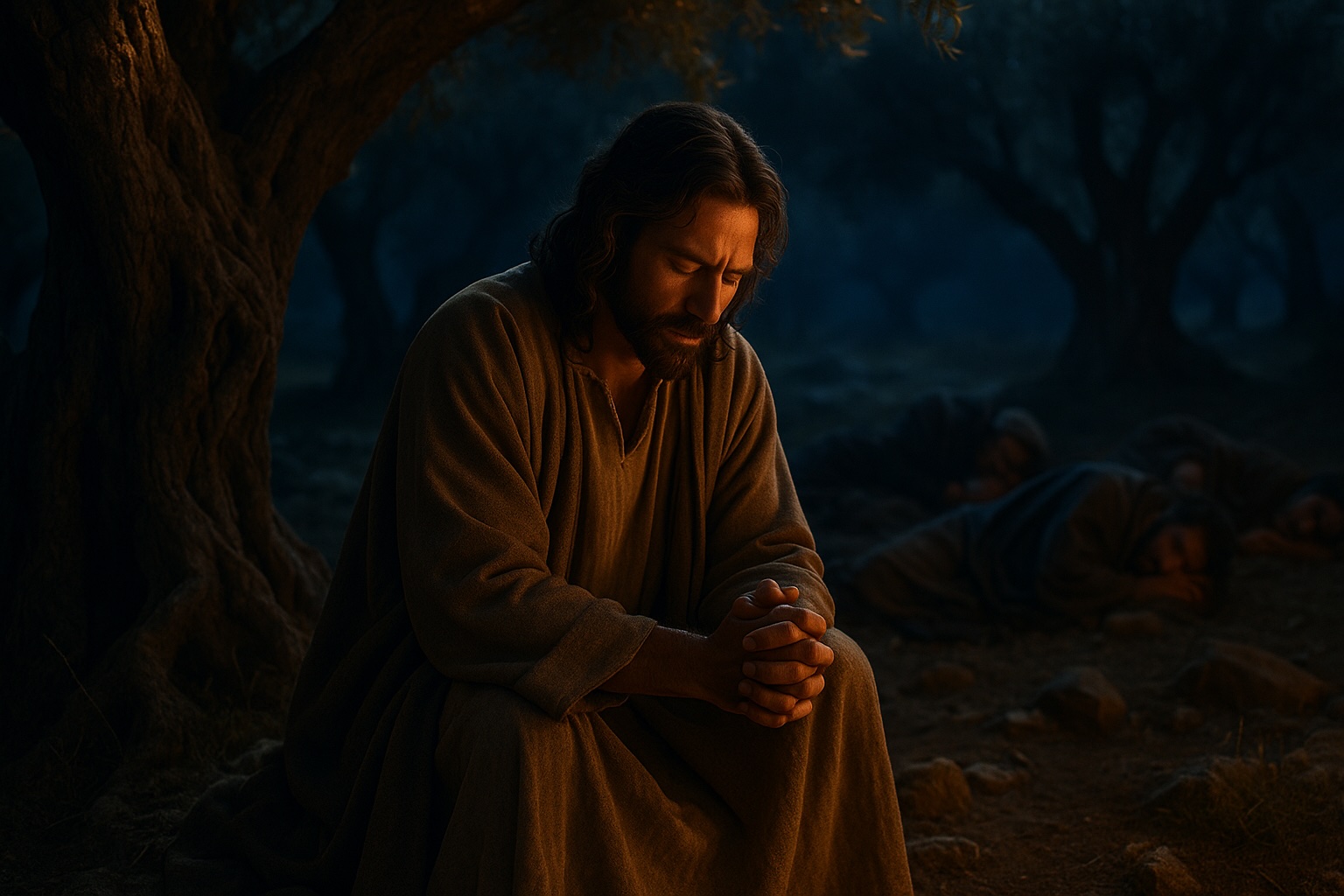
In the Garden of Gethsemane, this mystery of three took on a profoundly human dimension. Jesus returned three times to His disciples, only to find them sleeping³. "What, could ye not watch with me one hour?" (Matt. 26:40, KJV). Three times He prayed, three times He returned, three times the disciples failed. This threefold failure foreshadowed the three days during which the disciples believed all was lost. In Gethsemane we see humanity's inability to remain spiritually awake — an inability that causes us to fail to recognise God's work even as it unfolds before our very eyes.
To understand the significance of the three-and-a-half period, we must return to the Book of Daniel, where this temporal pattern receives its first clear expression⁴. Daniel 7:25 speaks of "a time and times and the dividing of time," Daniel 9:27 of half a week, and Daniel 12:7 again of "a time, times, and an half" (KJV). The Hebrew uses the word "moed," meaning an appointed time, a festival season, a moment ordained by God⁵.
This is not an arbitrary time span but a profound spiritual reality. Three and a half represents incompleteness, something unfinished — it is half of seven, the number of perfection. It is the moment when evil appears to triumph, yet that triumph is only apparent. In truth, it is the moment when God's plan turns toward its final victory⁶.
Daniel did not merely foretell future events but revealed God's pattern of engagement with history. Every great crisis endures this mystical span of time, and each is followed by God's intervention and the deliverance of His people. This pattern repeats again and again throughout history, ultimately culminating in that final three-and-a-half period preceding the return of Christ.
When Esther stepped before King Ahasuerus uninvited, she did more than break court protocol: she stepped into a prophetic role that foreshadowed the courage of the end-times witnesses⁷. Her three-day fast was not merely preparation through prayer but a confrontation with death itself, for Persian law was merciless: to appear before the king without summons meant death⁸.

Yet the depth of Esther's story only opens up when we understand its connection to Mordecai's refusal to bow before Haman. Here we see the same pattern that recurs in the end times: God's people refuse an act of obeisance that is, in reality, idol worship⁹. Haman's fury was not merely personal offence but the rage of one whose authority had been challenged. In the same way, the Antichrist in the end times will demand worship, and those who refuse will face the threat of death.
Esther's victory came not through military strength or political cunning but through her willingness to die for the truth. The extension of the golden sceptre was a prophetic image of how God raises up the humble and delivers those who dare to stand on the side of truth¹⁰. The golden sceptre represented grace overcoming the law — just as the grace of Christ overcomes the law of death.
Jesus' reference to the sign of Jonah contains layers we often overlook¹¹. When He said: "For as Jonas was three days and three nights in the whale's belly; so shall the Son of man be three days and three nights in the heart of the earth" (Matt. 12:40, KJV), He was not merely drawing a comparison between His own death and resurrection and Jonah's experience. He was establishing a universal pattern that recurs whenever God works among humanity.
The timing of the resurrection itself reveals a deeper truth. According to Jewish reckoning, the new day began at sunset, not at midnight¹². Jesus died on Friday at approximately three in the afternoon and was buried before sunset. After Friday evening the Sabbath began, and after the Sabbath ended on Saturday evening, the first day of the week commenced. Thus the Sunday morning resurrection actually occurred on "the third day" in Jewish reckoning — not after three full twenty-four-hour periods, but at the fullness of God's appointed time¹³.
This apparent contradiction reveals something profound about God's time: it is not the mechanical ticking of a clock but the fulfilment of moments laden with meaning. Just as a pregnant woman gives birth "when the time is full," not at precisely nine months, so God's promises are fulfilled in His moment, not in our calculations.
Jonah's experience in the belly of the sea creature was a perfect picture of death and resurrection¹⁴. It was also a picture of how God uses apparent judgement as an instrument of salvation. Jonah believed he was dying, but God used those three days to teach him mercy. In the same way, the death of Jesus appeared to be the failure of God's plan, but in reality it was its perfect fulfilment.
The two witnesses of the end times lie in the street of Jerusalem for three and a half days, and the whole world rejoices over their death¹⁵. This rejoicing is short-lived, for the Spirit of God enters them and they rise to their feet. This is the final fulfilment of the sign of Jonah: the last proof that death cannot overcome the life of God.
Revelation 11:13 mentions seven thousand names that perish in the earthquake, and this does not speak of a random catastrophe but of a profound spiritual reality¹⁶. The number seven thousand connects this event directly to the time of Elijah, when God preserved for Himself seven thousand "who have not bowed the knee to the image of Baal" (Rom. 11:4, KJV).
Here a striking paradox is revealed: these seven thousand die midway through the time of separation in an earthquake that, to everyone else, appears to be nothing more than a natural disaster. The world sees only tragedy, statistics, casualty figures. No one understands that God, in His mercy, has taken them away before worse times come¹⁷. They are God's quiet act of grace — those spared from coming suffering in a way that no one recognises.
These seven thousand are the exception, not the rule. Throughout history, God's people have been called to endure to the end, to "be thou faithful unto death" (Rev. 2:10, KJV). Paul writes: "We must through much tribulation enter into the kingdom of God" (Acts 14:22, KJV) — not by circumventing tribulation but by walking through it. Jesus Himself prayed: "I pray not that thou shouldest take them out of the world, but that thou shouldest keep them from the evil" (John 17:15, KJV). He knew that His own would walk the same road He walked: through suffering to glory.
The seven thousand die in the earthquake, just as many others have died in natural disasters throughout history. Their distinctiveness is not outwardly visible — there is no martyr's crown, no public recognition, no heroic final testimony. They are simply there, in the wrong place at the wrong time, in the eyes of the world. Only God knows the truth: that in His mercy He called them home before worse times arrive.
Paul uses these seven thousand as an example of "a remnant according to the election of grace" (Rom. 11:5, KJV). In Hebraic thought, the number seven represents perfection and a thousand represents multiplication¹⁸. Seven thousand is therefore the perfect number of those whom God has chosen for Himself. They are not random victims but specifically chosen by God, though the world will never understand this.
To grasp the significance of end-times events, we must plunge deeper into the theology of death. Paul teaches us that "the last enemy that shall be destroyed is death" (1 Cor. 15:26, KJV). Death is not merely the cessation of biological functions but a fundamental separation from God, who is the source of all life¹⁹.
When Adam and Eve fell into sin, they did not die physically at once, but they died spiritually. This spiritual death is the foundation of all physical death. This is why Jesus could say: "I am the resurrection, and the life: he that believeth in me, though he were dead, yet shall he live" (John 11:25, KJV). He was not merely promising life after death but revealing the truth that the believer never dies in the sense in which the world understands death²⁰.
This is the radical truth that changes everything. The death of Christ on the cross was not merely an atonement for sins but the overthrow of death itself. When He cried out: "It is finished" (John 19:30, KJV), He was not only declaring the completion of His work of redemption but the shattering of the power of death. Three days later, His resurrection confirmed that death had lost its power once and for all²¹.
In the Garden of Gethsemane, Jesus experienced the deepest human anguish — not only in dread of the coming physical suffering but in bearing the weight of all humanity's sin. "My soul is exceeding sorrowful, even unto death" (Matt. 26:38, KJV). In this sequence of three prayer vigils, we see the struggle of His human nature and the triumph of His divine will. Each return to the sleeping disciples deepened His solitude — just as every believer experiences their own Gethsemane moment, when others sleep on in spiritual oblivion²².
Satan, whom Jesus called "a murderer from the beginning" (John 8:44, KJV), is not merely the wielder of death but the embodiment of it²³. His entire strategy rests on using the fear of death as an instrument of control. The Epistle to the Hebrews reveals this: Jesus partook of flesh and blood "that through death he might destroy him that had the power of death, that is, the devil; and deliver them who through fear of death were all their lifetime subject to bondage" (Heb. 2:14–15, KJV).
Satan's greatest deception is making people accept spiritual death as a normal condition. He builds systems that keep people dead to God: religions without the Spirit, philosophies without truth, lifestyles without purpose. Psalm 115:8 warns: "They that make them are like unto them; so is every one that trusteth in them" (KJV). Those who worship what is dead become dead themselves²⁴.
In the end times, this strategy culminates in the system of the Antichrist, which demands that all receive the mark of the beast. This mark is not merely a form of identification but a spiritual allegiance to the kingdom of death. Those who refuse appear to die, but in reality they pass into life. Those who take the mark appear to live, but in reality they die for eternity²⁵.
The ministry of the two witnesses in Revelation represents God's final call to humanity. Their three-and-a-half-year testimony is filled with mighty signs and wonders, yet it ends in apparent defeat²⁶. They die and lie in the street, and "they that dwell upon the earth shall rejoice over them, and make merry, and shall send gifts one to another; because these two prophets tormented them that dwelt on the earth" (Rev. 11:10, KJV).
This rejoicing is short-lived. After three and a half days, the Spirit of God enters them and they rise to their feet in the sight of all people. This is the final sign of Jonah to the world — the ultimate proof that God conquers death. It happens in Jerusalem, in the same city where Jesus died and rose from the dead, and it is seen across the entire world, so that no one can say they did not know²⁷.
The connection between this event and Esther's courage is profound. Esther was willing to die for the salvation of her people; the two witnesses die for the salvation of all humanity. In both cases, apparent death leads to a greater victory. Esther received the golden sceptre and the deliverance of her nation; the two witnesses receive resurrection, and the whole world is made to behold the power of God.
This profound truth is not merely theoretical theology but a practical guide for life today. Every believer faces their own "three-and-a-half-day" seasons — times when evil appears to triumph, truth lies buried, and God is silent²⁸. These are the moments when faith is tested to its limit and the temptation to compromise is at its greatest.
The example of Esther, Jonah, and the two witnesses teaches us that these are precisely the moments when God is preparing His greatest victory. Every moment of hopelessness is an invitation to deeper faith. Esther received the golden sceptre at the very moment when her death seemed certain. Jonah received deliverance at the very moment when all hope seemed lost.
As we look around us and see the forces of darkness growing stronger, contempt for truth increasing, and religious persecution intensifying, we need not fear. These are signs that God's great plan is advancing. We are stepping into that final three-and-a-half period that precedes the return of Christ. We know the outcome: "Death is swallowed up in victory" (1 Cor. 15:54, KJV).
Our calling is to remain faithful to the truth to our very last breath, regardless of what threats or temptations we face. The world may demand that we bow, that we take the "mark of the beast" of our own age — whether it be economic coercion, social pressure, or political threat. We know the truth: those who remain faithful never die. They simply pass from the temporal into the eternal.
The seven thousand who die midway through the time of separation in the earthquake represent God's deepest mystery — His quiet grace. The world sees only the victims of a natural disaster, but God knows the truth. They are those whom He, in His mercy, has chosen to spare from what is to come. Not as heroes, not as martyrs in the eyes of others, but as God's quiet act of grace — like Enoch, who was taken away so silently that only his absence bore witness to it.
We stand at the centre of the spiral, where every three-and-a-half-day cycle has drawn us closer to the ultimate fulfilment. From Esther to Jonah, from Jonah to Christ, from Christ to the two witnesses — each turn has deepened our understanding that God writes straight with crooked lines. Every apparent defeat is merely preparation for a greater victory; every death is merely a gateway to resurrection²⁹.
The threefold prayer of Gethsemane, the three days of Christ's tomb, the three-and-a-half-year tribulation of the end times — all of these are expressions of the same divine rhythm. God does not hurry; He is never late. He acts in His own time, which is perfect. Three and a half is not merely a number but a promise: incompleteness shall become perfection, death shall become life, and apparent defeat shall be revealed as the final victory. ✝️
Sources
-
LaRondelle, Hans K. (1983). The Israel of God in Prophecy: Principles of Prophetic Interpretation. Andrews University Press. pp. 127–145.
-
Cullmann, Oscar (1962). Christ and Time: The Primitive Christian Conception of Time and History. SCM Press. pp. 51–73.
-
Marshall, I. Howard (1978). The Gospel of Luke: A Commentary on the Greek Text. Eerdmans. pp. 829–836.
-
Collins, John J. (1993). Daniel: A Commentary on the Book of Daniel. Fortress Press. pp. 315–321.
-
Goldingay, John E. (1989). Daniel: Word Biblical Commentary. Word Books. pp. 182–190.
-
Beale, G.K. (1999). The Book of Revelation: A Commentary on the Greek Text. Eerdmans. pp. 588–595.
-
Bush, Frederic W. (1996). Ruth, Esther: Word Biblical Commentary. Word Books. pp. 402–415.
-
Moore, Carey A. (1971). Esther: Introduction, Translation, and Notes. Doubleday. pp. 51–58.
-
Levenson, Jon D. (1997). Esther: A Commentary. Westminster John Knox Press. pp. 67–75.
-
Berlin, Adele (2001). Esther: The Traditional Hebrew Text with New JPS Translation. Jewish Publication Society. pp. 45–52.
-
France, R.T. (2007). The Gospel of Matthew: New International Commentary on the New Testament. Eerdmans. pp. 484–492.
-
Finegan, Jack (1998). Handbook of Biblical Chronology. Hendrickson Publishers. pp. 353–369.
-
Hoehner, Harold W. (1977). Chronological Aspects of the Life of Christ. Zondervan. pp. 65–74.
-
Stuart, Douglas (1987). Hosea–Jonah: Word Biblical Commentary. Word Books. pp. 431–440.
-
Osborne, Grant R. (2002). Revelation: Baker Exegetical Commentary on the New Testament. Baker Academic. pp. 415–425.
-
Mounce, Robert H. (1997). The Book of Revelation: New International Commentary on the New Testament. Eerdmans. pp. 218–225.
-
Wright, N.T. (2003). The Resurrection of the Son of God. Fortress Press. pp. 456–463.
-
Biblical Numerology Study Bible (1991). Numbers in Scripture: Their Symbolic Significance. Kregel Publications. pp. 234–241.
-
Murray, John (1959). The Epistle to the Romans: New International Commentary on the New Testament. Eerdmans. pp. 318–325.
-
Carson, D.A. (1991). The Gospel According to John. Eerdmans. pp. 411–418.
-
Brown, Raymond E. (1970). The Gospel According to John XIII–XXI: Anchor Bible. Doubleday. pp. 930–937.
-
Keener, Craig S. (1999). A Commentary on the Gospel of Matthew. Eerdmans. pp. 638–645.
-
Hendriksen, William (1967). Exposition of the Gospel According to John. Baker Book House. pp. 64–71.
-
Kidner, Derek (1973). Psalms 73–150: Tyndale Old Testament Commentaries. Inter-Varsity Press. pp. 406–410.
-
Johnson, Alan F. (1981). Revelation: Expositor's Bible Commentary. Zondervan. pp. 549–556.
-
Ladd, George Eldon (1972). A Commentary on the Revelation of John. Eerdmans. pp. 153–160.
-
Walvoord, John F. (1966). The Revelation of Jesus Christ. Moody Press. pp. 184–191.
-
MacArthur, John (1999). Revelation 1–11: MacArthur New Testament Commentary. Moody Press. pp. 327–334.
-
Morris, Leon (1987). The Revelation of St. John: Tyndale New Testament Commentaries. Eerdmans. pp. 147–154.