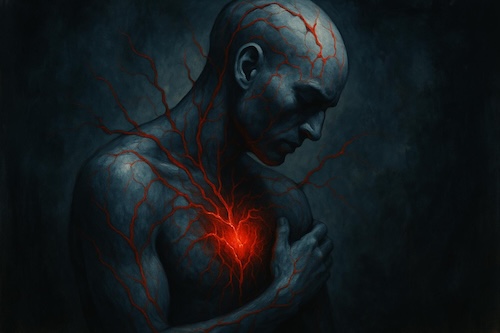
Body, Soul and Spirit — The Total Destructive Force of Casual Sex
The human being was created as an indivisible whole: spirit, soul and body as one, woven together so tightly that when a single thread breaks, the entire fabric tears. Casual sex does not touch just one dimension — it penetrates our entire being like a poison that travels through the bloodstream, slowly but surely reaching every cell. What the world markets as "harmless fun" gradually reveals itself as a total trauma — at first imperceptible, then disturbing, and finally devastating¹.
Touch was our first language, and it remains the deepest. A newborn learns love through the skin before grasping a single word, before even seeing clearly. The harrowing studies from orphanages lay bare a stark truth: children who received nourishment but no touch died or were permanently damaged. The skin is not merely a protective covering but a communication channel of the soul — a sacred pathway where the physical and the spiritual meet. When this sanctity is repeatedly violated in casual encounters, something deep within breaks — first imperceptibly, then irreversibly².
In sexual intimacy, every nerve ending comes alive, every cell resonates with the other. Our bodies speak a language older than words: "I belong to you, you belong to me." In casual sex, this ancient promise becomes a lie. The body swears faithfulness that the mind has already decided to break. In this contradiction — between the body's truth and the mind's lie — the first fracture is born, and it widens with every encounter³.
Neuroscience has revealed an astonishing truth: skin contact triggers a biochemical orchestra in which oxytocin, endorphins, serotonin and dopamine dance together — but when that contact occurs under the shadow of uncertainty, when attachment mingles with the fear of being abandoned, stress hormones also activate. The body lives in a constant state of alarm: pleasure and stress become intertwined in a way that ultimately destroys the ability to tell them apart⁴.

Our bodies remember. Not only in the brain but in every cell, every muscle, a memory lives: somatic memory — the body's own way of storing experience. Every touch leaves a mark, an invisible scar. Years later, a certain scent, a sound, or a gesture can awaken the body's remembrance. A person may rationally understand that she is safe with her current partner, but the body remembers past partners, past abandonments, past lies. This bodily memory does not vanish on command⁵.
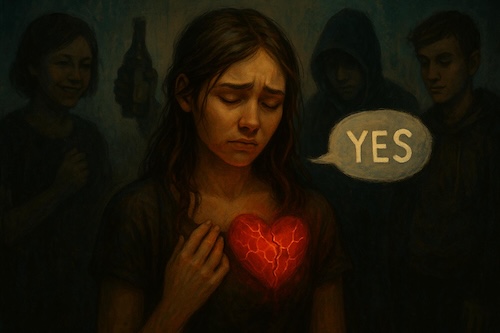
When we examine the deeper layers of consent, we confront modern culture's greatest lie. "Yes means yes" — this is what we are taught, but the heart knows a more complex truth. We can give our bodies while guarding our hearts behind walls. We can speak consent with our lips while our souls scream a warning. Every such conflicted consent is a small act of self-deception, and repeated deceptions harden us from within⁶.
Why do we consent? Loneliness drives us into another's arms even when we know it is temporary. The craving for acceptance makes us sell ourselves cheaply. Peer pressure, substances, a desperate need to feel something — anything — these are the forces that drive us to say "yes" when our entire being is screaming "no." Every such surrender carries us further from ourselves⁷.
When the heart has been wounded too many times, it begins to protect itself. The Bible speaks of the hardening of the heart — a heart of flesh that becomes a heart of stone (Ezek. 36:26). This is not merely a figure of speech but a description of a real spiritual process. A hardened heart can no longer be hurt, but the price is steep: it also loses its ability to truly love, truly feel, truly live⁸.
Dissociation — leaving the body — becomes a survival strategy. Prostitutes are masters of this skill: they can be physically present yet psychologically a million miles away. The same mechanism activates in "ordinary" casual sex as well. Gradually, we learn to sever the connection between bodily experience and emotion. This skill, which at first feels like protection, becomes a prison — we can no longer unite body and soul even when we want to⁹.
Who do we become through these encounters? Every partner reshapes our identity, leaves a mark on who we believe ourselves to be. A young woman who has shared herself with ten men carries ten different versions of herself — fragments that do not fit together. She sees herself through their eyes, but whose eyes saw the truth? Identity fragments, breaks into pieces that no longer form a coherent whole¹⁰.
Shame grows in silence. Though the culture insists "you have nothing to be ashamed of," the heart knows the truth. Shame is not born from social norms but from a deeper awareness that we are living contrary to our own deepest nature. Attempts to suppress this voice lead, paradoxically, to ever deeper self-destruction — we prove to ourselves that we do not care by doing more of what hurts us¹¹.
Paul wrote something revolutionary: "Flee fornication. Every sin that a man doeth is without the body; but he that committeth fornication sinneth against his own body" (1 Cor. 6:18, KJV). Why is sexual sin different? Because it touches the core of our being — the place where we are creative, life-giving, bearers of the image of God. It takes our most sacred capacity and reduces it to the banal¹².
Eastern cultures have long understood the reality of energetic bonds. Every sexual encounter creates an energetic connection — an invisible thread between partners. These threads do not break when the relationship ends; they remain dangling, tangling with one another, creating a complex web that binds us to the past. Many experience inexplicable anxiety, depression or restlessness because they carry the energetic traces of former partners¹³.
Touch was our first language, but in casual sex we learn to speak it wrongly. Every meaningless touch teaches our body that touch means nothing. Every empty promise teaches our heart that promises are made to be broken. Gradually, we lose the ability to speak and understand the language of love¹⁴.
Society pays a heavy price. Studies demonstrate a clear connection between casual sex and mental health problems — depression, anxiety, suicidal tendencies and substance abuse accumulate. This is not moralising but measurable reality. We have created a culture that encourages us to harm ourselves and then wonders why we are so broken¹⁵.
Sexually transmitted infections are only the most visible part of the physical consequences. HPV, herpes, chlamydia — many incurable, some leading to infertility or cancer — but at a deeper level, casual sex alters the body's fundamental functioning. The immune system, hormonal balance, even gene expression change under the weight of chronic stress and repeated microtrauma¹⁶.
Children inherit their parents' wounds. Those born from casual relationships often grow up without one parent, and even when the parents stay together, the trauma transfers — disrupting attachment patterns, creating fear of abandonment, breeding an inability to trust. Neuroscience has shown that stress and trauma can alter DNA methylation in ways that are heritable. Thus sins truly affect "the third and fourth generation"¹⁷.
Sexual union within marriage reveals the contrast in its sharpest relief. There, every touch deepens the bond, every encounter builds trust. Body, soul and spirit unite in harmony, creating something greater than the sum of its parts. Touch speaks truth, promises hold, identity is strengthened. This is not idealisation but a description of how things were meant to be¹⁸.
Can you recognise yourself in these words? Do you recognise in your body the memories, in your heart the hardening, in your soul the fragmentation? A return to wholeness is possible, but it begins with radical honesty. We must acknowledge — first to ourselves — the truth of what casual sex really is: not freedom but captivity, not empowerment but powerlessness, not pleasure but deep, disguised suffering¹⁹.
Healing takes time. The body needs months, even years, to reset itself. The soul needs a safe space to gather its scattered pieces. The spirit longs for cleansing from past bonds. This journey is neither quick nor easy, but every step brings us closer to wholeness. Every day without new wounds gives old ones the chance to scar over²⁰.
The final truth is simple yet revolutionary: we were created for love, not merely for sex. Sex is an expression of love, not its substitute. When we try to quench the thirst for love with a mere physical act, it is like trying to quench thirst with salt water — every mouthful only deepens the thirst. True freedom is not found in breaking boundaries but in living within the purpose for which we were created. This truth waits to be discovered beneath every broken experience, behind every failed attempt, in the silence of every empty morning²¹.
References
-
Nagoski, Emily (2015). Come As You Are. Simon & Schuster. pp. 112–134.
-
Field, Tiffany (2001). Touch. MIT Press. pp. 45–67.
-
Komisaruk, Barry R. et al. (2006). The Science of Orgasm. Johns Hopkins University Press. pp. 234–256.
-
Uvnäs-Moberg, Kerstin (2003). The Oxytocin Factor. Da Capo Press. pp. 89–102.
-
van der Kolk, Bessel (2014). The Body Keeps the Score. Viking. pp. 178–195.
-
Bader, Michael (2002). Arousal: The Secret Logic of Sexual Fantasies. St. Martin's Press. pp. 67–89.
-
Perel, Esther (2006). Mating in Captivity. Harper. pp. 134–145.
-
Cloud, Henry & Townsend, John (1992). Boundaries. Zondervan. pp. 201–218.
-
Herman, Judith (1997). Trauma and Recovery. Basic Books. pp. 102–114.
-
Erikson, Erik (1968). Identity: Youth and Crisis. Norton. pp. 156–178.
-
Brown, Brené (2012). Daring Greatly. Gotham Books. pp. 68–79.
-
Winner, Lauren F. (2005). Real Sex: The Naked Truth about Chastity. Brazos Press. pp. 89–102.
-
Chia, Mantak & Abrams, Douglas (1996). The Multi-Orgasmic Man. HarperCollins. pp. 45–58.
-
John Paul II (2006). Man and Woman He Created Them: A Theology of the Body. Pauline Books. pp. 345–367.
-
Sandfort, T.G.M. et al. (2006). "Sexual Behavior and Mental Health". Archives of Sexual Behavior, 35(4). pp. 456–468.
-
Genuis, Stephen J. (2008). "Are condoms the answer to rising rates of sexually transmitted infections?" Canadian Family Physician, 54(12). pp. 1669–1671.
-
Amato, Paul R. (2005). "The Impact of Family Formation Change on Child Well-Being". Future of Children, 15(2). pp. 75–96.
-
Rosenau, Douglas (2002). A Celebration of Sex. Thomas Nelson. pp. 67–89.
-
Carnes, Patrick (2001). Out of the Shadows: Understanding Sexual Addiction. Hazelden. pp. 134–156.
-
Laaser, Mark (2004). Healing the Wounds of Sexual Addiction. Zondervan. pp. 178–195.
-
Lewis, C.S. (1960). The Four Loves. Harcourt Brace. pp. 134–142.