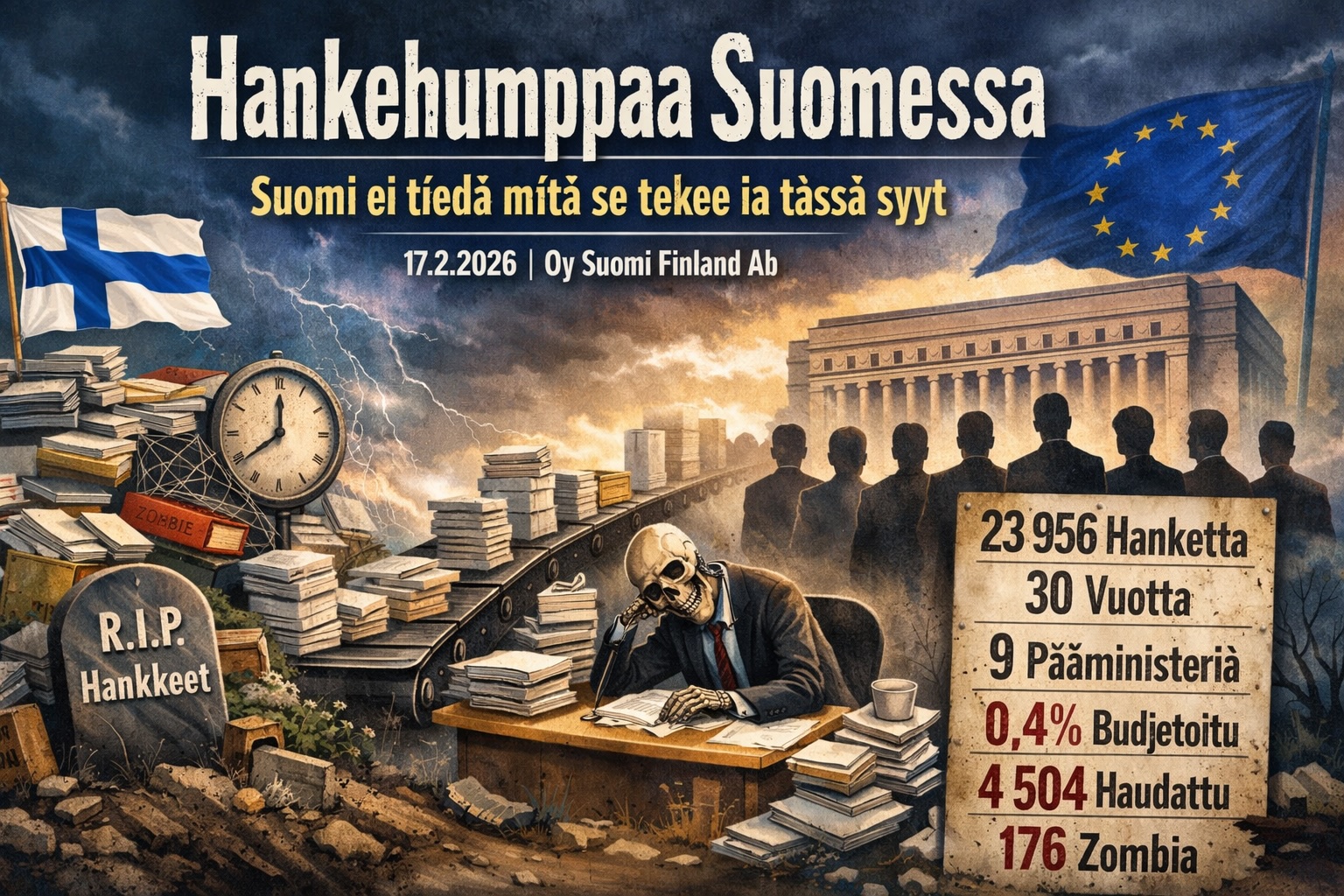
Finland's Project Shuffle: Finland Has No Idea What It's Doing — and Anyone Can See It
17.2.2026 | Oy Suomi Finland Ab
Finland's Government Project Portfolio contains 23,956 projects. Of those, 103 have a budget. That is 0.4 percent. Work effort estimates: zero. Not one. Zero.
Over the past 30 years, Finland has administered nearly 24,000 projects without knowing what they cost, how long they take, or whether they produce results. This is not a flaw in the system. This is the core feature of our administrative system.
This article is based on public data that anyone can verify through the Government Project Window. The data covers 30 years, nine prime ministers, and 15 themes. Every figure has been verified. Every finding is reproducible. Here is what the data says.
I: Nine Prime Ministers, No Results
What is remarkable is that Finland has not had just one failed government over 30 years. There have been nine consecutive failures, and every government produces the same result every time. I believe I am not the only one who has wondered why nothing changes even when the government changes — regardless of the coalition.
Half of all projects drift into the next government's term. Of the Sipilä government's 1,846 projects, 27 are still running under Orpo, seven years later. Not completed. Not terminated. And nobody has asked why.
| Government | Initiated | Completed in same term | Still running |
|---|---|---|---|
| Lipponen II | 2,835 | 52% | 2 |
| Vanhanen I | 3,091 | 46% | 0 |
| Katainen | 1,793 | 41% | 8 |
| Sipilä | 1,846 | 56% | 27 |
| Marin | 1,356 | 56% | 223 |
| Orpo | 875 | 30% | 595 |
The numbers paint a bleak picture. A government term is not a meaningful unit of time in Finnish administration. A third of all projects are not completed until two or more governments later. The government does not lead projects. It inherits them from its predecessor and bequeaths them to its successor.
Take a few of the most commonly repeated project themes:
Pension matters have been turned into projects 456 times across eight consecutive government terms. Child protection — every single term. Early childhood education — every single term. Every government starts from scratch. Every government appoints the same working groups, commissions the same studies, launches the same reforms. The next government buries them and starts its own.
| Topic | Projects | Government terms |
|---|---|---|
| Pensions | 456 | 8 |
| Immigration | 100 | 8 |
| Social security | 99 | 8 |
| Data protection | 57 | 7 |
| Early childhood education | 52 | 7 |
| Child protection | 30 | 7 |
The word "reform" has been inflated beyond recognition. During Lipponen's first term, 2.3 percent of projects contained the word "reform." Under Sipilä: 8.3 percent. Meanwhile, the total number of projects dropped from 3,091 to 875. Ever smaller matters are ever more frequently labelled as reforms — a grander-sounding and politically charged synonym for change.
Cuts account for 0.6–0.8 percent under every government, regardless of political colour. Nobody ever admits to cutting.
| Government | Reform share | Cut share |
|---|---|---|
| Sipilä | 50% | 0.6% |
| Rinne | 51% | 0.8% |
| Marin | 40% | 0.8% |
| Orpo | 48% | 0.7% |
There is no point blaming previous governments, because that chain of blame would lead all the way back to the year of Finland's independence. The fault does not lie with the people. Civil servants do their work. Members of parliament toil in committees. Ministers lead their ministries. The fault lies in a system that produces the same result regardless of who is in charge. The system is not led by any single individual — the system leads itself, as we have written in our book Truth About Hypnosis. The book lays bare the core of the entire global administrative system in plain language. Nine prime ministers, same structure, same result. This is the written footprint of absent leadership.
II: The EU Leads, Finland Follows
The share of EU implementation in Finland's projects has tripled in 30 years.
| Government | Projects | EU-related | Share |
|---|---|---|---|
| Aho | 87 | 4 | 4.6% |
| Lipponen I | 1,297 | 84 | 6.5% |
| Vanhanen I | 3,091 | 416 | 13.5% |
| Katainen | 1,793 | 334 | 18.6% |
| Sipilä | 1,846 | 371 | 20.1% |
| Marin | 1,356 | 270 | 19.9% |
| Orpo | 875 | 162 | 18.5% |
One in five projects is EU-driven. A directive is born in Brussels, passes through the Council and Parliament, and Finland's administration implements it. National room for manoeuvre is narrow: the content of the directive has been decided, Finland only decides how to execute it.
At the same time, Finland's own capacity has halved. The Vanhanen government initiated 67 projects per month. The Orpo government initiates 27. The directive tango consumes an ever-larger share of ever-shrinking resources.
Let us break down what Finland actually has left: EU implementations take up 18–20 percent. Administrative maintenance, institutional appointments, and reappointments consume roughly 20 percent. Inherited projects from previous governments and effectively dead zombie projects take 10–15 percent. The legislative project graveyard swallows a third of all law-related projects. For genuinely forward-looking, nationally originated policy, an estimated 5–10 percent of capacity remains.
Crumbs.
Member of Parliament Teemu Keskisarja stated in May 2025: "This is how hopeless the state of Finland's sovereignty is." The statistics support the observation, though the conclusion is his own. The problem is not EU membership alone. The problem is that Finland does not manage itself or its own capacity. Leaving the EU would not directly eliminate 23,956 projects, 176 zombies, or zero work effort estimates. These are domestic problems, and the same problems exist in every EU member state — because they all use the same system.
III: The Project Graveyard
4,504 projects have been quietly buried. One in five. They were not completed. They are not running. They simply vanished without a sound.
| Count | Share | |
|---|---|---|
| Completed normally | 17,817 | 79.8% |
| Buried without completion date | 4,504 | 20.2% |
A third of all legislative projects are buried. 30 percent of law-related projects never reach completion. Finland launches three legislative projects and one of them disappears without a trace. Repeatedly. Year after year. Government after government. This is how things are done here.
| Type | Buried |
|---|---|
| Legislation | 30% |
| Strategy | 12% |
| Project | 11% |
| Institution | 3% |
The most efficient undertaker of projects is a change of government.
| Transition | Buried within ±90 days |
|---|---|
| Stubb → Sipilä | 93 |
| Sipilä → Rinne | 72 |
| Rinne → Marin | 47 |
| Marin → Orpo | 151 |
The Marin-to-Orpo transition produced 151 burials in 90 days. Double the average. Nobody said aloud "let us bury 151 projects." Nobody is accountable for their death, because nobody tracked their life. No budget, no work estimate, no completion date. The project was born, it lived, it died. Statistically, it never existed.
This is the real mechanism of political accountability. The government programme makes promises. The project portfolio launches them. The next government buries them. A third government launches the same project under a new name. The cycle continues. Nobody is ever accountable for anything, because nobody ever finishes anything — not even when examined across a 30-year timeline.
IV: Healthcare Reform Does Not Work
The claim is blunt, because the statistics are blunt.
The healthcare and social services reform (SOTE) is Finland's largest structural overhaul. It affects every citizen, yet it is always a side project. SOTE reforms account for 10–16 percent of all reforms under every government, but they are never the main project. SOTE is nobody's primary job. Never more than a sixth of capacity — and then everyone wonders why it takes 20 years.
| Government | SOTE reforms | Share of all reforms |
|---|---|---|
| Sipilä | 73 | 12.5% |
| Rinne | 20 | 15.7% |
| Marin | 54 | 10.0% |
| Orpo | 48 | 11.4% |
The structural reason lies in ministerial silos. The Ministry of Social Affairs and Health builds services: 345 health projects, 269 social security projects. The Ministry of Finance manages the money: 736 economic projects. Joint projects: zero. They only talk to each other when the law forces them to.
The living proof of SOTE's funding problem is nine separate supplementary funding working groups for nine welfare regions, which speaks to an acute funding crisis and the structural, catastrophic failure of the entire SOTE reform. Each working group does the same job: assessing how much additional funding a single region needs. Not a single project in the entire 430-project SOTE portfolio addresses fixing the funding model itself.
Nine working groups stare at buckets that are filling up. Nobody fixes the leaking roof.
Of "SOTE Ltd's" 430 projects, 224 are classified as reforms. Three are classified as cuts — 0.7 percent of the total. In reality, far more projects amount to cuts: index freezes that erode purchasing power, housing benefit reductions rebranded as "modernisation," the staffing ratio reduction from 0.7 to 0.6 labelled a "development project." The mystical word "reform" is large enough to contain all of Finland's austerity policy.
At the same time, the SOTE project jungle entirely lacks an IT infrastructure project for the universal support system — the most significant social security reform of the decade. Britain built the equivalent Universal Credit system at a cost of 14 billion euros and five years behind schedule. Finland's portfolio contains no IT project at all, even though implementing the reform would require a complete overhaul of KELA's entire IT systems. Mental health, the single largest cause of disability pensions, is not the systematic focus of any of the 430 projects.
V: Zombie Finland
176 projects have been running for over four years. They do not finish. They do not die. Nobody kills them, because nobody likely even knows they exist anymore — apart from the individuals assigned as project leads.
| # | Age | Project |
|---|---|---|
| 1 | 23.9 yrs | Council of Europe convention on money laundering |
| 2 | 23.2 yrs | International rights regarding mobile equipment |
| 3 | 18.0 yrs | Fastening systems for transport equipment |
| 4 | 17.4 yrs | Equal treatment directive |
| 5 | 15.0 yrs | Nordic Sámi convention |
| 6 | 14.1 yrs | Council of Europe convention on illegal organ trafficking |
| 7 | 13.8 yrs | Steering group for the bean goose population management plan |
| 8 | 13.6 yrs | Council of Europe convention on combating counterfeit medicines |
| 9 | 8.4 yrs | SOTE terminology |
| 10 | 8.1 yrs | Abolition of daylight saving time |
The money laundering convention implementation has been in "pre-preparation" across five governments. Nearly a quarter of a century. The convention on illegal organ trafficking — 14 years. Organ trafficking.
SOTE terminology was turned into a project 8.4 years ago. In eight years, Finland has not managed to agree on the words to describe a system it cannot manage to build. Abolishing the clock change has been running for 8.1 years. A citizens' initiative from 2017. Should the clocks change or not. Eight years.
The Ministry of Agriculture and Forestry launched three separate projects on the same day, 18 September 2017: a fish processing development group, a commercial fishing development group, and an aquaculture development group. All three are still running 8.4 years later. On the same day: two timber measurement projects. Nine SOTE funding working groups. 723 fragmentation clusters, 2,987 projects, 12.5 percent of the entire portfolio.
The system cannot end anything. It cannot merge anything. It can only splinter and establish new working groups, like an absent-minded forester.
VI: Money Brings Discipline, But Money Is Not Tracked
A single figure explains why the system runs idle.
Projects with a budget link are completed 88 percent of the time. Without a budget link: 71 percent. Money brings discipline. The gap is 17 percentage points. The mechanism is simple: when someone tracks the money, someone tracks the result. Nobody tracks a project without money, because nobody knows it exists.
| Budget link | Completed | Buried |
|---|---|---|
| Budget link: yes | 88% | 10% |
| Budget link: no | 71% | 22% |
We know what works. Money, tracking, accountability. We do not do it. 99.6 percent of projects run without budget data. 103 projects have budgets, totalling 1.04 billion euros. The remaining 23,853 projects: no data. The single largest budgeted project is Lentorata Oy (Airport Rail Link), at 175 million euros. It is still running.
This is a choice, whether conscious or unconscious. It is a choice not to measure. Measuring would force prioritisation. Prioritisation would force letting go. Letting go is leadership. Leadership is not happening.
VII: No Preparation for Crises
Finland's project portfolio does not anticipate crises. It reacts to them — slowly and at low volume.
| Crisis | Directly related projects |
|---|---|
| Financial crisis 2008–09 | 14 |
| Refugee crisis 2015–16 | 8 |
| COVID 2020 | 18 |
| Energy crisis 2022 | 6 |
Pandemic preparedness before COVID: zero projects. Not one. Energy security before the energy crisis: four. Immigration preparedness before the 2015 refugee crisis: 17 projects, none of which were prepared for the volume.
COVID produced 18 named crisis projects and hundreds of temporary legislative amendments. The pandemic ended in 2023. The temporary laws are still in force. There is no exit strategy. The vaccine procurement working group was established before the pandemic and is still running after it. No permanent authorisation framework for future crises has been created in any theme.
When the next crisis hits, the same ad hoc circus will repeat: dozens of temporary legislative amendments that nobody coordinates and for which nobody drafts an exit strategy. The statistics show that the system does not learn from the previous crisis. It repeats the same pattern, decade after decade, like a perpetual motion machine.
VIII: Shuffle or Die
Member of Parliament Teemu Keskisarja used the word hankehumppa — "project shuffle" — in a parliamentary plenary session in April 2024. He was speaking about SOTE and bureaucracy: "The tempo of bureaucracy and the melody of chaos are dancing doctors and nurses to the point of collapse." He quoted the Finnish band Eläkeläiset: "Shuffle or die, or shuffle, or shuffle and die."
Journalist Santeri Nousjoki wrote in Maaseudun Tulevaisuus in May 2025: "At best, a project is established to develop development." He proposed a test: did the service improve or did costs decrease? If neither is true, it is a project the bureaucratic machine created for itself.
Both of them see it. Neither of them may have even known the exact figures, because intuition recognises the problem. The statistics presented here prove it. The difference is decisive, because intuition produces different conclusions depending on who is looking. For Keskisarja, the solution is leaving the EU. For another, it is more funding. For a third, it is administrative reform. Without statistics behind the intuition, the conclusion can be anything.
The statistics and history speak unambiguously: the system is structurally broken and always has been. The system does not know what it is doing, what it costs, or what is coming. It repeats the same mistakes from one government term to the next. It buries projects silently and launches new ones in their place. It fragments problems into pieces so small that nobody sees the whole picture. It reacts to crises instead of preparing for them. It does not measure itself, because measurement would force change.
23,956 projects. 30 years. 9 prime ministers. 0.4 percent budgeted. 4,504 buried. 176 zombies. Zero work effort estimates.
This is nobody's fault, but it is everyone's problem.
This analysis is based on Finland's Government's public project portfolio (hankeikkuna.fi), which contains 23,956 projects. The data is classified into 15 themes. All figures are public and verifiable. The methodology is open and the analysis is reproducible. Cross-analysis with parliamentary documents is underway and will be published later as part of this series.
Previous instalments in this article series: Oy Suomi Ab: Financial Statements 2025 (13.2.2026)