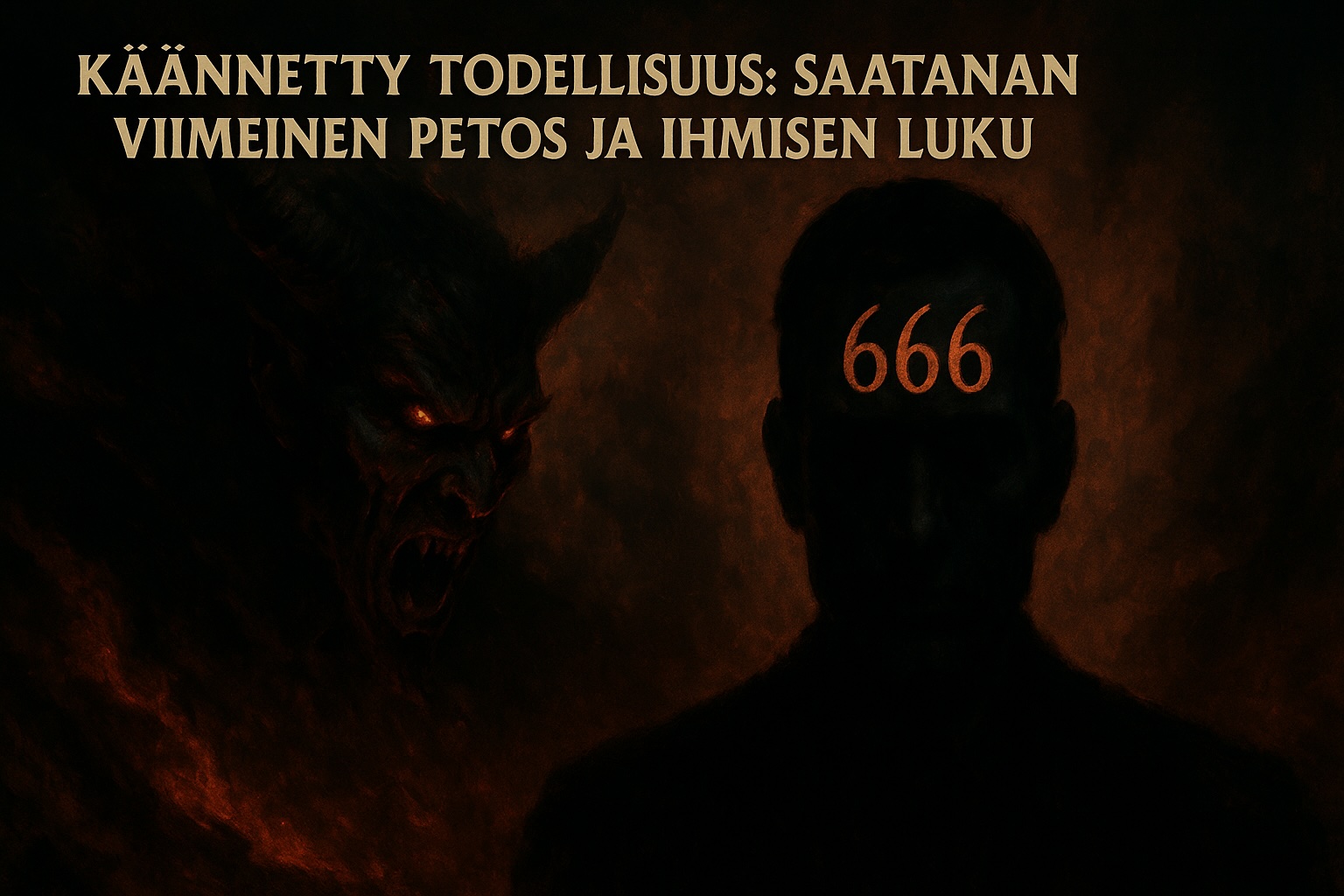
Inverted Reality: Satan's Final Deception and the Number of Man
"Here is wisdom. Let him that hath understanding count the number of the beast: for it is the number of a man; and his number is Six hundred threescore and six."¹ This enigmatic verse from the Book of Revelation has for centuries been interpreted almost exclusively as the number of Satan, a mystical symbol of evil. What if we have understood it all wrong? What if this very misunderstanding is part of a greater deception — the final and most devastating illusion, in which truth and falsehood trade places so completely that even the elect would be led astray, if it were possible?
In Greek, the expression "arithmos gar anthrōpou estin", "for it is the number of a man", does not necessarily refer to a single individual but to humanity itself. The number 666 may in fact represent mankind's striving toward divinity without God — a threefold attempt to reach perfection (7), always falling one step short. It is the spirit of the Tower of Babel expressed in numbers: humanity's eternal "almost but not quite" state in its effort to reach heaven by its own strength.
History's greatest paradox was fulfilled when God Himself "was made flesh, and dwelt among us"². The Creator stepped into His creation, the Infinite into the finite, the Holy into a sinful world. This mystery of the incarnation is so profound that it surpasses human understanding. And that is precisely why it becomes the perfect target for Satan's final deception. For what could be a greater lie than turning Truth itself into falsehood, Light into darkness, the Saviour into a destroyer?
In the spiritual climate of our age, we can already see this inverted reality taking shape. In the name of "inclusivity," the uniqueness of Jesus is branded as "exclusive" and therefore evil. In the name of "love," proclaiming truth is classified as "hate speech." In the name of "tolerance," Christianity's absolute truth claim is condemned as "fundamentalism." Each of these conceptual inversions prepares the ground for the moment when the ultimate accusation is made: that the followers of Christ are the true supporters of the Antichrist.
This process does not happen suddenly but gradually, like a frog in slowly heating water. In the media, in academia, and in popular culture, Christianity is increasingly portrayed as the enemy of history: a source of oppression, violence, and hatred. At the same time, spirituality that accepts all paths to God is elevated as a mark of enlightenment. This narrative prepares humanity to accept that when a world religion³ rises, it represents true love and peace. Those who hold to the uniqueness of Christ are enemies of peace.
In connection with the mark of the beast⁴, this inversion reaches its apex. Those who refuse the mark for Christ's sake are branded as enemies of society, threats to global peace and security akin to terrorists. Their refusal is interpreted as selfishness, fanaticism, even evil. Meanwhile, taking the mark is presented as a responsible, loving act: a demonstration of solidarity with humanity.
Jesus' prophecy concerning His own followers is chilling: "But before all these, they shall lay hands on you, and persecute you, delivering you up to the synagogues, and into prisons, being brought before kings and rulers for my name's sake… And ye shall be betrayed both by parents, and brethren, and kinsfolks, and friends; and some of you shall they cause to be put to death. And ye shall be hated of all men for my name's sake."⁵ Notice that the hatred is directed at them "for Jesus' name's sake." Not because they have done anything objectively wrong, but because the very name of Jesus has become a symbol of hatred.
This inverted reality is also reflected in how the two witnesses⁶ of Revelation will be perceived. As they proclaim judgement and truth, the world does not rejoice in their message but quite the opposite: "And they that dwell upon the earth shall rejoice over them, and make merry, and shall send gifts one to another; because these two prophets tormented them that dwelt on the earth." The proclaimers of truth are seen as "tormentors," disturbers of the peace. Their death is cause for celebration. In a world of falsehood, truth is the greatest threat.
Psychologically, this phenomenon is known as projection: we accuse others of what we ourselves are or do. Satan's masterpiece is to make all of humanity project its own rebellion against God onto those who are faithful to God. Thus the fundamental lie of the Fall — "ye shall be as gods"⁷ — is turned into an accusation that God's children are trying to be gods. In reality, they merely acknowledge the true God. In an inverted world, this acknowledgement is interpreted as pride and exclusivity.
Technology⁸ enables the maintenance of this illusion with unprecedented power. Algorithms can shape the perception of reality, deepfake technology can fabricate "evidence" of nearly anything, and social media can spread a lie faster than the truth. Add to this artificial intelligence's ability to analyse and predict human behaviour, and you have the perfect control system in which "truth" is whatever the system determines it to be.
The biblical worldview⁹ teaches that history is moving toward its climax, where everyone must choose a side. Satan's final deception ensures that this choice is presented in reverse: choosing Christ appears in the eyes of the world as choosing evil. Joining the Antichrist's system appears as choosing good, love, and peace. This is the ultimate moral inversion, in which the very foundations of the choice have been turned upside down.
How do we prepare for this? First, we must root ourselves so deeply in truth that no illusion can shake us. This means a profound knowledge of God's Word — not mere surface familiarity. Second, we must prepare ourselves to be seen as evil. Not for wrongs we have committed, but for standing on truth itself. Third, we must understand that this suffering is not a sign that we are wrong — quite the contrary. It confirms that we walk the same road as the Master, who "came unto his own, and his own received him not"¹⁰.
The paradox is complete: God, who came to save humanity, will ultimately be accused of being humanity's greatest threat. His followers, who proclaim the message of love and truth, will be branded as spreaders of hatred and lies. The system that enslaves humanity — the kingdom of the Antichrist — will be presented as the pinnacle of freedom and progress. This is Satan's final and greatest deception, in which the very fabric of reality is turned inside out.
Ultimately the question is this: Do we know the truth so well that we recognise it even when the entire world says it is a lie? Are we ready to stand with Christ even when it means being branded a supporter of the Antichrist? This is not a theoretical theological exercise but a practical reality that lies very near ahead of us. Preparation begins now: in knowing the truth, in deepening our roots, and above all in love for Him who is "the way, the truth, and the life"¹¹ — no matter what the world may call Him.
Sources:
- Revelation 13:18. King James Version (KJV).
- John 1:14. King James Version (KJV).
- Schaeffer, F. A. (1976). How Should We Then Live? The Rise and Decline of Western Thought and Culture. Fleming H. Revell. pp. 245-253.
- Thomas, R. L. (1995). Revelation 8-22: An Exegetical Commentary. Moody Publishers. pp. 169-185.
- Luke 21:12-13, 16-17. King James Version (KJV).
- Revelation 11:10. King James Version (KJV).
- Genesis 3:5. King James Version (KJV).
- Ellul, J. (1964). The Technological Society. Vintage Books. pp. 432-442.
- Hoekema, A. A. (1979). The Bible and the Future. Eerdmans Publishing. pp. 318-324.
- John 1:11. King James Version (KJV).
- John 14:6. King James Version (KJV).