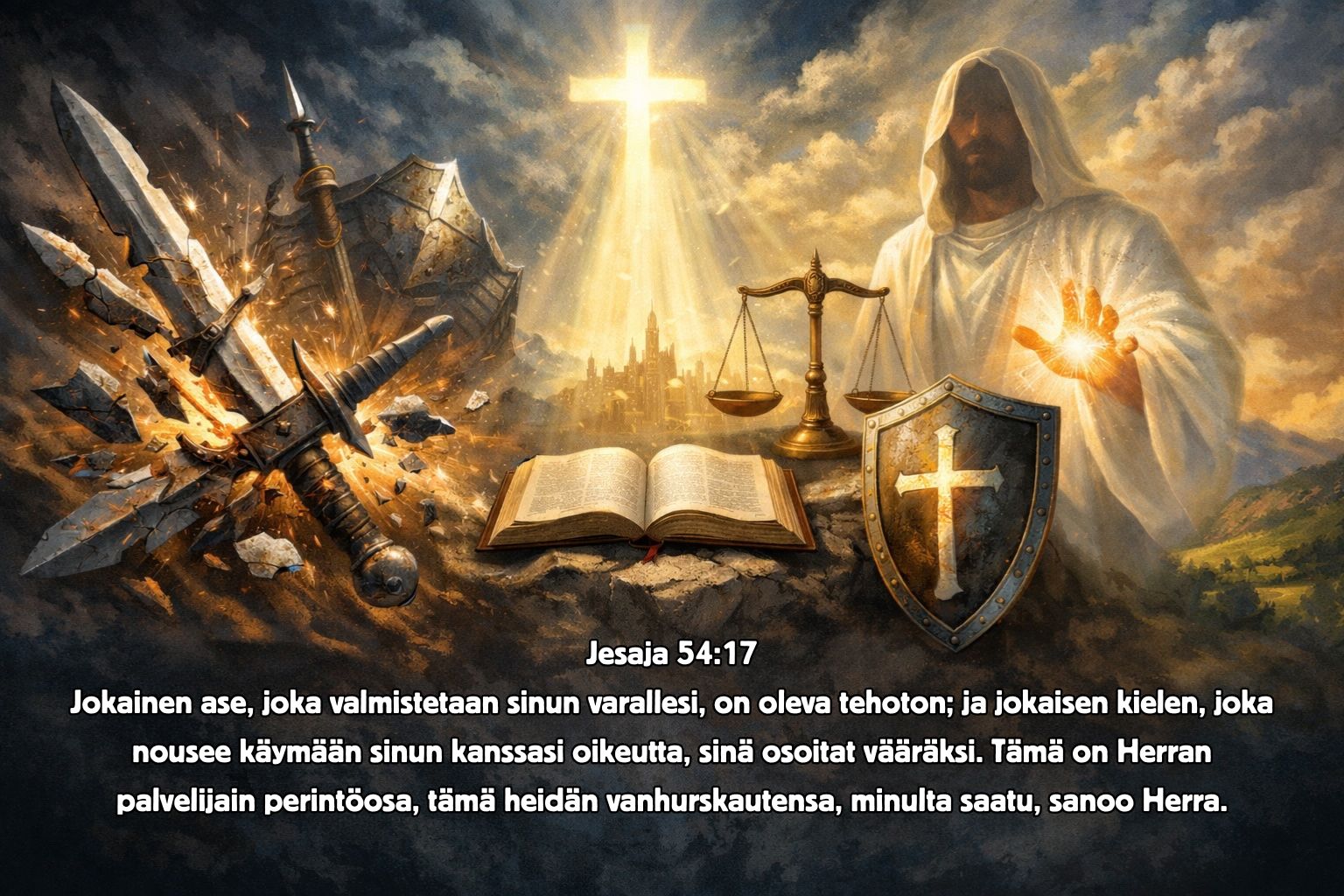
Isaiah 54:17 — The Heritage of the Servants of the LORD
"No weapon that is formed against thee shall prosper; and every tongue that shall rise against thee in judgment thou shalt condemn. This is the heritage of the servants of the LORD, and their righteousness is of me, saith the LORD."
— Isaiah 54:17 (KJV)
This verse is like a gemstone that refracts light differently from every angle. Within it lies a promise that stretches from the beginning of the Bible to the end, from Moses to Revelation. It is not a single word of encouragement but an entire theological structure resting on the very nature of God.
1. The Structure of the Promise: Three Pillars
Isaiah 54:17 contains three distinct promises that together form a comprehensive shield:
The first pillar: Weapons are rendered powerless. Every weapon formed against the servant of the Lord loses its force. It does not say that no weapons will be forged. They will be forged. The attacks are real. The promise is not immunity from hardship but a promise that the attacks will not achieve their aim.
The second pillar: Accusations are overturned. Every tongue that rises in judgment is condemned. This is a courtroom image: someone brings charges against God's servant, but the charges are dismissed. The prosecutor loses the case.
The third pillar: This is a heritage. The promise is not a one-time miracle but a permanent standing. It is a heritage belonging to the servants of the Lord from generation to generation. The righteousness on which this protection rests is "of me" — originating from God, not a product of human effort.
2. The Futility of Weapons: God Commands the Battlefield
Isaiah 54:15 gives this first pillar a deeper explanation: "Behold, they shall surely gather together, but not by me: whosoever shall gather together against thee shall fall for thy sake." Here the Lord separates Himself from the attack. He is not the one who sends the enemy — rather, He promises that the attacker will fall before you.
This theme runs through the entire Bible like a scarlet thread:
Ezekiel chapters 38–39 describe Gog's assault against Israel. Ezekiel 38:9–10 tells of the enemy coming "like a storm" and devising "an evil thought," yet the entire massive campaign ends in complete destruction — not of Israel, but of the attacker. God Himself fights for His people.
Jeremiah 30:16 turns the tables entirely: "Therefore all they that devour thee shall be devoured...and all that prey upon thee will I give for a prey." The same principle of reversal echoes throughout. What the enemy intends to do to God's people turns back upon himself.
In Daniel chapter 3, this materialises in astonishing fashion. Shadrach, Meshach, and Abednego are thrown into the fiery furnace, yet the fire does not harm them. Instead, the soldiers who threw them in perish from the force of the flames. The weapon turned against its maker. Nebuchadnezzar himself was compelled to acknowledge the power of their God (Dan. 3:26).
Likewise in Daniel chapter 6, the king calls into the lions' den with a grieving voice: "O Daniel, servant of the living God, is thy God, whom thou servest continually, able to deliver thee from the lions?" (Dan. 6:20). The answer is yes. The lions did not touch Daniel, but they tore his accusers to pieces.
Saul's repeated attempts to kill David with a spear (1 Sam. 18:11, 19:10) provide another example: David evaded twice, and the spear never struck. The weapon was formed, but it did not prosper. Later, Saul himself declared: "Blessed be thou, my son David: thou shalt both do great things, and also shalt still prevail." (1 Sam. 26:25). The persecutor was ultimately compelled to bless the persecuted.
Joshua 10:21 distils this principle to the scale of warfare: "And all the people returned to the camp to Joshua at Makkedah in peace: none moved his tongue against any of the children of Israel." Joshua 24:10 also recalls Balaam, who was hired to curse Israel but was forced to bless instead. The weapon was turned to its opposite.
Isaiah 25:5 employs a beautiful image: the song of the ruthless fades away like heat under the shadow of a cloud. God's protection is not always a dramatic miracle — it is often a quiet shadow that neutralises every scorching assault.
Psalm 27:3 expresses the experiential side of this faith: "Though an host should encamp against me, my heart shall not fear." This is not arrogance but resting on the certainty of the promise.
3. Condemning the Tongue: The Accuser and the Advocate
The second pillar — the overturning of accusations — opens perhaps an even deeper theological dimension.
Isaiah 50:8 delivers this perspective powerfully: "He is near that justifieth me; who will contend with me?" This is a courtroom scene: God Himself acts as the judge who declares righteous. Who dares to bring charges against one whom the Judge of the Supreme Court has acquitted?
Paul seizes upon this same imagery in Romans chapter 8, which is the definitive crescendo of this entire network:
Romans 8:1 opens with the foundational declaration: "There is therefore now no condemnation to them which are in Christ Jesus, who walk not after the flesh, but after the Spirit." All accusations begin and end with this reality.
Romans 8:31 poses the rhetorical question: "If God be for us, who can be against us?" The answer: no one with any real authority.
Romans 8:33 takes the matter directly into the courtroom: "Who shall lay any thing to the charge of God's elect? It is God that justifieth." This is the New Testament fulfilment of Isaiah 54:17's second pillar. The accuser may rise, but the Judge has already issued the verdict of acquittal.
Romans 8:39 closes the circle: "Nor height, nor depth, nor any other creature, shall be able to separate us from the love of God, which is in Christ Jesus our Lord." No created thing can separate us. This is Isaiah 54:17 expanded to cosmic scale.
Zechariah chapter 3 displays this battle scene with dramatic force: the high priest Joshua stands before the angel of the Lord in filthy garments while Satan accuses him (Zech. 3:1). The situation appears hopeless — the accused truly is unclean, the accuser is real. But the Lord says: "Take away the filthy garments from him...Behold, I have caused thine iniquity to pass from thee, and I will clothe thee with change of raiment" (Zech. 3:4). The accuser's case collapses — not because the charge was without basis, but because God Himself removes the cause and clothes him in purity.
Revelation 12:10 proclaims the cosmic resolution of this battle: "...the accuser of our brethren is cast down, which accused them before our God day and night." The accuser has been silenced. Every tongue that rose in judgment against God's people has been definitively condemned.
Psalm 31:18 prays for the same: "Let the lying lips be put to silence; which speak grievous things proudly and contemptuously against the righteous."
Psalm 109:31 offers a comforting image: "For he shall stand at the right hand of the poor, to save him from those that condemn his soul." Satan stands at the right hand to accuse (Zech. 3:1), but God Himself takes that very same position as defender.
In the Book of Acts, we see this in practice. Stephen spoke with such wisdom and spirit that his opponents "were not able to resist the wisdom and the spirit by which he spake" (Acts 6:10). Of Paul it was said: "We neither received letters out of Judaea concerning thee, neither any of the brethren that came shewed or spake any harm of thee" (Acts 28:21). The accusations went nowhere.
The Book of Job illuminates this theme with particular poignancy. Satan accuses Job of serving God only for the benefits: "But put forth thine hand now, and touch all that he hath, and he will curse thee to thy face" (Job 1:11, 2:5). The accusation proved false. Job did not curse. In the end, God Himself defended Job against his friends: "...ye have not spoken of me the thing that is right, as my servant Job hath" (Job 42:7). The tongues that rose against Job were condemned, exactly as Isaiah 54:17 promises.
4. The Heritage: A Righteousness Not Our Own
The third pillar is perhaps the most profound: "This is the heritage of the servants of the LORD, and their righteousness is of me."
The word "heritage" points to the Promised Land given to Israel — a permanent possession passed from generation to generation. This protection is not a temporary gesture of grace but a permanent standing rooted in a relationship with the Lord.
Psalm 61:5 confirms: "For thou, O God, hast heard my vows: thou hast given me the heritage of those that fear thy name."
Psalm 119:111 declares: "Thy testimonies have I taken as an heritage for ever: for they are the rejoicing of my heart."
Isaiah 58:14 promises: "...and feed thee with the heritage of Jacob thy father: for the mouth of the LORD hath spoken it." The promise is confirmed by the Lord's own mouth, and it cannot change.
But the foundation of this heritage is what makes the entire network the very heart of the Gospel: a righteousness that is "of me." It is not human righteousness.
This is precisely what Paul unfolds in the Book of Romans:
Romans 3:21–22 proclaims: "But now the righteousness of God without the law is manifested...Even the righteousness of God which is by faith of Jesus Christ unto all and upon all them that believe."
Romans 10:4 explains: "For Christ is the end of the law for righteousness to every one that believeth."
Philippians 3:9 makes it personal: Paul desires to be found in Christ, possessing "not having mine own righteousness, which is of the law, but that which is through the faith of Christ."
2 Corinthians 5:21 distils this in the most wondrous way: "For he hath made him to be sin for us, who knew no sin; that we might be made the righteousness of God in him." This is an exchange that surpasses human understanding. Christ took our sin so that we might receive His righteousness.
1 Corinthians 1:30 names Christ Himself as our righteousness: "But of him are ye in Christ Jesus, who of God is made unto us wisdom, and righteousness, and sanctification, and redemption."
Jeremiah 23:6 gives this righteousness a name: "...and this is his name whereby he shall be called, THE LORD OUR RIGHTEOUSNESS." The name itself is the promise. Our righteousness is the Lord Himself.
Isaiah 61:10 breaks into praise at this reality: "I will greatly rejoice in the LORD...for he hath clothed me with the garments of salvation, he hath covered me with the robe of righteousness." This is the same clothing that Zechariah 3 depicts: filthy garments replaced with festal robes. It is the same reality to which Isaiah 54:17 points when it speaks of "their righteousness is of me."
Psalm 24:5 unites blessing and righteousness: "He shall receive the blessing from the LORD, and righteousness from the God of his salvation."
Psalm 37:6 promises: "And he shall bring forth thy righteousness as the light."
Psalm 71:16 and 71:19 exalt this righteousness that reaches to the heavens.
Romans 4:6 refers to David's praise of the one "unto whom God imputeth righteousness without works." This is the heart of grace: righteousness is not an achievement but a gift.
Isaiah 45:24–25 seals this theme: "Surely, shall one say, in the LORD have I righteousness and strength...In the LORD shall all the seed of Israel be justified."
5. The Assurance of Safety: No One Shall Pluck Them
John 10:28–30 brings all of this into Christ's own words: "And I give unto them eternal life; and they shall never perish, neither shall any man pluck them out of my hand...I and my Father are one."
Here all three pillars converge. Weapons do not prevail because Christ's hand holds firm. Accusations do not penetrate because Father and Son are one in defence. The heritage is eternal life, which no one can take away.
Isaiah 49:25 extends this promise to encompass our loved ones: "...for I will contend with him that contendeth with thee, and I will save thy children." The protection does not cover the servant alone — it reaches to their family.
1 Peter 1:5 describes this safety: "Who are kept by the power of God through faith unto salvation." Preservation does not depend on our strength but on the power of God.
Romans 6:22–23 shows where all of this leads: freedom from sin, fruit unto holiness, and the end result — eternal life, which is "the gift of God...through Jesus Christ our Lord."
Romans 6:18 sums up our identity: "Being then made free from sin, ye became the servants of righteousness."
6. The Testimony of Examples: A Cloud That Confirms the Promise
This network of promises is not abstract theology. It has been proven through countless lives:
Jacob faced Laban's treachery: his wages were changed ten times. Yet he testified: "...but God suffered him not to hurt me" (Gen. 31:7).
Joseph was falsely accused by Potiphar's wife (Gen. 39:14), but every tongue that rose against him proved powerless. He rose from prison to become viceroy.
Jonathan's words to David are like Isaiah 54:17 in personal form: "Fear not: for the hand of Saul my father shall not find thee" (1 Sam. 23:17).
Esther received a challenge that reads like Isaiah 54:17 in practical application: "...and who knoweth whether thou art come to the kingdom for such a time as this?" (Est. 4:14). Haman's weapon turned against himself.
Paul received a promise in Corinth: "For I am with thee, and no man shall set on thee to hurt thee" (Acts 18:10).
7. The Heart of the Network: Christ Is the Foundation
This entire vast network of promises rests on a single foundation. In Matthew 16:18, Jesus said: "...upon this rock I will build my church; and the gates of hell shall not prevail against it." This is the ultimate fulfilment of Isaiah 54:17. No weapon, no accusation, no power — not even death and hell — can prevail against what Christ has built.
Psalm 2 sets this in a cosmic frame: "Why do the heathen rage, and the people imagine a vain thing?" (Ps. 2:1). The answer is God's own action: "Yet have I set my king upon my holy hill of Zion" (Ps. 2:6). In the midst of all turmoil, God's King reigns.
2 Peter 1:1 draws it all together concisely: our faith is "like precious faith with us through the righteousness of God and our Saviour Jesus Christ." This is the "of me" righteousness that Isaiah 54:17 speaks of.
Isaiah 29:8 gives a final image of the enemy's fate: like a hungry man who dreams of eating but wakes up famished, "...so shall the multitude of all the nations be, that fight against mount Zion." The enemy's victory is always only a dream. It never comes to pass.
Acts 12:24 captures everything in a single sentence, after Herod had tried to destroy the church: "But the word of God grew and multiplied."
8. What This Network Teaches Us
Standing before this vast network, a few truths rise above the rest:
Attack is to be expected, not feared. Isaiah 54:17 does not promise a life free of attack. It promises that attacks will not achieve their aim. This is a crucial distinction. The Book of Job shows that trials can be real and severe, yet the outcome rests in God's hands. Job 5:21 promises: "Thou shalt be hid from the scourge of the tongue."
Our defence is a Person, not a principle. Protection is not based on following a particular formula but on whose we are. Jeremiah 15:21 says: "And I will deliver thee out of the hand of the wicked." The emphasis falls on the word "I." God Himself acts.
Righteousness is a gift, not an achievement. The scarlet thread running through the entire network is that the righteousness on which this protection rests is not our own. It is received, put upon us, imputed to our account. Romans 3:22, Philippians 3:9, and 2 Corinthians 5:21 repeat this from different angles. Psalm 72:7 promises that upon this righteousness, "In his days shall the righteous flourish; and abundance of peace so long as the moon endureth."
Zechariah 1:20 offers a beautiful detail. Four horns rose against Israel, but the Lord also revealed four carpenters who came to cast the horns down. For every threat, God has a ready answer. We may not always see the carpenters arriving, but they are on their way.
Mark 14:6 brings a human touch. The woman who anointed Jesus faced accusations. Jesus Himself defended her: "Let her alone...she hath wrought a good work on me." Isaiah 54:17 is fulfilled on the scale of everyday life as well — whenever the Lord Himself defends His servant against false accusations.
Esther 4:14 reminds us that we ourselves are part of God's plan. The promise does not make us passive — it positions us in the right place, at the right time, for the right task.
1 Peter 4:19 gives instruction even for suffering: "Wherefore let them that suffer according to the will of God commit the keeping of their souls to him in well doing, as unto a faithful Creator." Even suffering does not nullify the promise. It is part of the journey whose end is secured.
In Closing: A Promise That Carries
Isaiah 54:17 is not an isolated word of comfort. It is one of the Bible's most expansive networks of promise, encompassing history, prophecy, courtroom metaphors, battlefields, personal narratives, and the cosmic war between good and evil.
It all descends to a single truth: the Lord Himself is the righteousness, the shield, and the giver of the heritage of His servants. This does not rest on our strength, our purity, or our wisdom. It rests on Him who says: "I and my Father are one" (John 10:30) and "neither shall any man pluck them out of my hand" (John 10:28).
Psalm 32:6 calls us to respond to this promise: "For this shall every one that is godly pray unto thee in a time when thou mayest be found: surely in the floods of great waters they shall not come nigh unto him."
This is the heritage of the servants of the LORD.
This is their righteousness, received from the Lord.
And the mouth of the LORD hath spoken it.
Amen.