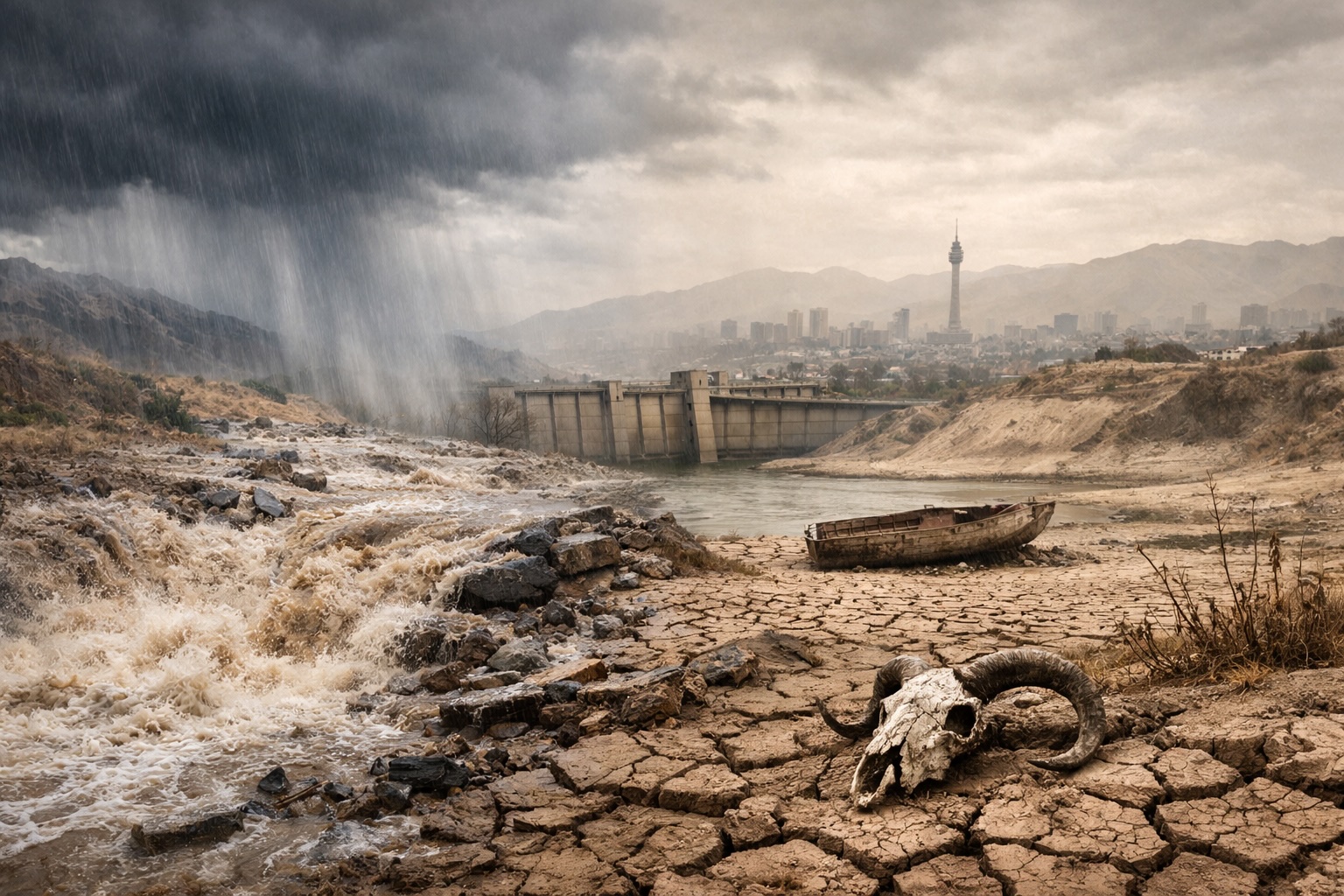
Yle is lying: one rainfall does not save a sixth year of drought
24.3.2026 | yirah.fi
On 23 March 2026, Yle published an article headlined "Iran's severe drought easing, heavy rains on the way." The article reports that a rain system is approaching southern and western Iran, bringing heavy precipitation of over one hundred millimetres. It mentions that light rains have fallen in recent days. It notes that the northeast, where the drought has been worst, will receive less rain.
The headline is a lie.
What Yle left out
Iran is in its sixth consecutive year of drought. The 2024–2025 water year registered 81 per cent below the historical average in precipitation. Tehran's five main dams are operating at roughly 10 per cent capacity; the Lar Dam has dried up entirely. Over 70 per cent of Iran's major groundwater formations have been irreversibly over-pumped. President Pezeshkian has publicly warned that Iran has "no alternative" but to relocate the capital away from Tehran — a project analysts estimate would cost 100 billion dollars.
Kaveh Madani, director of the UN University's Water Institute and former Iranian vice president, told Carbon Brief last week that recent rains have momentarily postponed the acute "day zero" threat. But he immediately added: "Many, many places in Iran are in water bankruptcy mode." Water bankruptcy means a state in which water systems have been depleted to a point from which they can no longer recover without causing irreversible environmental damage.
In January 2026, Iran International documented the mechanism that renders individual rainfalls meaningless: rain does not absorb into parched ground but runs off the surface, causing floods. The water stays on top, collects mud and debris, and never reaches the groundwater. Expert Alireza Eskandari stated: "These floods could be used to recharge aquifers. Without preparation, they are simply not utilised."
At the same time, American and Israeli strikes on oil depots near Tehran are contaminating groundwater in ways that will not be remedied for decades. The WHO Director-General has warned of acid rain. On 7 March, a strike destroyed a desalination plant on Qeshm Island, cutting off water to 30 villages. Iran's retaliatory strike damaged a facility in Bahrain. The 56 desalination plants in the Persian Gulf produce over 90 per cent of the drinking water for approximately 100 million people.
In November 2025, World Weather Attribution confirmed that Iran's five-year drought is the worst in recorded history and that climate change has shifted its intensity from "normal" to "extreme" or "exceptional." Without human-caused warming, a comparable drought would recur once every 50 to 100 years. Now it recurs once every ten.
Why one rainfall is not enough
Groundwater recovery requires years of consistent, steady precipitation. A single rain system, however heavy, does not replenish an aquifer drained over six years. It is the equivalent of headlining "famine easing" because someone ate one meal.
Spain offers a recent comparison. After the catastrophic drought of 2022–2024, intense winter rains in 2024–25 filled surface reservoirs rapidly: Spain's dam levels rose above 90 per cent in spring 2025, and Barcelona declared the drought over. Months later, southern Spain's reserves were back to 25–33 per cent. The momentary filling of surface reservoirs is not the end of a drought. It is a reprieve that can last weeks.
Why this matters
The headline is the most important sentence in any article, because it is the only one most readers will ever read. "Iran's severe drought easing" sticks in the mind. It signals: the situation is turning around, no cause for alarm. It normalises a crisis that is existential. The reader moves on. Yle has done its job: reported the weather, stated a fact, filled the column space, shifted attention to the next topic.
That same day, on the same website, among Yle's most popular stories were an article on discount warehouse prices in Italy, a cat behaviour study from Japan, and Tottenham's football results.
That same day, on Fox News, UN Water Institute director Kaveh Madani warned that Iran may strike Middle Eastern desalination plants within days, potentially collapsing water supply across vast regions.
That same day, the WMO published its State of the Global Climate 2025 report, confirming that climate change is accelerating.
Yle chose to headline the easing of the drought.
Sources
- Yle: "Iranin hurja kuivuus helpottamassa, runsaita sateita tulossa" (23.3.2026)
- Carbon Brief: "Q&A: How climate change and war threaten Iran's water supplies" (March 2026)
- Iran International: "After the drought came the floods: why rain is no panacea" (January 2026)
- World Weather Attribution: "Human-induced climate change compounded by socio-economic water stressors increased severity of 5-year drought in Iran" (November 2025)
- World Resources Institute: "Iran War Could Worsen Middle East's Water Crises" (March 2026)
- Carnegie Endowment: "Iran's Water Crisis Is a Warning to Other Countries" (November 2025)
- Yale E360: "After Ruining a Treasured Water Resource, Iran Is Drying Up" (2026)
- NIAC: "Iran's Escalating Water Crisis Amid Historic Drought" (November 2025)
- Fox News / Kaveh Madani: Iran's threat of "water war" (23.3.2026)
24 March 2026