Romans 13: How the Bible Is Once Again Being Turned into a Tool of Power
This article is a continuation of our earlier text on Romans 13.
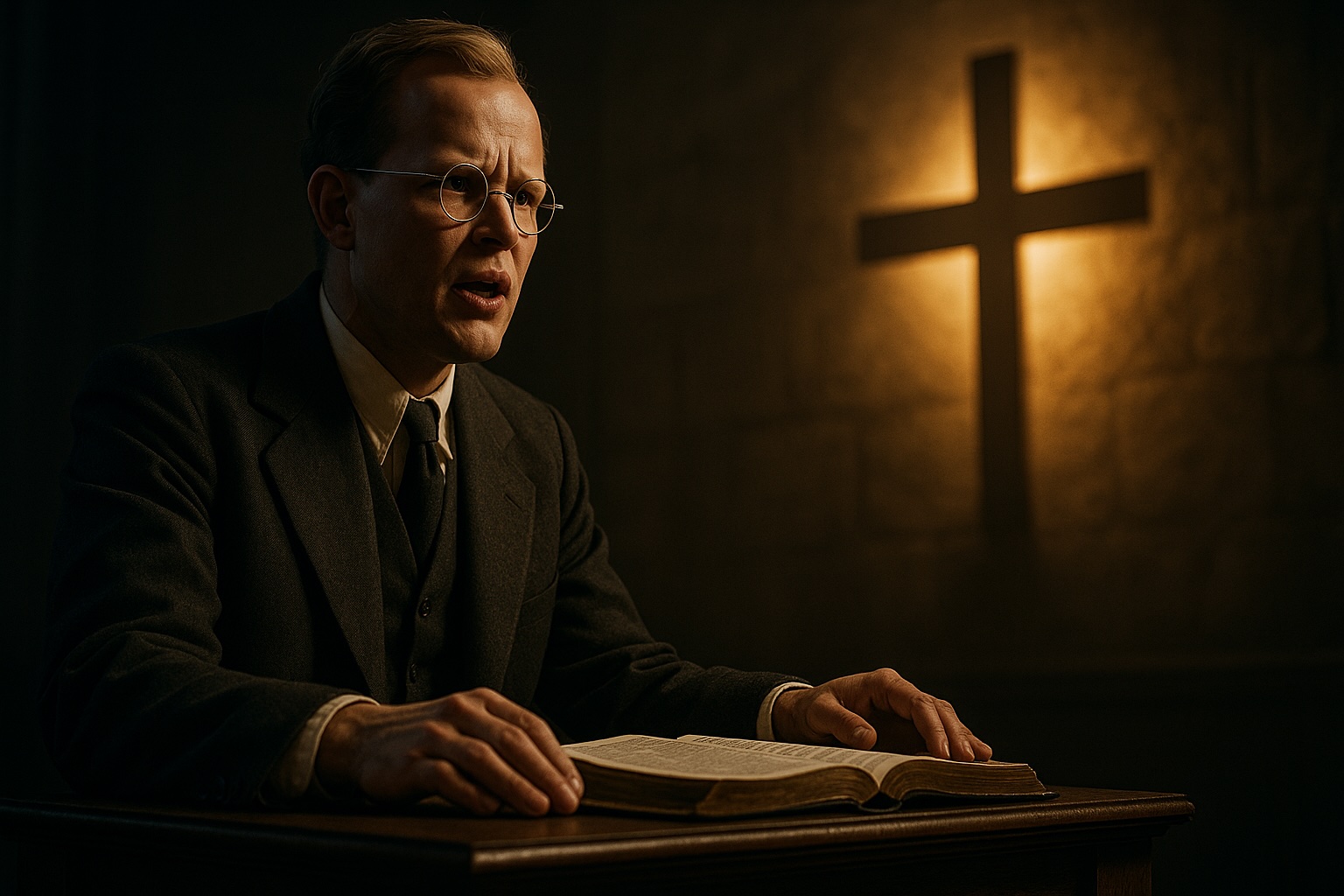
In Berlin in 1934, a young German pastor named Dietrich Bonhoeffer stood in the pulpit and proclaimed words that would ultimately cost him his life: "Only he who cries out for the Jews may sing Gregorian chants." His words were a direct challenge to German Christians who had begun interpreting Romans 13 in a way that justified the actions of the Nazi regime. Bonhoeffer understood a truth that many were willing to forget: when Scripture is twisted to serve power, the church loses its prophetic voice and becomes an instrument of oppression¹.
This historical moment illuminates a painfully relevant truth today. Finland's new Bible translation, UT2020, has done something to Romans 13 that bears an alarming resemblance to the darkest chapters of the past. This translation does not merely interpret — it alters the very nature of the text in a way that serves authoritarian power. It adds words that do not exist in the original, changes meanings, and creates a theological justification for total obedience. This is not a minor slip but a grave spiritual deception with potentially catastrophic consequences.
The original Greek word ὑποτάσσω (hypotassō), which appears in Romans 13:1, is originally a military term. It means to arrange oneself in order, to fall into rank — not slavish submission. The same verb is used when Paul urges Christians to "order themselves" with one another in love. It is about order within society, not absolute obedience. Yet UT2020 translates it as: "Everyone must submit to the orders of those in power and the authorities." The word "orders" has been inserted into the text — it does not exist anywhere in the original Greek².
This addition fundamentally changes the nature of the text. Paul was writing to a congregation in Rome, living in the heart of a hostile empire. His instructions aimed to help Christians live in peace and bear witness to the Gospel without unnecessary conflict. He was not teaching blind obedience but wise navigation through a difficult situation. Let us remember that this same Paul wrote in Ephesians: "For we wrestle not against flesh and blood, but against principalities, against powers [ἐξουσίας]" (Eph. 6:12, KJV). The very same Greek word ἐξουσία (exousia), used in Romans 13:1 to describe earthly powers, appears here describing our spiritual enemies³.
Historical perspective reveals how dangerous the misinterpretation of Romans 13 is. After Emperor Constantine's "conversion" in 313 AD, a process began in which the church traded its prophetic voice for political power. Romans 13 became a tool for legitimising authority. During the Middle Ages, this text was used to justify the Inquisition, witch hunts, and the Crusades. Kings claimed a divine right to rule, and the church provided it under the cover of Romans 13⁴.
Defenders of slavery in the 18th and 19th centuries appealed to the same text. They argued that since slavery was a legal institution approved by the authorities, Christians were obliged to submit to it. William Lloyd Garrison, an abolitionist, wrote in 1845: "If Romans 13 means what the slaveholders claim, then the Bible is the devil's book, not God's"⁵. His words were harsh, but they reveal how deeply the abuse of this text violates the very heart of the Gospel.
The apartheid regime in South Africa used the same argument. The Dutch Reformed Church taught that racial segregation was the will of God and that Romans 13 obligated Christians to obey apartheid laws. Desmond Tutu and other prophetic voices resisted this interpretation, but the price was steep. Many Christians were imprisoned, tortured, and killed because they refused to accept unjust laws in the name of "God's will"⁶.
The experience of Nazi Germany is particularly instructive. The "German Christians" movement taught that Hitler was God's gift to Germany and that Romans 13 demanded obedience to him. Reichsbischof Ludwig Müller declared in 1934: "Christ has come to us in the form of Adolf Hitler"⁷. Against this backdrop, the resistance of Bonhoeffer and the Confessing Church takes on its true proportions. They understood that when the state demands what belongs to God, a Christian must say no — even if it costs their life.
The UT2020 translation continues this dark legacy, on the path paved by Nazi Germany. "The authorities are on God's mission" transforms the original word διάκονος (diakonos), meaning servant, into something approaching a sacred agent. This is the same word used for servants of the congregation. UT2020 creates the impression that government officials operate under a special divine mandate. "No one comes to power except by the will of God" transforms God's permission into active will. This is a theologically dangerous shift that blurs the line between what God permits and what He truly wills⁸.
Jacques Ellul, a Christian philosopher and social scientist, wrote in his work "Anarchy and Christianity": "The state is part of the world whose prince is Satan. God permits its existence to restrain chaos, but that does not make it holy"⁹. Ellul understood that the Christian's relationship with power is always one of tension. We respect order, but we acknowledge only one Lord.
The politics behind this translation work reveal deeper forces — the spirit of antichrist at work throughout the Bible Society and the translation team. Who benefits from teaching Christians to be uncritically obedient? Why, precisely now — when digital surveillance, social credit systems, and centralised control are expanding — is the Bible being translated to support totalitarianism? UT2020 was not born in a vacuum but as part of a broader societal shift. It is preparing Christians to accept a level of control that would have been unthinkable before¹⁰.
The real tragedy is faith being replaced by religiosity. Genuine faith challenges injustice, as Jesus did when He overturned the tables of the money changers in the temple. Religiosity, by contrast, seeks a comfortable alliance with power. UT2020 serves religiosity by offering a religious legitimisation for the exercise of power. It transforms prophetic faith into compliant religiosity¹¹.
The Book of Acts shows us the right way. When Peter and John were forbidden to speak in the name of Jesus, they answered: "Whether it be right in the sight of God to hearken unto you more than unto God, judge ye" (Acts 4:19, KJV). Later they declared: "We ought to obey God rather than men" (Acts 5:29, KJV). This was not the exception but the rule in the early church. Christians acknowledged only one Kyrios — Jesus Christ¹².
Oscar Cullmann examined the early Christian attitude toward the state in his classic work "The State in the New Testament." He demonstrated that Christians lived in the tension between two kingdoms. They respected order but never gave to the state what belonged to God. This is why they were persecuted — not because they were anarchists, but because they refused to acknowledge Caesar as Lord¹³.
Stanley Hauerwas has written: "The church is a political community that challenges all other political communities simply by its existence"¹⁴. This is why totalitarian systems always seek either to destroy the church or to make it their ally. UT2020 represents the latter strategy: the church is not destroyed but transformed into a partner of power.
The practical consequences are already visible. During the Covid pandemic, we saw how swiftly fundamental rights could be swept aside in the name of "the common good." Many churches shut their doors without protest, invoking Romans 13. Digital health passes, movement restrictions, bans on gathering — all were accepted because "the authorities are on God's mission." UT2020 provides a theological justification for ever more invasive control¹⁵.
The new UT2020 is revealing in its entirety: it shows us precisely where the antichrist is heading, as it constructs a new world religion.
The critical question is: where is the line? If the "orders" of authorities must be obeyed in the name of God's will, what happens when those orders violate God's law? What happens when the state demands ideological indoctrination of children? When it bans the proclamation of the Gospel as "hate speech"? When it demands participation in acts that the conscience condemns? UT2020 draws no line — it offers an open blessing for absolute and blind obedience¹⁶.
The truth is that Paul never taught the kind of obedience UT2020 demands. He wrote in a context where he sought to prevent unnecessary conflicts, but he never placed the state above God. On the contrary, the entire Epistle to the Romans proclaims the lordship of Christ. "If God be for us, who can be against us?" (Rom. 8:31, KJV). This is not a call to worship the state but an encouragement to stand in truth, even if the whole world stands against us.
William Stringfellow, an American lawyer and theologian, lived through the Vietnam War and witnessed how Romans 13 was used to justify war crimes. He wrote: "The biblical view of power is that it is a fallen, demonic force that God uses temporarily to prevent chaos. It is not sacred but permitted"¹⁷. This distinction is decisive. God permits evil power, as He permitted Pharaoh, but that does not make it good or worthy of obedience when it violates God's law.
Karl Barth, writing in the shadow of Nazi rule, understood this. His famous Barmen Declaration of 1934 rejected the idea that Christians have any Lord other than Jesus Christ. "Jesus Christ, as He is attested to us in Holy Scripture, is the one Word of God which we have to hear, and which we have to trust and obey in life and in death"¹⁸. This declaration cost many of its signatories their freedom or their lives, but it preserved the witness of the church.
Jeremiah once stood at the gates of the temple and proclaimed a truth that no one wished to hear. He exposed how the religious leaders had made the temple a "den of robbers" — a shelter for injustice. They cried "The temple of the Lord, the temple of the Lord!" but rejected the Lord's law. Jeremiah paid a heavy price for speaking the truth, but his words endured and stand in judgement over every generation that trades truth for falsehood¹⁹.
Today we stand at a similar moment. UT2020 represents a spiritual compromise that destroys what remains of the church's voice. It has turned the Bible — meant to set free — into an instrument of enslavement. It makes the Word of God a servant of power. This is a spiritual catastrophe whose consequences reach far into the future.
The Word of God, rightly understood, sets free — it does not enslave. It calls us to be the "light of the world" and the "salt of the earth", not lapdogs of power. It reminds us that we are "strangers and pilgrims" in this world, citizens of the Kingdom of God, whose primary allegiance belongs to Christ²⁰.
Dietrich Bonhoeffer, sitting in a Nazi prison awaiting his execution, wrote: "Cheap grace is the deadliest enemy of our Church"²¹. Cheap grace accepts everything, demands nothing, challenges nothing. UT2020 offers cheap grace to power: "Do what you please — God is on your side." Costly grace, the kind Bonhoeffer wrote of, costs everything. It demands truth, justice, love. It does not bow before power but stands firm, even if it costs one's life.
The question before us is: do we choose cheap grace or costly grace? Do we accept the comfortable religiosity that UT2020 offers, or do we stand in truth, whatever the cost? History condemns those who choose comfort over truth, but it remembers and honours those who stood in truth when everything was against them.
"Woe unto them that call evil good, and good evil" (Isa. 5:20, KJV), warns the prophet. UT2020 does precisely this with Romans 13. It calls slavery obedience, submission piety, the worship of power the will of God — but we who know the truth cannot be silent. We must speak, write, and bear witness. We must expose the lie and proclaim the truth. For the truth shall make you free, and Christ has set us free unto freedom.
- Metaxas, Eric. (2010). Bonhoeffer: Pastor, Martyr, Prophet, Spy. Thomas Nelson. pp. 240-241.
- Kittel, Gerhard, and Friedrich, Gerhard, eds. (1964-1976). Theological Dictionary of the New Testament. Trans. Geoffrey W. Bromiley. Eerdmans. Vol. 8, pp. 39-46.
- Arnold, Clinton E. (1992). Powers of Darkness. InterVarsity Press. pp. 87-103.
- MacCulloch, Diarmaid. (2009). Christianity: The First Three Thousand Years. Viking. pp. 291-342.
- Garrison, William Lloyd. (1845). "The Bible and Slavery". The Liberator, March 14, 1845.
- De Gruchy, John W. (2005). The Church Struggle in South Africa. 25th Anniversary Edition. Fortress Press. pp. 58-94.
- Scholder, Klaus. (1988). The Churches and the Third Reich. Vol. 2. Fortress Press. p. 122.
- UT2020 Raamatunkäännös. (2020). Suomen Pipliaseura ja Kirkon keskusrahasto.
- Ellul, Jacques. (1991). Anarchy and Christianity. Trans. Geoffrey W. Bromiley. Eerdmans. pp. 45-46.
- Zuboff, Shoshana. (2019). The Age of Surveillance Capitalism. PublicAffairs. pp. 376-397.
- Kierkegaard, Søren. (1991). Practice in Christianity. Trans. Howard V. Hong. Princeton University Press. pp. 211-213.
- Bruce, F.F. (1988). The Book of Acts. NICNT. Eerdmans. pp. 96-97, 116-117.
- Cullmann, Oscar. (1956). The State in the New Testament. Charles Scribner's Sons. pp. 50-70.
- Hauerwas, Stanley. (1983). The Peaceable Kingdom. University of Notre Dame Press. p. 99.
- Agamben, Giorgio. (2020). Where Are We Now? The Epidemic as Politics. ERIS. pp. 43-62.
- O'Donovan, Oliver. (1996). The Desire of the Nations. Cambridge University Press. pp. 146-157.
- Stringfellow, William. (1973). An Ethic for Christians and Other Aliens in a Strange Land. Word Books. pp. 89-90.
- Barth, Karl. (1934). "The Barmen Declaration". In Cochrane, Arthur C., The Church's Confession Under Hitler. Westminster Press, 1962. pp. 237-242.
- Brueggemann, Walter. (1998). A Commentary on Jeremiah: Exile and Homecoming. Eerdmans. pp. 64-73.
- Elliott, John H. (1990). A Home for the Homeless: A Social-Scientific Criticism of 1 Peter. Fortress Press. pp. 101-104.
- Bonhoeffer, Dietrich. (1995). The Cost of Discipleship. Trans. R.H. Fuller. Touchstone. p. 43.