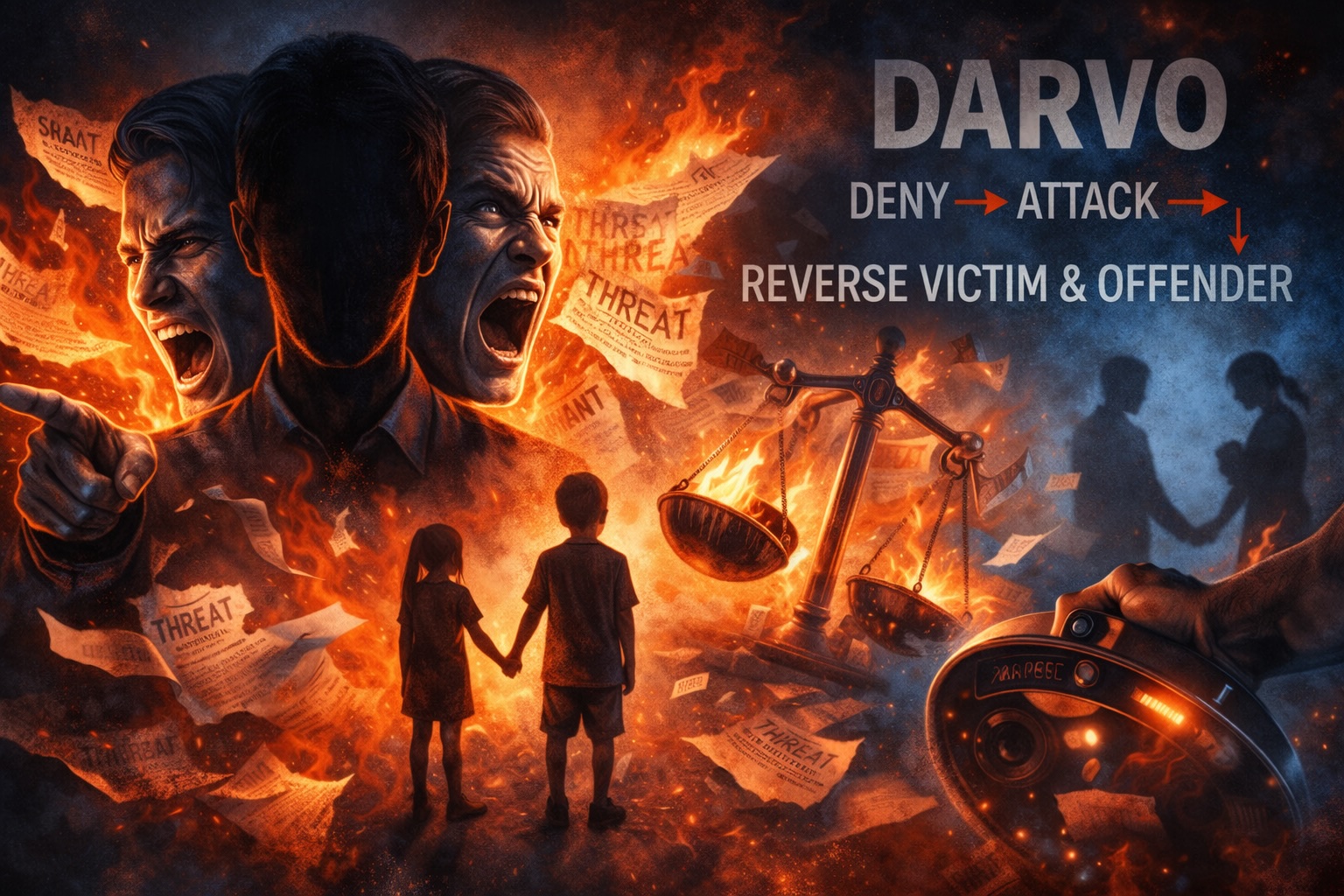
When the Mask Cracks: DARVO, Narcissistic Collapse, and the Anatomy of Manipulative Parenting
A Case Study of a Threatening Letter and Its Psychological Analysis
ABSTRACT
This article examines the manipulation techniques employed by narcissistic personalities in the context of family law, with particular focus on the DARVO technique (Deny, Attack, Reverse Victim and Offender) and its manifestation during narcissistic collapse. Through a detailed, anonymised case study, the article analyses how a professionally high-ranking individual responded to the initiation of a regulatory investigation by sending a threatening letter under a fabricated identity.
The analysis reveals several distinct "personas" — contradictory psychological states within the letter — that illustrate the dynamics of narcissistic collapse. The article demonstrates how rational thought is overridden in the midst of emotional crisis, and how the perpetrator paradoxically exposes themselves through the very actions intended to protect them.
In a broader context, the article examines how two psychologically unstable parents can operate in concert, using children as instruments to harm their former partners. The article connects the DARVO technique, parental alienation, custodial harassment, and Factitious Disorder Imposed on Another (FDIA) into a unified framework in which the best interests of the child are systematically disregarded.
Keywords: DARVO, narcissistic collapse, manipulation, parental alienation, custodial harassment, FDIA, personality disorders, family law
I. INTRODUCTION: DARVO — The Basic Formula of Manipulation
1.1 Definition of the DARVO Technique
DARVO is a manipulation technique identified and named by psychologist Jennifer Freyd in 1997, used particularly by abusers when held accountable for their actions. The acronym stands for:
| Letter | English | Description |
|---|---|---|
| D | Deny | The perpetrator denies everything |
| A | Attack | The perpetrator attacks the accuser |
| R-V-O | Reverse Victim and Offender | The perpetrator presents themselves as the victim |
DARVO is an especially effective manipulation technique because it:
- Diverts attention away from the original offence
- Confuses the victim and bystanders
- Activates defence mechanisms in the accuser
- Creates a narrative in which the perpetrator is the victim
Freyd's research demonstrates that DARVO is particularly prevalent in situations where the perpetrator holds a position of power over the victim — such as a parent's relationship with a child or professional authority.
1.2 DARVO in the Family Law Context
Family law disputes provide fertile ground for the DARVO technique. When one parent files a report about the other parent's conduct — whether a child protection report, a complaint to a regulatory authority, or a criminal report — the DARVO response follows a typical pattern:
Phase 1: DENY
- "These are baseless accusations"
- "Nothing happened"
- "This is entirely fabricated"
Phase 2: ATTACK
- "The reporter is unstable/paranoid/psychotic"
- "This is a smear campaign"
- "The reporter is trying to harm me"
Phase 3: REVERSE VICTIM AND OFFENDER
- "I am the victim here"
- "My reputation has been damaged"
- "I need protection"
This pattern is so consistent that recognising it is both possible and essential for all professionals working in family law.
1.3 Purpose of the Article
This article:
- Analyses in detail a real threatening letter as a manifestation of the DARVO technique. The original threatening letter is included in anonymised form as part of the article.
- Identifies the psychological "personas" that emerge in the letter
- Explores the dynamics of narcissistic collapse and its significance in exposing manipulation
- Connects the DARVO technique to the broader context: parental alienation, custodial harassment, and FDIA
- Provides tools for recognising manipulation — for professionals and victims alike
II. NARCISSISTIC AND PSYCHOPATHIC PARENTING
2.1 Definitions
Narcissistic Personality Disorder (NPD) is a personality disorder as defined in the DSM-5, characterised by:
- Grandiosity and inflated self-importance
- A constant need for admiration
- Lack of empathy
- Sense of entitlement
- Exploitation of others for personal gain
Psychopathic traits (Hare PCL-R) include:
- Superficial charm
- Pathological lying
- Manipulativeness
- Callousness
- Irresponsibility
- Impulsivity
"Covert narcissist" is a term used to describe an individual whose narcissistic gratification comes from the victim role — from the constant pursuit of attention and sympathy through suffering.
2.2 The Child as an Instrument
For the narcissistic and psychopathic parent, a child is not an independent, beloved individual but an instrument for satisfying various needs:
| Need | The child's role |
|---|---|
| Narcissistic gratification | Maintaining the image of the "perfect parent" |
| Control | A means of controlling the former partner |
| Revenge | An instrument for harming the former partner |
| Attention | A source of attention (e.g., the mother/father of a "sick child") |
| Identity | An extension of their own identity, not a separate person |
This instrumentalisation is extremely damaging to the child, who learns that their own feelings, needs, and wishes have no value — that they exist solely to serve the parent's needs.
2.3 The Difficulty of Identification
Identifying a narcissistic or psychopathic parent is exceptionally difficult for several reasons:
1. The "good parent" mask
- Outwardly caring, involved, "perfect"
- Social media full of images of a "happy family"
- Professionals see only the façade
2. Professional status as a shield
- Training in healthcare, law, or social services
- Knows how to "speak the right language" with authorities
- Protected by professional collegiality
3. Manipulation skills
- Charm and persuasiveness
- Ability to read other people
- Narrative control
4. DARVO works
- The first story is usually believed
- The victim appears "unstable" when reacting
- The system grows weary of "feuding parents"
III. PARENTAL ALIENATION AND CUSTODIAL HARASSMENT
3.1 Definition of Parental Alienation
Parental alienation refers to the process in which one parent systematically damages the child's relationship with the other parent. Richard Gardner first described the phenomenon in 1985, and current research recognises it as a serious form of child maltreatment.
Typical methods of parental alienation include:
- Badmouthing the other parent to the child
- Preventing or obstructing contact
- Enlisting the child as an "ally"
- Excluding the other parent from decision-making
- Creating false memories
3.2 Forms of Custodial Harassment
Custodial harassment is a broader concept encompassing all means by which one parent seeks to harm, control, or subjugate the other parent through the child or in matters concerning the child:
| Form | Example |
|---|---|
| Withholding information | Concealing the child's health records, school records, or other information |
| Financial coercion | Extortion related to child support, hiding expenses |
| Manipulating authorities | False child protection reports, criminal reports |
| Legal intimidation | Threatening letters, "contractual penalties," threats of litigation |
| Social isolation | Damaging the other parent's reputation |
| "Pre-emptive strike" | A pre-emptive attack: accusing the other of what you yourself are doing |
3.3 Case Example: Withholding Information
A particularly insidious form of custodial harassment is concealing a child's records from the other parent. When one parent is a healthcare professional, they may have the ability to:
- Place a "client access restriction" on the child's records in healthcare systems
- Block the other parent's access to the child's health information
- Simultaneously serve as both the child's custodian AND treating physician
This creates a situation where the professional-parent sees everything, while the other parent sees nothing. It is an abuse of information asymmetry and a serious breach of custodial responsibilities.
When a complaint about such conduct is filed with the supervisory authority, it can trigger a powerful reaction — a narcissistic collapse.
IV. WHEN TWO PERPETRATORS ACT IN CONCERT
4.1 The Dynamics of Alliance
In rare but particularly damaging cases, two psychologically unstable individuals can form an alliance against a common "enemy" — typically their former partners. This alliance can form through:
Trauma bonding:
- Both perceive themselves as "victims"
- The shared experience validates both of their narratives
- Mutual support reinforces a distorted sense of reality
Through a common enemy:
- New partners = former partners are now together
- "They have conspired against us"
- A shared project: harming their former partners
4.2 Common Traits
When two manipulative parents operate in collaboration, their behaviour typically shares common features:
| Trait | Manifestation |
|---|---|
| Projection | Both accuse their former partners of what they themselves are doing |
| Victim role | Both present themselves as victims, despite being the perpetrators |
| Children as instruments | Both use children to harm the other |
| Reactions to authorities | Both react aggressively to official proceedings |
| DARVO | Both employ the same manipulation pattern |
4.3 Convergence of Behavioural Patterns
Although individual personalities and methods may differ — one may be "rational" and legally oriented, the other emotional and active on social media — the underlying structure is the same:
- The child is an instrument, not an object of love
- The former partner is an enemy who must be harmed
- One's own actions are always justified, the other's always condemnable
- Authorities are a threat when they do not support one's own narrative
- Collapse occurs when control threatens to break down
V. DARVO IN PRACTICE: Analysis of a Threatening Letter
5.1 Case Background
In the following, we analyse a real, anonymised case in which a professionally high-ranking individual responded to the initiation of a regulatory investigation.
Context:
- Person A is a professional with access to healthcare systems
- Person A has concealed the shared children's records from their former partner
- The former partner and their current partner have filed a complaint with the supervisory authority
- The authority has accepted the complaint for investigation
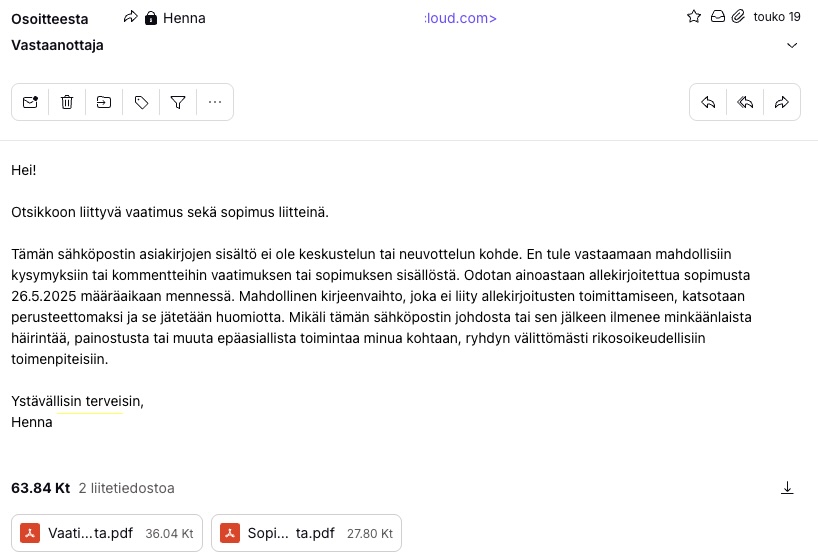
Response:
- Person A sends a threatening letter
- The letter comes from a "fabricated person" (an invented name)
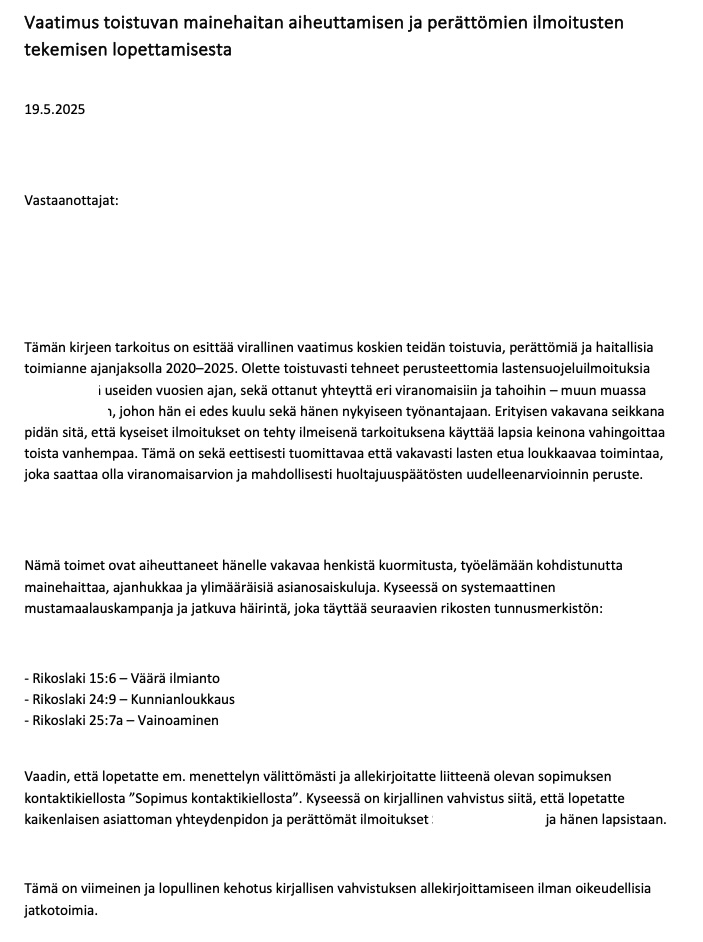
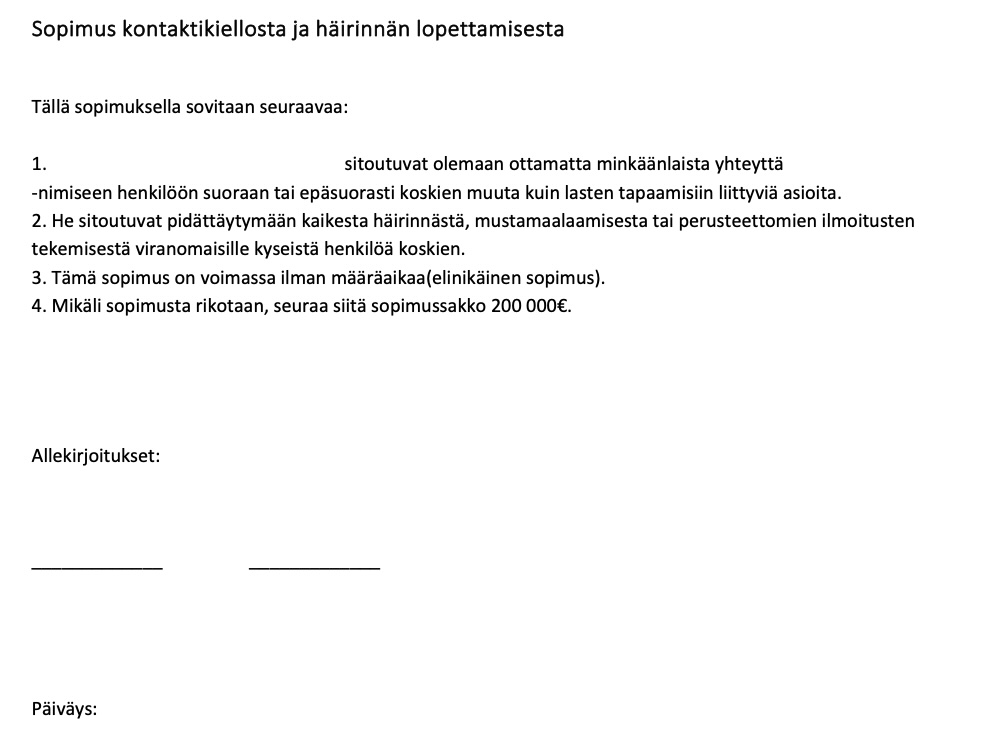
- The letter contains a demand for a "lifelong agreement" and a €200,000 contractual penalty
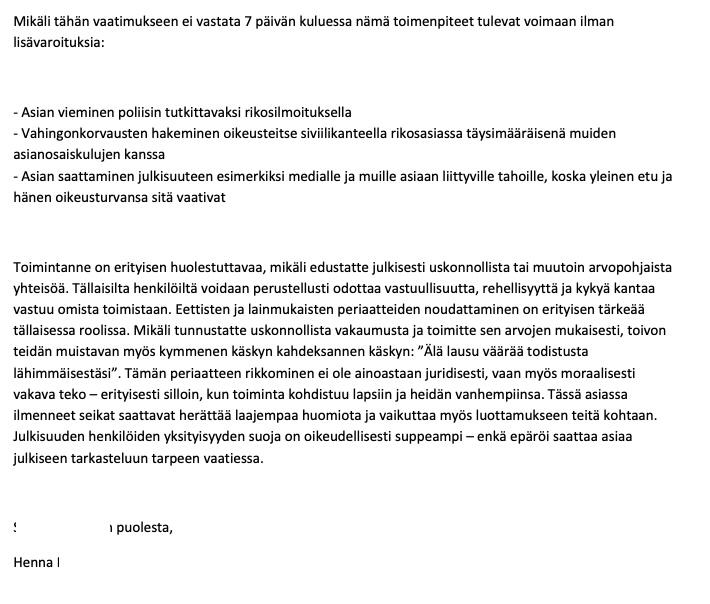
- The letter threatens legal action, public exposure, and "immediate criminal proceedings"
5.2 DARVO Analysis of the Letter
DENY
Denial manifests in the letter as claims that the actions of those who filed the complaint are:
"Repeated, baseless, and harmful actions"
"Groundless child protection reports"
"A systematic smear campaign"
Notably, the letter at no point addresses what Person A has actually done (withholding information, custodial harassment, parental alienation, etc.). Instead, all attention is redirected to the alleged actions of those who filed the complaint.
ATTACK
The attack is the dominant element of the letter:
"With the apparent purpose of using children as a means to harm the other parent"
This is classic projection: the perpetrator accuses others of precisely what they themselves are doing.
"This is both ethically reprehensible and conduct that seriously violates the best interests of the children"
Moral superiority combined with legalistic language.
Threats:
- Criminal report
- Damages through litigation
- "Bringing the matter to public attention"
- €200,000 contractual penalty
"I will not hesitate to bring this matter to public scrutiny if necessary"
REVERSE VICTIM AND OFFENDER
The reversal of victim and offender is the psychological core of the letter:
"These actions have caused her severe emotional distress, reputational damage in her professional life, loss of time, and additional legal expenses"
The person who has concealed the children's records from the other parent presents themselves as the victim who has been harmed.
"Should any form of harassment, intimidation, or other inappropriate conduct directed at me arise as a result of or following this email..."
The person who sends a threatening letter under a fabricated identity warns others about harassment.
5.3 The Anatomy of Projection
The letter is a textbook example of psychological projection: a defence mechanism in which a person transfers their own unacceptable thoughts, feelings, or actions onto others.
| What the author accuses others of doing | What the author is actually doing |
|---|---|
| "Using children as a means to cause harm" | Concealing the children's records from the other parent |
| "Baseless reports" | Sending a letter under a fabricated identity |
| "Harassment and intimidation" | Threatening legal action and public exposure |
| "Smear campaign" | Accusing others of crimes without evidence |
| "False witness" | Impersonating a person who does not exist |
The formula of projection: "What I myself am doing, I accuse you of doing."
This mechanism serves two psychological purposes:
1. Conscience avoidance: By transferring "evil" onto others, one's own actions remain "good"
2. Pre-emptive strike: By accusing others first, their subsequent accusations appear to be "retaliation"
5.4 The Role of Social Media
The narcissistic individual often uses social media as part of their DARVO strategy. Typical features include:
Constructing the victim role:
- Posts about one's own "suffering" and "heartbreak"
- References to "difficult relationships"
- Documenting a "healing journey"
Implicit contempt for the former partner:
- Posts about "emotionally distant" or "manipulative" people
- A "self-worth" narrative that implies the other's worthlessness
- "Setting boundaries" with people who "don't deserve" one's time
Projection as public performance:
- Selling "trauma attachment" content while simultaneously creating one
- Speaking about "recognising manipulation" while actively manipulating
- Emphasising "healthy boundaries" while violating every boundary
The complete absence of the child:
- In a crisis, a healthy parent focuses on the child
- The narcissistic parent focuses on themselves and their former partner
- The child is not in their thoughts: the child is an instrument
VI. FDIA AND GROOMING: THE SHARED ROOTS OF CHILD MANIPULATION
6.1 FDIA in Brief
Factitious Disorder Imposed on Another (FDIA), formerly Munchausen syndrome by proxy, is a serious form of child maltreatment in which a caregiver:
- Fabricates or exaggerates the child's symptoms
- Or actively induces illness in the child
The typical motivations of an FDIA perpetrator are:
- Gaining attention and sympathy as the "parent of a sick child"
- Controlling medical personnel
- Maintaining the victim role
Healthcare professionals are overrepresented among FDIA perpetrators: they have both the knowledge and access to the means.
6.2 The Grooming Process
"Grooming" refers to the process by which an abuser prepares their victim for abuse. Although the term is most commonly used in the context of sexual abuse, the same mechanisms operate in all forms of child manipulation:
| Phase | Grooming | FDIA | Parental alienation |
|---|---|---|---|
| Trust | "I'm your friend" | "Mummy/Daddy knows best" | "Only I understand you" |
| Isolation | "Our secret" | "The doctors don't understand" | "Dad/Mum doesn't care about you" |
| Dependency | "You need me" | "You're ill, you need treatment" | "You can't cope without me" |
| Normalisation | "This is normal" | "Your illness is part of who you are" | "It's normal to hate the other parent" |
6.3 The Dangerous Narrative of "Self-Determination"
A particularly dangerous manipulation technique is the misuse of "self-determination":
"You have the right to decide for yourself"
"Adults don't understand you"
"You're more mature than others your age"
"The relationship between us is special"
These phrases come straight from the professional abuser's toolkit. The large-scale abuse cases uncovered in Rotherham and elsewhere in Britain demonstrated how authorities interpreted the mass exploitation of children as young as eleven as "a lifestyle of young people making informed choices."
The same mechanism operates in parental alienation: a child's "choice" not to see the other parent is interpreted as genuine, even though it is the product of manipulation.
6.4 FDIA, Parental Alienation, and Custodial Harassment — The Same Foundation
All of these phenomena share the same psychological foundation:
| Element | Manifestation |
|---|---|
| Child as instrument | The child's wellbeing is not the goal but a side issue |
| Need for control | Controlling the child, the other parent, and/or professionals |
| Need for attention | The role of "victim" or "hero" |
| Lack of empathy | The child's actual needs go unseen |
| Projection | One's own actions are attributed to others |
When two separate parents share these traits and operate in collaboration, children are in an especially vulnerable position, because protection comes from neither side — both are using the children for their own purposes.
VII. NARCISSISTIC COLLAPSE
7.1 Definition
Narcissistic collapse is a psychological crisis state that arises when a narcissistic individual's "perfect" self-image and façade are threatened with exposure. It can be triggered by:
- Exposure: The truth about the perpetrator's actions comes to light
- Abandonment: A significant person rejects or leaves them
- Failure: Professional or social failure
- Loss of control: The situation spirals beyond their grasp
- Humiliation: Public shame or criticism
For the narcissist, these experiences are not ordinary disappointments — they are existential threats, because the narcissistic identity is built upon "perfection."
7.2 The Dynamics of Collapse
When a narcissistic individual perceives a threat to their identity, a series of psychological reactions occurs:
Phase 1: Denial
- "This can't be true"
- "They are wrong"
- Rejection of reality
Phase 2: Rage
- Intense emotional reaction
- Attack on the "guilty parties"
- Disproportionate response to the situation
Phase 3: Impulsive action
- Judgement fails
- Actions that, in a rational state, would be recognised as foolish
- Paradoxical self-exposure
Phase 4: Victim role
- "I am being wronged"
- Seeking sympathy
- Reversing the narrative
7.3 Case Analysis: The Threatening Letter as a Manifestation of Narcissistic Collapse
The threatening letter analysed through the lens of narcissistic collapse (The full content of the threatening letter, including the email, can be found at the end of the article in the Appendices)
Trigger:
- Complaint filed with the supervisory authority
- Threat to professional identity
- Loss of control
Signs of collapse in the letter:
| Sign | Manifestation in the letter |
|---|---|
| Disproportionate response | €200,000 penalty, "lifelong agreement" |
| Impulsivity | Fabricated identity, an easily exposed lie |
| Grandiosity | "Public figure," moral authority |
| Rage | Threats of legal action, public exposure |
| Need for control | "No negotiation," "I will not answer questions" |
| Victim role | "Harassment against me," "reputational damage to me" |
| Detachment from reality | Religious references while lying |
7.4 The "Personas" in the Letter — A Fragmented Psyche
During narcissistic collapse, the individual's psyche fragments: different "personas" or states alternate, often contradictorily. Several distinct "voices" can be identified in the threatening letter:
Persona 1: "The Lawyer"
"The contents of the documents in this email are not subject to discussion or negotiation."
"Any possible correspondence... will be disregarded."
Traits:
- Cold, formal language
- Pseudo-legal terminology
- An illusion of control and authority
Psychological function:
- Protects against emotional vulnerability
- Creates an impression of rationality
- Attempts to intimidate through the weight of "legality"
Persona 2: "The Victim"
"These actions have caused her severe emotional distress..."
"Should... any form of harassment... directed at me arise..."
Traits:
- Emphasis on suffering
- Seeking sympathy
- Displaying vulnerability (paradoxically, in a threatening letter)
Psychological function:
- Activates empathy in potential readers
- Justifies the attack: "because I have been wronged"
- Reverses roles: the one making threats is the "victim"
Persona 3: "The Tyrant"
"I will not respond to any questions or comments."
"I expect only a signed agreement."
"...I will immediately initiate criminal proceedings."
Traits:
- Absolute control
- No dialogue, only obedience
- Threats and coercion
Psychological function:
- Restores the sense of control
- Compensates for internal chaos with external dominance
- Reflects primal rage
Persona 4: "The Preacher"
"...I would ask you also to remember the eighth of the Ten Commandments: 'Thou shalt not bear false witness against thy neighbour.'"
"Adherence to ethical and lawful principles is particularly important..."
Traits:
- Moral superiority
- Religious authority
- A didactic, sermonising tone
Psychological function:
- Positions the self as morally superior
- Projects own guilt onto others ("false witness")
- Hypocrisy: preaches while lying about their own identity
7.5 Contradictions Between Personas — The Collapse Exposed
The contradictions between these "personas" reveal the collapse:
| "The Lawyer" says | "The Victim" says | Contradiction |
|---|---|---|
| "I will not answer questions" | A two-page explanation | Cannot stay silent |
| "No negotiation" | Demands a signature | Needs validation |
| "This matter is not open for discussion" | Threatens public exposure | Craves attention |
| "The Tyrant" says | "The Preacher" says | Contradiction |
|---|---|---|
| "I will take immediate action" | "Ethical principles" | Threatens, yet preaches ethics |
| "Sign or else" | "Thou shalt not bear false witness" | Coerces, yet demands honesty |
| "The Victim" says | Reality | Contradiction |
|---|---|---|
| "Harassment against me" | Sends a threatening letter | The one making threats is the "victim" |
| "Reputational damage to me" | Sends the letter under a fabricated identity | A liar demands honesty |
These contradictions are not conscious strategies — they are manifestations of a fragmented psyche. In the midst of collapse, different "states" alternate without any coherent whole.
7.6 Why Collapse Reveals
Narcissistic collapse is paradoxically the perpetrator's "best" moment to be detected, because:
1. Impulsivity overrides judgement
- A normally calculating individual makes foolish mistakes
- The fabricated identity is easily exposed
- The email trail is recorded
2. Emotions bleed through
- The "lawyer" mask fails: emotional content shows through
- Rage and fear are audible beneath the formal language
- Contradictions become visible
3. Projection reveals
- The accusations tell us about the perpetrator themselves
- "False witness" — sends a letter under a fabricated identity
- "Using children as instruments" — conceals the children's records
4. A document is created
- Written evidence of irrational behaviour
- Can be analysed after the fact
- Reveals the personality structure
7.7 The Psychological Significance of Collapse
What does narcissistic collapse tell us about the state of a person's psyche?
1. Lack of integration
- A healthy psyche can integrate different aspects of the self
- The narcissistic psyche is fragmented: "good self" vs. "forbidden self"
- Collapse exposes this fragmentation
2. Impaired reality testing
- Belief in one's own omnipotence ("a €200,000 penalty will work")
- Belief that one won't be caught (fabricated identity)
- Belief in one's own moral superiority (preaches while lying)
3. Lack of empathy
- No ability to see how one's actions appear to others
- No understanding of how transparent the letter is
- No ability to predict others' reactions
4. Primitive defence mechanisms
- Denial, projection, splitting
- These do not function in the adult world
- They are exposed under pressure
VIII. TOOLS FOR IDENTIFICATION
8.1 DARVO Identification
When encountering an individual who responds to accusations or investigation:
Ask yourself:
- Do they deny everything?
- Admit nothing, not even partially
- "Completely baseless," "utter lies"
-
Take no responsibility whatsoever
-
Do they attack the accuser?
- Ad hominem: attacking the person, not the argument
- "Unstable," "paranoid," "psychotic"
-
Threats: legal action, public exposure, "consequences"
-
Do they present themselves as the victim?
- "I have been harmed"
- "Harassment against me"
- "I have suffered so much"
If all three are present: probable DARVO.
8.2 Signs of Narcissistic Collapse
| Sign | Question |
|---|---|
| Disproportionate response | Is the reaction far stronger than the situation warrants? |
| Impulsivity | Is the person acting recklessly, to their own detriment? |
| Contradictions | Is the person saying contradictory things within the same context? |
| Fragmentation | Do "styles" or "voices" shift rapidly? |
| Projection | Is the person accusing others of what they themselves are doing? |
| Need for control | Is the person attempting to control the situation through unrealistic means? |
| Grandiosity | Is the person overestimating their own position or influence? |
8.3 Identifying Projection
Rule: Listen carefully to what a manipulative person accuses others of: it is often precisely what they themselves are doing.
| They say | They are likely doing |
|---|---|
| "They manipulate" | Manipulating |
| "They lie" | Lying |
| "They use children" | Using children |
| "They are unstable" | Having serious problems of their own |
| "They are stalking me" | Stalking the other |
8.4 The Importance of Documentation
When dealing with a manipulative individual:
- Save all written communication
- Emails, messages, letters
- Metadata (dates, times)
-
Do not alter or delete anything
-
Document events
- Date, time, place
- Who was present
-
What happened, what was said
-
Identify patterns
- Do the same themes recur?
- Is the DARVO pattern visible?
-
How does projection manifest?
-
Store evidence securely
- Multiple copies
- In different locations
- Known to trusted individuals
IX. CONCLUSIONS
9.1 Key Findings
1. DARVO is systematic and identifiable
The reactive pattern of a manipulative individual — deny, attack, reverse victim and offender — is so consistent that recognising it is both possible and essential. When this pattern is identified, the power of the manipulation diminishes.
2. Narcissistic collapse exposes the perpetrator
Paradoxically, the best moment to identify a narcissistic manipulator is during collapse. When the mask threatens to crack, impulsivity overrides judgement, and the individual makes mistakes that reveal their true nature — such as sending a threatening letter under a fabricated identity.
3. Persona fragmentation is diagnostic
When an individual's communication displays multiple contradictory "voices" — the lawyer, the victim, the tyrant, the preacher — it reveals psychic fragmentation. A healthy person's communication is coherent; in the midst of narcissistic collapse, that coherence breaks down.
4. Projection is the key
By listening carefully to what a manipulative person accuses others of, we often receive a precise description of their own behaviour. "False witness," says the person who sends a letter under a fabricated identity. "Using children as instruments," says the person who conceals the children's records.
5. Documentation is protection
The manipulative individual relies on the assumption that their actions will not be documented. Every saved message, letter, and recorded event is evidence that diminishes the power of manipulation and protects victims.
9.2 Recommendations
For Professionals
Child protection services:
- Train staff to recognise DARVO
- Do not allow the first story to define the truth
- Document both parents' reactions in crisis situations
Healthcare:
- Recognise FDIA warning signs
- Take note if symptoms appear only in the presence of one caregiver
- Exercise caution when a parent has a healthcare background
The judiciary:
- Understand the dynamics of narcissistic collapse
- Recognise projection as evidence
- Analyse written material through the lens of "personas"
For Victims and Their Loved Ones
- Document everything: every message, letter, event
- Recognise DARVO: when it is being used against you
- Do not react emotionally: it feeds the perpetrator
- Seek professional help: a lawyer, a psychologist, a support network
- Trust the process: manipulation is exposed over time
9.3 Final Words
The threatening letter analysed in this article is a document of narcissistic collapse. It was written by a person whose professional and personal identity was under threat, and who responded to that threat in a way that paradoxically exposed them.
The letter contains all the elements of the DARVO technique: denial, attack, and assumption of the victim role. It contains multiple contradictory "personas": the lawyer, the victim, the tyrant, and the preacher. It contains complete projection: accusations that describe the perpetrator themselves.
None of this is unique. These patterns repeat in hundreds, thousands, tens of thousands of cases around the world, every day. What is unique here is the documentation — the written evidence that makes analysis possible.
When we understand these patterns, we can recognise them. When we recognise them, we can protect children and victims. When we protect children and victims, we do justice.
A child's right to safety, health, and the love of both parents is absolute. No child should ever be an instrument in the wars of adults.
REFERENCES
DARVO and manipulation
- Freyd JJ. Violations of power, adaptive blindness, and betrayal trauma theory. Feminism & Psychology. 1997;7(1):22-32.
- Harsey SJ, Freyd JJ. Deny, Attack, and Reverse Victim and Offender (DARVO): What Is the Influence on Perceived Perpetrator and Victim Credibility? Journal of Aggression, Maltreatment & Trauma. 2020;29(8):897-916.
- Harsey S, Zurbriggen E, Freyd JJ. Perpetrator Responses to Victim Confrontation: DARVO and Victim Self-Blame. Journal of Aggression, Maltreatment & Trauma. 2017;26(6):644-663.
Narcissism and personality disorders
- Kernberg OF. Borderline Conditions and Pathological Narcissism. New York: Jason Aronson; 1975.
- Ronningstam E. Identifying and Understanding the Narcissistic Personality. Oxford: Oxford University Press; 2005.
- Hare RD. Without Conscience: The Disturbing World of the Psychopaths Among Us. New York: Guilford Press; 1993.
- Vaknin S. Malignant Self-Love: Narcissism Revisited. Prague: Narcissus Publications; 2015.
Parental alienation and custodial harassment
- Gardner RA. Recent trends in divorce and custody litigation. Academy Forum. 1985;29(2):3-7.
- Bernet W, von Boch-Galhau W, Baker AJL, Morrison SL. Parental alienation, DSM-V, and ICD-11. American Journal of Family Therapy. 2010;38(2):76-187.
- Harman JJ, Kruk E, Hines DA. Parental alienating behaviors: An unacknowledged form of family violence. Psychological Bulletin. 2018;144(12):1275-1299.
FDIA
- Feldman MD, Ford CV. Patient or Pretender: Inside the Strange World of Factitious Disorders. New York: John Wiley & Sons; 2000.
- Sheridan MS. The deceit continues: an updated literature review of Munchausen Syndrome by Proxy. Child Abuse & Neglect. 2003;27(4):431-451.
- Bass C, Glaser D. Early recognition and management of fabricated or induced illness in children. Lancet. 2014;383(9926):1412-1421.
Grooming and child abuse
- Craven S, Brown S, Gilchrist E. Sexual grooming of children: Review of literature and theoretical considerations. Journal of Sexual Aggression. 2006;12(3):287-299.
- Jay A. Independent Inquiry into Child Sexual Exploitation in Rotherham 1997-2013. Rotherham Metropolitan Borough Council; 2014.
APPENDICES
Appendix 1: DARVO Identification Form
| Behaviour | Yes | No | Notes |
|---|---|---|---|
| DENY | |||
| Denies everything completely | |||
| Admits nothing, not even partially | |||
| "Completely baseless" | |||
| ATTACK | |||
| Attacks the accuser | |||
| Uses ad hominem arguments | |||
| Threatens legal action | |||
| Threatens public exposure | |||
| REVERSE | |||
| Presents themselves as the victim | |||
| Claims reputational damage | |||
| Accuses the other of harassment | |||
| SUMMARY | |||
| All three elements present? |
Appendix 2: Signs of Narcissistic Collapse
- ☐ Disproportionate response to the situation
- ☐ Impulsive, reckless actions
- ☐ Clear contradictions in words or deeds (pathological lying)
- ☐ Shifting "styles" or "voices" in communication
- ☐ Clear projection (accuses others of what they themselves are doing)
- ☐ Unrealistic need for control
- ☐ Grandiosity (overestimation of own position)
- ☐ Moral superiority combined with their own unethical conduct
If 5 or more: strong indication of narcissistic collapse
Appendix 3: Identifying Projection
Instructions: Record what the individual accuses others of. Compare with their own actions.
| Accusation against others | Their own actions | Projection? |
|---|---|---|
| ☐ Yes ☐ No | ||
| ☐ Yes ☐ No | ||
| ☐ Yes ☐ No | ||
| ☐ Yes ☐ No | ||
| ☐ Yes ☐ No |
Appendix 4: Anonymised original email, demand letter, and agreement
Email
Demand letter page 1
Demand letter page 2
"Agreement"
This article has been written as an anonymised case study. The authors do not take a position on the legal assessment of individual cases. The purpose of the article is to increase understanding of manipulation techniques and the dynamics of narcissistic collapse, so that children and victims can be protected more effectively.