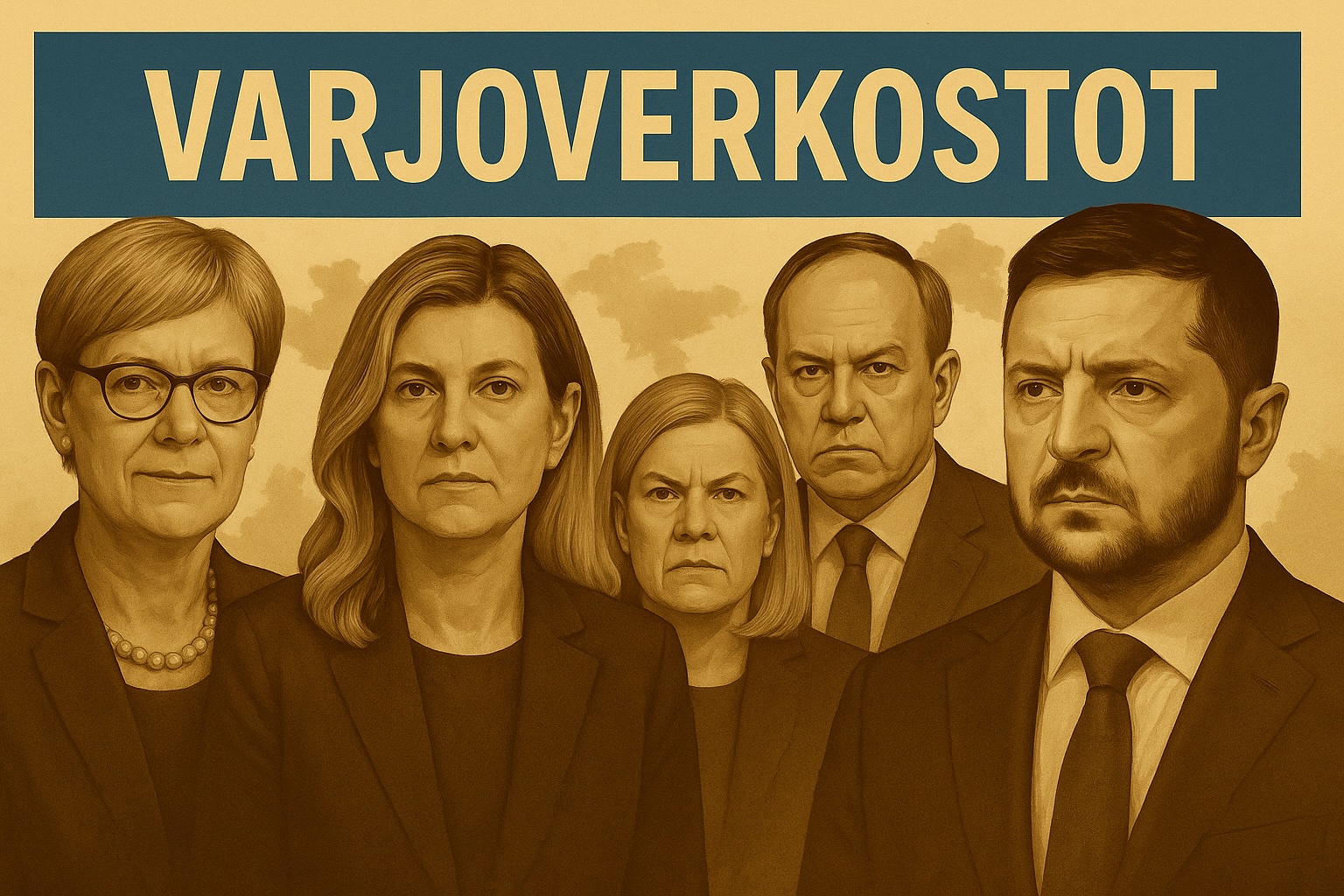
Shadow Networks
An analytical review of Finland-Ukraine charity networks and the risks associated with them
December 2025 – Investigative Analysis
1. Introduction
This analysis examines the connections between Finnish and Ukrainian actors through charitable organisations, communications consultancies, and state-level channels. The aim is to identify structural risks related to donation flows, personal networks, and a lack of transparency.
The analysis is based on public sources: official websites, news articles, corporate registry data, and reports by international investigative journalists. The concerns raised here are substantiated by documented observations and events.
The central finding is this: The Finnish donors who supported the Olena Zelenska Foundation in March 2025 form a tight-knit network in which Nokia-connected board professionals, financial sector lobbyists, and the Miltton consulting firm are deeply intertwined. Meanwhile, on the receiving end in Ukraine, a massive corruption scandal has been uncovered — one that reaches all the way to the president's closest adviser.
2. Olena Zelenska Foundation
2.1 Foundation Profile
The Olena Zelenska Foundation is led by the wife of Ukraine's president and focuses on helping children and families affected by the war. Its flagship project is "School of Superheroes" — educational spaces operating inside hospitals for children with long-term illnesses. By early 2025, there were 17 such centres in 13 cities.
The foundation has worked with over 70 partners from more than 30 countries. Its funders include the government of Liechtenstein, the state of Portugal, South Korean charitable organisations, and now Finnish private donors.
2.2 March 2025: Finnish Donors
In March 2025, Olena Zelenska visited Helsinki for an event organised by Miltton Group. Finnish philanthropists donated funds to establish two new School of Superheroes centres.
The publicly named donors were Anna Lehtonen, Anu Waaralinna, Ellen Järnström, Elsa Millerin säätiö, Johanna Lilja, Julianna Borsos, Kiira Tuohimaa-Leisio, Kirsi Komi, Kitty Salovaara, Lena Jungell, Lotta Kopra, Marjo Miettinen, Sanna-Mari Jäntti, Maya Sviberg-Järnström / Miltton Group, Nina Kurth, Paula Salovaara, Piia-Noora Kauppi, Rafaela Seppälä, Riikka Ihamuotila, Riikka Tieaho, Sari Baldauf, Sophia Jansson, and Valentina Lundström. Some donors chose to remain anonymous.
2.3 Concern: Donor Profile
Among the donors, there is a significant concentration of individuals with Nokia backgrounds and financial sector influence. This is not inherently objectionable, but it raises the question of whether the donation represents genuine civil society solidarity or elite networking in which charity serves as a vehicle for reputation management and influence.
3. Miltton Group – The Intermediary Organisation
3.1 Company Profile
Miltton Group is a Finnish communications and public affairs consultancy founded in 2001. It has grown into Finland's largest marketing communications agency, employing over 400 specialists. The company's defining feature is the so-called "revolving door" — the movement of politicians and public officials into the consultancy's employ.
Notable revolving-door cases include Jan Vapaavuori (National Coalition Party, former Mayor of Helsinki), who joined Miltton's board and became an adviser; Stefan Wallin (Swedish People's Party, former MP and minister), who worked at Miltton; and Elina Moisio (Greens, former ministerial adviser), who became CEO of Miltton Networks.
3.2 Miltton Ukraine
Miltton established its Ukrainian office in July 2023, with official registration completed in November 2023. The company's stated objective is to help Nordic businesses participate in the reconstruction of Ukraine — an estimated €500 billion market and the largest construction project in the world.
Key figures at Miltton Ukraine are Christer Haglund (Chairman of the Board), who previously served as Director of the Nordic Council of Ministers' Estonian office, CEO of Suomen Messut Oyj (Finnish Fair Corporation), and Head of Communications and Public Affairs at Finnair; and Tetiana Tregobchuk (Managing Director), who previously served as Communications Director at Ukraine's largest media company, 1+1 Media.
3.3 Strategic Partnership with EastCham Finland
In November 2024, Miltton and EastCham Finland announced a strategic partnership at the Rebuild Ukraine conference in Warsaw. EastCham Finland is a chamber of commerce formerly known as the Finnish-Russian Chamber of Commerce. It changed its name and redirected its focus towards Ukraine in 2022 following Russia's invasion. Notably, Russia declared EastCham Finland an "undesirable organisation" in September 2023.
3.4 Concern: Miltton's Role
Miltton is not merely an event coordinator. It is an active player connecting political networks, corporate interests, and charity.
Zelenska's visit to Finland and the donation campaign were organised by Miltton. Zelenska was interviewed at the event by Kaius Niemi, former editor-in-chief of Helsingin Sanomat, who is now a partner and Deputy CEO at Miltton. Sanna-Mari Jäntti, Miltton's "Head of New Markets", is herself among the donors.
This raises the question: whose interests does Miltton truly serve, and how does charity intertwine with the company's commercial ambitions in the Ukrainian reconstruction market?
4. Donor Network Analysis
4.1 The Nokia Network
Among the donors are several individuals with current or historical ties to Nokia. Sari Baldauf is the company's current Chair of the Board, while Kirsi Komi's Nokia career ended as far back as 2010.
Sari Baldauf has served as Chair of Nokia's Board since 2020. She led Nokia's network business division from 1998 to 2005. Earlier, she served as Chair of Fortum's Board from 2011 to 2018, becoming the first woman to chair a major Finnish listed company. She has also served on the Supervisory Board of Daimler AG.
Kirsi Komi is a board professional whose Nokia career ended in 2010. She served as General Counsel and executive board member of Nokia Siemens Networks from 2007 to 2010, as Head of Legal Affairs at Nokia Networks from 1997 to 2007, and in various legal roles at Nokia from 1992 onwards. Unlike Baldauf, Komi does not sit on Nokia's current board. Her current board positions include Member of the Board at Metsä Board Oyj, Chair of the Board at Docrates Oy, and Chair of the Board at the Finnish Red Cross Blood Service. She previously served as Vice Chair of the Board at Patria Oyj and Board Member at Citycon Oyj. Komi has stated that she learned a great deal from Sari Baldauf.
4.2 Financial Sector Lobbyist
Piia-Noora Kauppi served as a Member of the European Parliament from 1999 to 2008, representing the National Coalition Party and the EPP. She was the youngest Finnish MEP ever elected at the time. Kauppi moved directly from her MEP role to become CEO of Finance Finland (Finanssiala ry), serving from 2009 to 2022. This transition earned her a "Conflict of Interest of the Year" award from an EU lobbying watchdog.
The Wall Street Journal reported in 2005 that Kauppi proposed amendments to the EU's Anti-Money Laundering Directive that were word-for-word identical to those drafted by the banking industry's lobby group. She currently serves as a partner at Odgers Berndtson (executive search) and holds board positions at UPM Kymmene Oyj, Gofore Oyj, and the SOS Children's Villages Foundation (Chair). She has also been a member of the Trilateral Commission since 2019.
4.3 The Miltton Connection
Sanna-Mari Jäntti is Miltton Group's "Head of New Markets". She appeared among the donors both as a private individual and as a Miltton Group representative alongside Maya Sviberg-Järnström. Her previous roles include Director of World Design Capital 2012, Director of the Guggenheim Helsinki project, and Director of Strategic Projects for the City of Helsinki.
4.4 Network Analysis Conclusion
The donors are not a random collection of private individuals. They form a tight elite network in which the same names, the same companies, and the same boardrooms keep recurring. Baldauf and Komi know each other from Nokia. Kauppi sat on the UPM board, whose chair was Björn Wahlroos. Jäntti is on Miltton's payroll while simultaneously appearing as a donor.
This does not prove illegality, but it does demonstrate that this is not genuine civil society solidarity. It is elite networking in which charity may serve purposes beyond aid.
5. Operation Midas – A Corruption Scandal in Zelenskyy's Inner Circle
5.1 The Investigation Revealed
In November 2025, Ukraine's National Anti-Corruption Bureau (NABU) and the Special Anti-Corruption Prosecutor's Office (SAP) published the results of a 15-month investigation known as Operation Midas. The investigation involved 1,000 hours of wiretaps and over 70 raids.
The investigation uncovered a vast corruption network within Ukraine's energy sector. The key allegations were as follows: a criminal group operated inside the state nuclear energy company Energatom; contractors were extorted for 10–15 per cent of contract values as bribes; and an estimated $100 million was embezzled. The bribery ring extended to the safety operations of the Khmelnytskyi Nuclear Power Plant.
5.2 Key Figures
Timur Mindich is Zelenskyy's former business partner and co-owner of the Kvartal 95 production company. According to NABU, Mindich led the bribery ring. Corruption researchers have long referred to him as the "shadow controller of the energy sector". Mindich fled to Israel after receiving a tip about the impending raids and remains a fugitive.
Oleksiy Chernyshov served as Deputy Prime Minister and was identified on NABU recordings under the codename "Che Guevara". He faces charges of illicit enrichment and is alleged to have received approximately $1.2 million and nearly €100,000 through a money laundering scheme.
Herman Halushchenko served as Energy Minister and Svitlana Hrynchuk served as Justice Minister. Both resigned in the wake of the scandal in November 2025.
5.3 Andriy Yermak's Resignation
Andriy Yermak served as Head of Ukraine's Presidential Office from 2020 to 2025. Politico called him "Kyiv's Grey Cardinal" and Time Magazine named him among the world's 100 most influential people in 2024. He was Zelenskyy's closest adviser and de facto "vice president".
Yermak played a significant role in security negotiations: he led coordination calls with Western national security advisers from Germany, Italy, France, the United Kingdom, Finland, the EU, and NATO. These calls addressed Ukraine's security guarantees, peace negotiations, and military aid.
On 28 November 2025, NABU agents conducted a raid on Yermak's residence in the early hours. That same day, Yermak resigned. Zelenskyy announced the departure in a video statement: "Russia truly wants Ukraine to make mistakes. We will not make mistakes."
NABU possesses wiretap recordings in which a person using the codename "Ali Baba" — believed to be Yermak — instructs law enforcement officials to obstruct the work of anti-corruption bodies.
5.4 The Critical Question
How is it possible that a person who is now resigning amid corruption allegations led daily coordination calls with the most senior security officials in the West? How much did Western governments truly know about Yermak's activities? Why was he kept in such a central position despite repeated scandals?
This raises a broader question about how transparent Ukraine's governance truly is, and how effectively Western aid reaches its intended destination.
6. Historical Context: Challenges in Child Protection
6.1 Bellingcat Investigation: Historical Gaps in Ukrainian Legislation
In September 2019, the investigative journalism organisation Bellingcat published a thorough investigation in which it geolocated a child abuse image from Europol's database to Ukraine. The investigation revealed a broader historical case that highlights the shortcomings in Ukraine's child protection legislation at the time.
The case documented by Bellingcat concerned a network known as "Studio A", which operated in 2001 in the Odesa region. The network's methodology was systematic: children were smuggled from Moldova to Ukraine under the guise of "modelling work". Victims' families were paid the equivalent of a monthly salary, and the children were offered seemingly legitimate services such as computer and language courses. The network's security staff consisted of former law enforcement officers.
According to investigative documents, the network had at least 60 victims aged 8 to 17. Over 7,300 images were produced in under a year, and approximately 270 image sets were published on two websites. Production took place at multiple locations in the Odesa region, including Kuyalnik Lagoon, Oleksandrivske Reservoir, and the village of Kalahliya.
The Ukrainian government opened an investigation in 2002, but charges were dismissed in 2003. The reason was significant: Ukrainian legislation at the time contained no provisions criminalising the production of child sexual abuse material. This historical case demonstrates how corruption and weak legislation enabled criminal activity.
It is important to note that this case is historical and has no documented connection to current networks or to Finland. It does, however, contextualise Ukraine's institutional challenges in child protection.
6.2 International Abuse Ring Uncovered in Finland
Serious crimes against children have also been investigated in Finland, demonstrating the international nature of the phenomenon. In March 2019, the Finnish National Bureau of Investigation (KRP) uncovered a large-scale sexual offence case, the investigation of which had been initiated in the autumn of 2017 based on a tip from foreign authorities.
The investigation extended to 17 countries, primarily in Europe and other Western nations. Five Finnish men were suspected of involvement in a network that produced violent child sexual abuse material. There were six victims, all Finnish boys aged 6 to 15. The suspected offences took place between 2004 and 2018.
KRP's lead investigator Sanna Springare described the case at a press conference: it involved "ring-like activity" that could even be called organised crime. The main suspect had built a network of like-minded individuals around himself. The suspects were "integrated into society" and "employed" — they were indistinguishable from ordinary citizens.
The seized material was exceptionally vast: 138 electronic devices, 96 terabytes of data, and over 400 hours of illegal video material. The material contained elements of various fetishes, Nazism, and Satanism.
This case is unrelated to Ukraine, but it demonstrates how crimes against children are an international phenomenon requiring constant vigilance and international cooperation.
6.3 Concern: The Impact of Conflict on Children's Safety
Human trafficking and child exploitation increase during conflicts. The war in Ukraine has created conditions in which vulnerable children are particularly susceptible to abuse. This context makes it all the more essential that the operations of foundations focused on helping children, such as the Olena Zelenska Foundation, are fully transparent and subject to oversight.
7. Russian Propaganda vs. Legitimate Concerns
It is important to distinguish legitimate concerns from Russian disinformation. The EADaily website, a Russian propaganda outlet, claimed in August 2024 that "the Elena Zelenskaya Charitable Foundation sells children from Ukraine to European paedophiles" and that "Yermak runs a black organ trade".
These claims are baseless. The School of Superheroes centres are documented educational spaces within hospitals. They operate inside children's hospitals and are funded by international partners. The foundation's activities are transparent and reported.
The fact that Russian propaganda spreads lies does not mean that all criticism is unfounded. The Operation Midas corruption scandal is real. Yermak's resignation happened. Hundreds of millions were demonstrably embezzled from Ukraine's energy sector. These are facts, not propaganda.
8. Summary: Identified Risks
8.1 Transparency Risk
Finnish donors cannot verify where their money truly ends up in Ukraine, where corruption is endemic. Operation Midas demonstrated that even the president's inner circle was involved in embezzlement. Charitable donations can inadvertently end up in the wrong hands or serve as cover for legitimate-looking operations.
8.2 Reputation Laundering Risk
Charity can serve as a tool for reputation management. A person like Piia-Noora Kauppi, who received a "Conflict of Interest of the Year" award for lobbying on behalf of the banking sector, can improve her public image by donating to children's causes. This does not make the donation wrong, but it makes assessing motives more difficult.
8.3 Network Risk
Miltton Group coordinates both the charity campaign and commercial interests in Ukraine's reconstruction. The same company that organised Zelenska's donation event is seeking to help Finnish businesses secure contracts in Ukraine. This blurs the line between charity and business in a way that raises questions.
8.4 Revolving Door Risk
The movement of politicians and public officials into consultancy firms creates networks in which public authority and private interests intermingle. In Miltton's case, this means that former politicians have direct access to decision-makers and can leverage that access for their clients' benefit.
8.5 Oversight Risk
Who is overseeing where Finnish donations actually end up? The Olena Zelenska Foundation operates in Ukraine, where anti-corruption bodies have just uncovered a massive scandal. Finnish donors have no practical means of verifying how the funds are used.
9. Conclusions
This analysis does not claim that the Olena Zelenska Foundation is a criminal organisation or that the Finnish donors have done anything illegal. What this analysis demonstrates is the following:
First, "charity" is not as straightforward as it appears. When Miltton Group coordinates a donation campaign while simultaneously pursuing commercial gains from Ukraine's reconstruction, the line between charity and business becomes blurred.
Second, the donor network is elite-centred. Nokia-connected board professionals and financial sector lobbyists form a tight network that does not represent broad civil society but a specific social class.
Third, corruption in Ukraine is a real problem. The Operation Midas scandal demonstrated that even the president's closest advisers were involved in embezzlement. This makes all funds directed towards Ukraine inherently risky.
Fourth, the Andriy Yermak case raises serious questions. A man who led Ukraine's security negotiations with the West and was regarded as a trusted partner was forced to resign amid a corruption scandal. How do Western governments assess their partners?
Fifth, transparency is essential. Finnish donors and citizens have the right to know exactly where funds end up and who manages them. At present, this information is inadequate.
10. Final Words
Seeking the truth is not an act against Ukraine. It is responsible citizenship. The people of Ukraine deserve support, but they also deserve honesty about who acts in their name and for what purposes funds are truly used.
This analysis was written in service of truth: not propaganda, not agenda, but truth alone.
Sources
This analysis is based on the following public sources:
Corruption scandal:
- Atlantic Council: "Zelenskyy faces the biggest corruption scandal of his presidency" (November 2025)
- German Marshall Fund: "Ukraine's Corruption Scandal Part Two" (November 2025)
- NPR: "Corruption investigation rocks Ukraine's leadership" (December 2025)
- Hungarian Conservative: "Zelenskyy's Inner Circle Rocked by Massive Corruption Scandal" (November 2025)
Miltton and Finland connections:
- Official website of the President of Ukraine: "Finnish Philanthropists Supported the Olena Zelenska Foundation" (March 2025)
- Miltton Group: Press releases and website (2023–2025)
- Yle: "Olena Zelenska Ylelle Suomen-vierailustaan" (March 2025)
- Iltalehti: "Olena Zelenska otti Helsingissä vastaan merkittävän lahjoituksen" (March 2025)
Bellingcat investigation:
- Bellingcat: "Europol's Child Abuse Image Geolocated In Ukraine: A Forgotten Story Hidden Behind A Landscape" (September 2019)
KRP investigation:
- Yle: "Police suspect Finns of role in violent international child porn ring" (March 2019)
- MTV Uutiset: "KRP:n paljastamassa lasten hyväksikäyttöringissä raiskauksia" (March 2019)
- Helsinki Times: "KRP wraps up investigation into large child sexual abuse ring" (March 2019)
This analysis was prepared in accordance with journalistic standards in service of investigating, seeking, and revealing the truth.