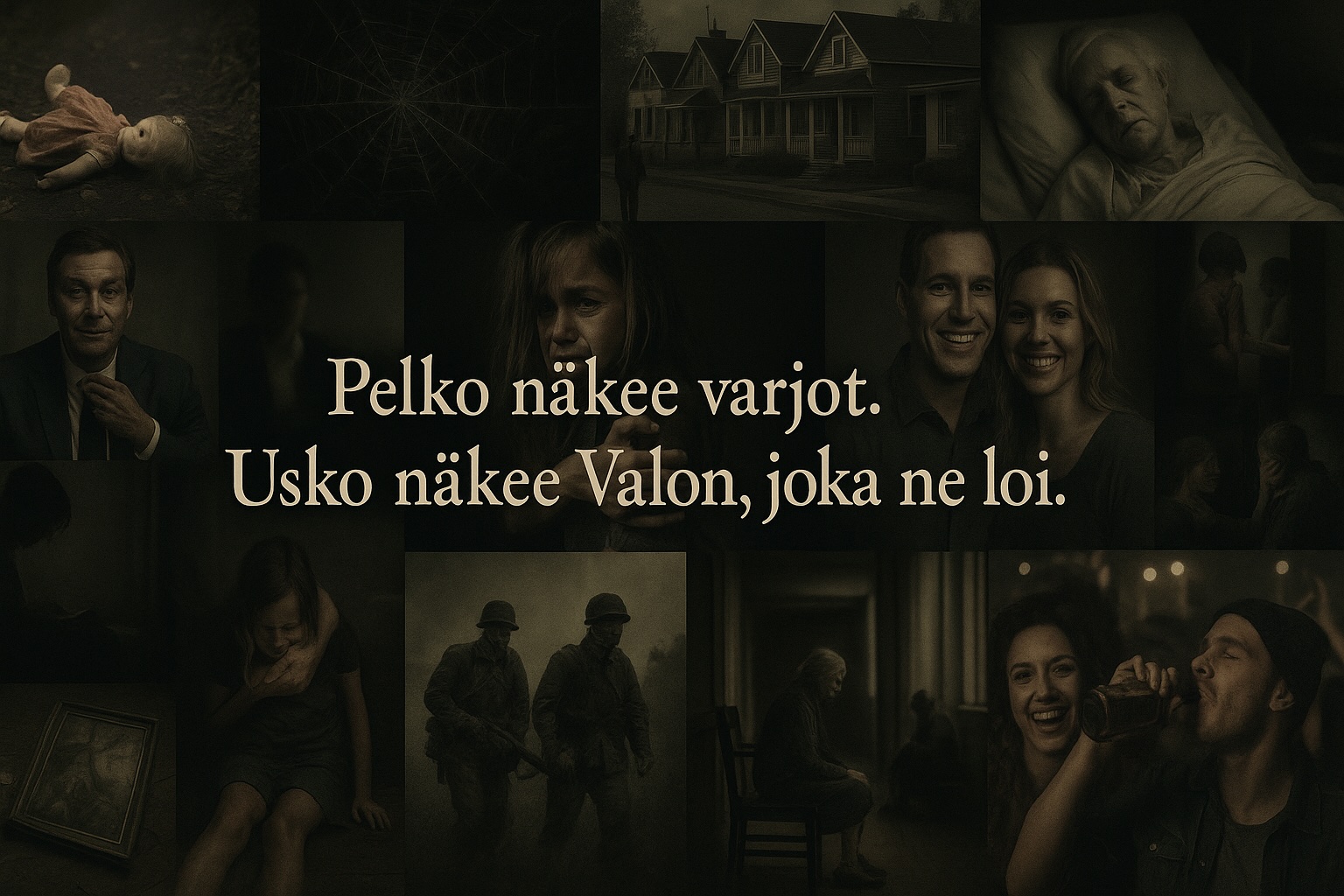
People of the North
Reflections on the shadows and light of Finnish identity
I. The Shackle of Consensus
Finland has a strong consensus culture. This makes truth-telling exceptionally costly — socially.
Where does it come from? A small nation, a cold climate, a fight for survival. Cooperation was essential. Disagreement was a luxury no one could afford. This is in our blood, our bones, our way of reading a room and reading each other.
Consensus is not a spoken rule. It is in the air. It is in the glances. It is in who gets invited for coffee and who does not. It is in doors that close quietly, without a sound, without explanation. A Finn does not need a threat: he reads the room and conforms. This is a survival skill that has turned against itself.
Note: Finns admire bold dissenters — as long as they are in the history books or in another country. Mandela. Luther. Bonhoeffer. Solzhenitsyn. A living, present truth-teller, on the other hand, is "difficult," "a troublemaker," "impossible to work with." There is no room for him.
When truth demands standing alone, a Finn faces his deepest fear: exclusion. We have no cultural foundation for being alone and right. So we stay silent. So we "don't want to cause problems." So we look the other way.
II. Horizontal Accountability
When the Christian foundation — accountability before God — is removed, only horizontal accountability remains. And horizontal accountability can be circumvented, if one has enough power or the right networks.
Vertical accountability anchors a person: when he knows he stands before the face of God, it does not matter what others think. It does not matter what the network demands. There is a higher Judge who cannot be bribed, who cannot be escaped, before whom everything is laid bare.
When this vertical connection is severed, all that remains is the question: "What will others think? What will the consequences be? Who is watching?"
And here is the problem: the gaze of men can be bought and bypassed.
"No one sees" — so I can act. "Everyone does it" — so it is acceptable. "I have protectors" — so I am untouchable. "The system protects its own" — so I will never be held accountable.
Corrupt networks operate on exactly this principle: Accountability is diffused. No one is solely responsible. Everyone is a little involved — and when everyone is involved, no one speaks, because speaking would expose oneself as well.
"Be not deceived; God is not mocked: for whatsoever a man soweth, that shall he also reap." (Gal. 6:7, KJV)
Horizontal accountability can be circumvented. Vertical accountability cannot be escaped.
III. Shame Without Sin
The Western Christian tradition built a guilt culture: an act is wrong regardless of whether anyone sees it. Conscience condemns in the dark, alone, because God sees.
Finland has layers of shame culture older than Christianity.
Wrong is what you get caught doing.
What the community does not see does not exist. That is why the façade is everything. That is why "what will the neighbours think" has been a higher law than "what does God see."
This produces a strange paradox: a Finn can feel shame without guilt — and guilt without shame. He feels shame over failure, poverty, being different — things that are not sins. But he may feel no guilt over wrongdoing, as long as it stays hidden.
This makes the voice of conscience weak. It is drowned out by the noise of shame.
IV. The Heritage of Silence
"Silence is golden." This has corroded deep. It is taught to children. It is a survival strategy reaching back generations: first under Swedish rule, then in the shadow of Russia. Speaking was dangerous. Silence kept you alive.
But now the same silence that once protected is protecting wrongdoing. It has turned against itself.
The child does not tell. The employee does not speak. The witness does not step forward. Everyone knows. No one says a word. Silence is Finland's national disease, and its symptoms are everywhere: in families, in workplaces, in institutions. We know how to silence something to death.
V. Authority Without Anchor
Finns trust institutions. This has been a strength. Society functions when people trust that the system is fair.
But it is also a blind spot.
When a police officer, a judge, a doctor, a teacher, a social worker, a bank director speaks, a Finn believes. Questioning feels un-Finnish. "Surely they know." "An authority does not lie." "The system is trustworthy."
This makes us vulnerable. When an institution becomes corrupt, a Finn does not see it. Not because he is stupid, but because he cannot bring himself to believe it. It would break something fundamental in his worldview.
That is why victims are not believed. That is why whistleblowers are isolated. They must be wrong — because the alternative is too frightening.
The institution has taken the place of God — and when a god fails, the world collapses.
VI. The Law of Jante* Without Grace
"Don't think you're something!" This is the Nordic shadow. It keeps people in line, but without a Christian foundation it turns to poison.
The original Christian humility said: "Before God you are small, but infinitely precious. He died for you."
The Law of Jante — the unwritten Nordic code of collective conformity — without God simply says: "You are small. Full stop. Don't rise. Don't stand out. Don't believe you can change anything. Who do you think you are?"
This kills prophets before they open their mouths. A truth-teller rises. He stands out. He believes he can change something. The Law of Jante condemns him before his message is even heard.
And envy — in Finland it is almost a virtue. It is called "equality" or "fairness." But at its heart it is: "If I cannot, then neither can you."
Heroes are not supported. They are watched. People wait for the mistake. Wait for the fall. And when it comes — relief! "Nothing special after all."
*The Law of Jante
The term comes from the novel "A Fugitive Crosses His Tracks" (En flyktning krysser sitt spor, 1933) by Danish-Norwegian author Aksel Sandemose.
The Ten Commandments of Jante
Sandemose wrote them as follows:Don't think you're anything.
Don't think you're as good as us.
Don't think you're wiser than us.
Don't imagine you're better than us.
Don't think you know more than us.
Don't think you're more than us.
Don't think you amount to anything.
Don't laugh at us.
Don't think anyone cares about you.
Don't think you can teach us anything.
VII. A State Church, Not Christ's
Finnish Lutheranism has been a state religion, not a religion of the heart. Church and power merged so completely that they became indistinguishable. Faith became a civic duty, not a living relationship with God.
When "Christianity" means church membership and a church tax — not following Christ — secularisation feels like nothing. There is nothing to lose. The shell remains; the core vanishes.
And when living faith is absent, so is the courage that comes from the Spirit, the truth that is a Person, the freedom that conquers fear.
What remains is religion without power. Form without substance. Tradition without life.
VIII. The Forest and the Escape
Finns flee to the forest. This is beautiful. The forest is a sanctuary, a cathedral of silence, a place where the soul rests.
But it is also an escape.
In the forest, one need not confront. Not people, not conflict, not truth that demands action. Silence is safety. Solitude is shelter.
But God speaks. He gives no peace to the one who flees his calling. Elijah hid in a cave, but God came and asked: "What doest thou here?" The forest, too, declares His glory. And one cannot hide there from what one knows to be right.
The forest is a good resting place. It is not home.
IX. The Remnant
And yet.
Consensus culture combined with secularisation has created the perfect environment for corruption. Not because Finns are worse than others, but because the mechanisms that would prevent it — individual courage and accountability before God — have been systematically weakened.
But God always raises a remnant. Those who will not bow.
Elijah thought he was alone. He was exhausted, had fled, was ready to give up. But God said: "Yet I have left me seven thousand in Israel, all the knees which have not bowed unto Baal."
Seven thousand. Elijah did not know about them. They did not know about each other. But they existed.
So it is in Finland, too.
X. People of the North
Stoic, reserved, a northern people who speak a strange language.
We have learned to stay silent when we should speak. To conform when we should stand. To fear people more than God. To trust systems more than Truth.
But we can still learn.
Learn that silence is not wisdom when injustice cries out. That consensus is not a value when it shelters sin. That the fear of shame is smaller than the fear of God. That institutions are made by men, and men stand before God.
Learn that there is a vertical accountability that cannot be circumvented. That there is an Eye that sees everything. That there is a Judge who cannot be bribed. And that He is also the One who shows mercy — who receives everyone who turns to Him.
The way out is the same as it has always been: revival. Not fixing the system, but the changing of hearts. When one person, then another, then ten, then a hundred says: "I am afraid. But my God is greater than my fear. I will speak."
"And fear not them which kill the body, but are not able to kill the soul: but rather fear him which is able to destroy both soul and body in hell." (Matt. 10:28, KJV)
Finland needs prophets who will not bow to Baal. They already exist. They are lonely, but God is gathering them.
And the people of the north — stoic and reserved, who have learned to survive in the dark and the cold — they can also learn to stand in the light.
In the name and blood of Jesus.