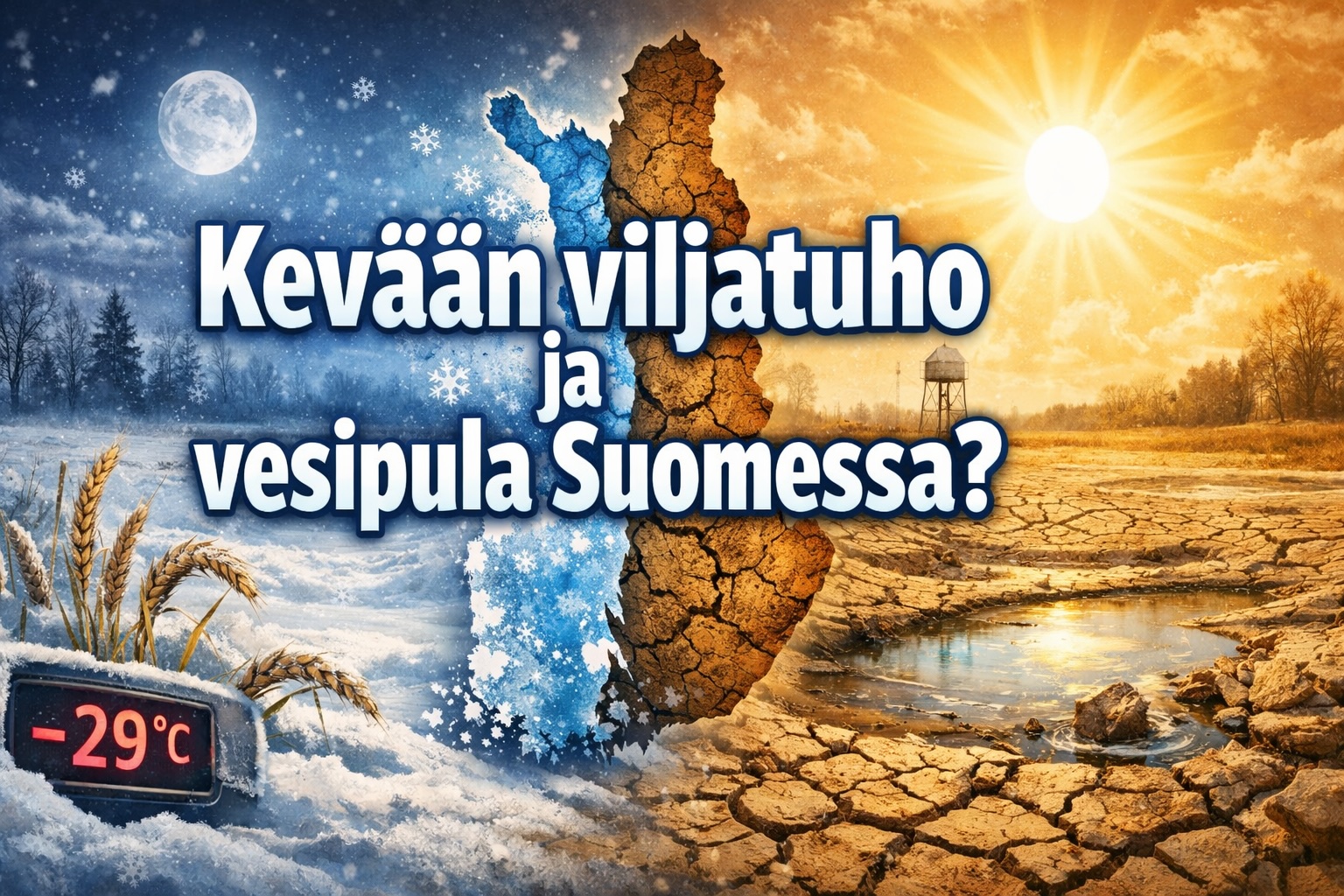
Statistics sound the alarm, authorities stay silent: does Finland face crop destruction and water shortage this spring?
The winter of 2025–2026 has brought Finland a rare combination: extreme cold and exceptionally thin snow cover. Approximately 100,000 hectares of winter grain are at risk of winterkill, groundwater levels have dropped up to nearly a metre below normal in some areas, and the spring snowmelt pulse threatens to be a fraction of what it usually is. Public data shows all of this. No official warnings have been issued.
In mid-February, driving at night across the open fields of Southern Ostrobothnia, my car thermometer reads −29.5 degrees. Last season's stubble pokes through a thin blanket of snow. Normally this field should be uniformly white, buried under 30 to 40 centimetres of snow. Now there is less than ten centimetres — in places, barely that.
This is not one field. This is the whole of agricultural Finland.
The Finnish Meteorological Institute's snow map paints the same picture from Southwest Finland to Southern Ostrobothnia, from Häme to Satakunta: 4 to 22 centimetres of snow across the regions where Finland's approximately 2.3 million hectares of farmland are located. Only in Lapland is the snow cover normal or thicker. All of this is happening at the same time as temperatures have dropped to levels not seen in decades.
This article describes what is happening in the ground right now — literally beneath the surface — and why it matters more for spring than any temperature record.
The coldest January in decades hit bare ground
January 2026 was the coldest in Lapland in nearly 40 years. Across Finland, temperatures ran 2 to 10 degrees below the 1991–2020 average, and the Copernicus Climate Change Service confirmed it as Europe's coldest January since 2010. Enontekiö recorded −44.3 degrees on 5 January — the coldest reading in Finland this century. Sodankylä dropped to −40 degrees on 9 January, and Savukoski Tulppio reached −42.8 degrees.
What matters most is what happened before the cold arrived. November and December were 2 to 4 degrees warmer than normal in the south. Snow came late or not at all. The ground entered the most severe cold spell essentially without a protective snow cover and without significant prior frost.
Precipitation failed to materialise alongside the cold. The Finnish Meteorological Institute classified January rainfall at many stations as "rare or exceptionally low." Utsjoki Nuorgam received a total of 2.8 millimetres for the entire month. Several stations recorded their driest January in the entire measurement history. At the start of February, snow depth in North Karelia, North Savo, Central Finland and Kainuu was 10 to 25 centimetres below the average — a level seen once a decade or less.
February continued the same pattern. The ECMWF monthly forecast predicted only 0 to 2 centimetres of additional snow over the following five days and below-average precipitation through the end of February. Vihti's winter temperature record was broken on Valentine's Day, 14 February, with a reading of −32.8 degrees.
The polar vortex breakdown explains the paradox
Extreme cold and extreme dryness occurring simultaneously appears contradictory, since cold air masses typically carry moisture. The explanation lies in the stratosphere.
In late November 2025, a rare early sudden stratospheric warming event occurred — described as the earliest in approximately 70 years. The event split the polar vortex into two separate lobes. A high-pressure blocking pattern that formed over Greenland channelled arctic air masses directly into Scandinavia, while simultaneously deflecting the Atlantic's moisture-laden low-pressure systems southward, toward Southern Europe, which received above-normal precipitation.
La Niña conditions amplified planetary wave activity that favours stratospheric warming events. The result was a climatologically rare situation: Finland received arctic cold without arctic moisture. Cold air without snow.
The same mechanism that froze the eastern United States in January operated in parallel over Finland. This was not a local weather phenomenon but a disruption in global circulation.
Snow is an insulator, a water reservoir and a soil builder
Most people think of snow as scenery. In agriculture and hydrology, snow serves three functions simultaneously — and all three are now absent.
Insulator. Ten to fifteen centimetres of snow cover prevents the ground from freezing almost entirely. In a normal winter, the soil surface beneath the snow stays at around −2 to −3 degrees even when the air temperature is −30. Snow acts like a blanket: it insulates the soil from air temperature. Without snow cover, frost is in direct contact with the ground, and on open fields where the wind strips away even the little snow there is, the situation is at its worst.
Water reservoir. In a normal winter, the snow cover stores moisture for months. Spring meltwater forms the single most important groundwater recharge event of the year, raises lake levels, initiates spring runoff and resets the annual cycle of watercourses. Finland's entire water cycle is built on the assumption of this spring melt pulse. This spring, it will not arrive normally.
Soil builder. Frost normally freezes the water in soil pores, expands it and "loosens" the structure of clay soils, conditioning them for spring fieldwork. This requires moisture in the soil before freezing. Dry, frozen ground does not benefit from frost's structure-improving effect in the same way.
When all three functions fail simultaneously, the consequences compound through one another.
Frost has penetrated a third deeper than normal
The best-documented frost measurements come from Yara's Kotkaniemi station in Vihti, where agricultural land is monitored. Frost depth has reached −38.4 centimetres with only 15.5 centimetres of snow cover. The long-term average for 1965–2024 is −29.2 centimetres of frost with 23.8 centimetres of snow. Frost is therefore 31 per cent deeper than normal and snow 35 per cent thinner. The previous season's corresponding reading was only −11.4 centimetres of frost, which underscores how exceptional the current situation is.
The Vihti measurement represents a single point in southern Finland. On open fields in Ostrobothnia, where snow cover is even thinner and sub-zero temperatures have persisted for weeks on end, frost depths are likely considerably greater. Historical data from Mietoinen in Southwest Finland reveals how dramatic the difference can be: in a low-snow, cold winter, open-field frost reached 74 centimetres in January and nearly a metre in February, while in the adjacent forest, frost remained a fraction of that.
Finland operates a 35-station frost measurement network maintained by the Finnish Environment Institute (SYKE). The frost map on vesi.fi shows that frost is deepest in western Finland, where snow cover is thinnest, and in northern Lapland, where it exceeds one metre. In eastern Finland, frost is paradoxically only 10 to 20 centimetres, because thicker snow cover insulates the ground effectively.
Frost depth normally reaches its maximum around the turn of February and March. Weeks of further deepening still lie ahead.
Deep frost thaw time could delay spring fieldwork by a month or two
The consequences of deep frost do not end with winter. In a study by MTT (now Luke) at Halola, Maaninka, snow was experimentally removed from a field. Frost penetrated to two metres and did not begin to thaw until Midsummer, whereas thawing normally begins in mid-April.
Extrapolation from the current situation suggests that 50 to 70 centimetres of frost on agricultural fields will likely not thaw until late May or early June. That means spring fieldwork delayed by 3 to 6 weeks compared to normal.
Deep frost also triggers a chain reaction: when snow melts on top of frozen ground, water runs off across the surface rather than soaking into the soil. The result is a simultaneous increase in phosphorus loading into watercourses and a decline in groundwater recharge. Less water ends up where it should, and more where it should not.
100,000 hectares of winter grain in a survival test
According to the Natural Resources Institute Finland (Luke), approximately 100,000 hectares of winter grains were sown in the autumn of 2025: roughly 65,000 hectares of winter wheat, 22,200 hectares of winter rye (of which approximately 5,800 hectares organic), 9,800 hectares of triticale, 2,200 hectares of winter barley, and 7,100 hectares of winter turnip rape and rapeseed. Sowing areas are slightly smaller than the previous year due to a wet autumn and low grain prices.
The sowings are concentrated in Southwest Finland, Uusimaa, Häme, Satakunta, Pirkanmaa and Southern Ostrobothnia — precisely the areas where snow cover is now thinnest.
The threshold values established by winterkill research are clear. The lethal temperature at the crown level for properly hardened winter wheat is approximately −21 degrees. For winter rye, the corresponding threshold is approximately −27 degrees. Without more than 20 centimetres of snow cover, soil surface temperature approaches air temperature directly. With night-time temperatures of −20 to −30 degrees for weeks on end across grain-growing regions and snow cover below 20 centimetres in many places, winter wheat is in the most acute danger: crown-level temperatures have likely reached or exceeded the lethal threshold during the cold spells of January and February.
Winter rye is more resilient, but even it is not safe. Two additional factors worsen the situation: plants' cold tolerance weakens as winter progresses into February, and any brief thaw followed by refreezing permanently impairs the plant's ability to reharden.
The true extent of winterkill will not become clear until after snowmelt in April–May, when it becomes apparent whether the shoots resume growth or not.
Groundwater has dropped 40 to 90 centimetres below normal
The vesi.fi groundwater situation report of 13 February 2026 paints a troubling picture.
Small groundwater formation levels in western Southern Finland are locally 40 to 90 centimetres below normal — the most severe reading in the country. In Central Finland, the deficit is 15 to 60 centimetres. In Kainuu, 30 to 40 centimetres. Only in Northern Finland and Western Lapland are groundwater levels above average, in some places as much as 65 centimetres above normal.
The situation has deteriorated rapidly. In the assessment at the end of 2025, Central Finland deficits were still 20 to 30 centimetres, but they have now grown to 50 to 60 centimetres. Behind the situation lie two consecutive weak recharge seasons: the winter of 2024–2025 was also exceptionally mild and low-snow, meaning that the spring 2025 recharge may have been inadequate.
In Finland's climate, spring snowmelt is the single most important groundwater recharge event of the year. Groundwater levels typically fluctuate 0.5 to 1.0 metres between the spring peak and the late-summer trough. Studies by Kløve and colleagues (2017) and Nygren and colleagues (2020) have already documented declining spring recharge in Finland as a consequence of diminishing winter snow.
With snow cover at roughly half of normal and frost having penetrated to exceptional depths, it is reasonable to estimate based on the literature that spring recharge could drop to 30 to 40 per cent of normal in the worst-affected areas. This figure accounts for both the smaller volume of meltwater and the impaired infiltration through frozen ground.
The reference year 2018 shows what follows when the water runs out
The summer 2018 drought caused groundwater to drop 10 to 60 centimetres below average in small groundwater formations, and in Kainuu and North Karelia by as much as 80 centimetres. Wells dried up in various parts of Central and Eastern Finland. SYKE specialist Jari Rintala noted at the time that in both 2002–2003 and 2018, groundwater levels in Southwest and Central Finland dropped "by as much as several metres."
In the aftermath of the 2018 drought, water was transported by tanker lorries, emergency water connections were built in municipalities (at a cost of approximately 25,000 euros per household) and water conservation advisories were issued. The Central Union of Agricultural Producers and Forest Owners (MTK) estimated total agricultural losses at approximately 400 million euros, and the government granted an emergency package of 86.5 million euros.
No nationwide total of dried-up wells exists, as Finland has no national well registry. The Winland policy recommendation subsequently proposed establishing one.
Now the starting point is worse than in 2018. Groundwater is already 40 to 90 centimetres below normal before a comparable spring, whereas in 2018 the deficits only began in late summer. The most vulnerable areas — Southwest Finland, Uusimaa and sparsely populated areas dependent on small groundwater formations — are the same areas now showing the largest groundwater deficits.
Farmers face losses of 400 to 700 euros per hectare with no public compensation
If winterkill proves widespread, the economic consequences are significant. The lost autumn investment (seed approximately 100 to 130 euros per hectare, plus fertilisation, tillage and sowing) totals 200 to 350 euros per hectare. Resowing in spring adds another 100 to 200 euros per hectare. Spring-sown grains yield 15 to 30 per cent less than winter grains even in good conditions, and late sowing reduces yields further. The total economic impact of complete winterkill — accounting for lost investment, resowing costs and yield reduction — is approximately 400 to 700 euros per hectare compared to a successful winter grain crop.
At this point, the economic structure reveals a second layer.
Finland abolished its state-funded crop damage compensation scheme in 2015 following opposition from the EU Commission. Since then, farmers have been reliant on private crop insurance. A 2017 study by Liesivaara (Helsinki/Luke) showed that only 46.5 per cent of surveyed farmers had taken out an insurance product. Roughly half of farmers are therefore without a safety net.
The Finnish Food Authority's guidelines allow winterkill fields to retain their original winter grain code in subsidy applications, and eco-scheme winter cover compensation is paid even in the event of winterkill, provided the crop was sown in the autumn. These are administrative flexibilities, however, not economic relief.
The global market situation adds further uncertainty. Severe cold hit the Black Sea region at the same time: 37 per cent of Russian winter wheat was reported in "poor condition" in January 2026, and the EU imposed a 95-euro-per-tonne tariff on Russian grain at the beginning of the same month. World wheat futures are rising. Among Finnish grain prices, malting barley has risen to a notably high level of 425 euros per tonne (Viking Malt).
Boreal Plant Breeding has warned that in years of widespread winterkill, the supply of spring seed can tighten rapidly and early preparation is crucial. The most recommended replacement crops are spring turnip rape (approximately 450 euros per tonne with strong demand), spring barley, oats and legumes.
Luke's first grain production forecast for 2026 will not be published until August.
Water levels have already been lowered less, because spring flooding is not expected
The Flood Centre's situation report of 13 February 2026 assigns a green warning level with 80 per cent probability — meaning no damage is expected. River flows across the country are "at typical winter low-flow levels." In Southern Ostrobothnia, water levels and flows are at winter minimums, "even slightly below average" according to the regional vesi.fi report.
The single most telling sign of what is expected is the Lake Vanajavesi regulation decision: the lake surface has not been lowered as far as usual, because "due to the low snow volume, there is no need to lower the surface as much." Water managers are already operating on the assumption that the spring flood will be weak.
Lake Saimaa is clearly below its seasonal average, while some lakes in Lapland are above average thanks to abundant December precipitation.
A weak spring flood means ecological consequences, particularly in shallow lakes. Small headwater ponds along the Nurmonjoki river in Southern Ostrobothnia are already suffering from oxygen depletion, and the oxygen levels in the surface layer of Lake Kuorasjärvi are at their worst since 2002. When ice forms over shallow water, the reduced water volume consumes oxygen more rapidly, releases phosphorus from sediment and can lead to fish kills that are only revealed after ice-out in spring.
No one has sounded the alarm
At this point, it is worth pausing.
All of the data in this article is public. The Finnish Meteorological Institute's monthly reviews, vesi.fi's groundwater reports, Luke's sowing area statistics, Yara Kotkaniemi's frost measurements, the Flood Centre's situation reports — all freely available. The mechanisms are known. The thresholds have been researched. The risks can be calculated.
Yet as of 14 February 2026, no Finnish authority had published an official winterkill assessment, groundwater warning or spring water situation forecast that accounts for the severity of the current situation. The English-language page of vesi.fi states: "There are no active bulletins on the groundwater level situation right now." Meanwhile, the same service's own data shows deficits of 40 to 90 centimetres in western Southern Finland.
ProAgria West Finland noted in its January review that the autumn 2025 sowings "progressed unevenly" and anticipated an increased need for spring grain — an indirect acknowledgement of winterkill risk. ProAgria and Farmit highlighted the snow mould risk for lush, early-sown crops. Actual winterkill assessments are typically published only in March–April after snowmelt.
This is understandable: before the snow melts, no one can say with certainty what has died and what has survived. That does not, however, prevent warning about the risk. The data exists now, not only in spring.
Particularly noteworthy regarding the groundwater situation is that neither SYKE nor any Centre for Economic Development, Transport and the Environment (ELY Centre) has published a warning or assessment of the spring 2026 groundwater situation, even though the deficits are already at the level that in 2018 led to concrete problems.
Climate change makes this winter contradictory, not impossible
The winter of 2025–2026 runs against Finland's dominant climate trend. FMI and the Climate Guide's CMIP6 scenarios project 2 to 7 degrees warmer winters, increasing precipitation and decreasing snow. Snow-cover days in Southern Finland are projected to halve by the end of the century, and the snow water equivalent could decline by 80 to 90 per cent. Very cold temperatures are expected to become rarer.
Yet the winter of 2025–2026 demonstrates that natural variability can still produce extreme cold and dry spells. When these hit an environment where snow resilience has generally weakened, the impacts can be more severe than usual.
Cold-drought as a unified climate risk phenomenon has not been studied in the Fennoscandian context in peer-reviewed literature. The phenomenon is studied through its component parts: negative NAO/AO indices, Scandinavian blocking patterns and polar vortex disruptions. A negative NAO brings cold, dry air to Northern Europe, and the loss of Arctic sea ice may be linked to cooler Eurasian winters via altered circulation, as studies by Cohen and colleagues (2012, 2014) and Mori and colleagues (2014) have proposed. Whether the frequency of polar vortex disruptions changes as the climate warms is a subject of active scientific debate.
The ECMWF seasonal forecast for March–May 2026 shows no clear signal in either direction for temperature or precipitation, suggesting that the blocking pattern is expected to break down and more normal conditions to return. That offers cautious hope for spring, but a normal March cannot undo the damage already inflicted on crops or the groundwater deficit that limits spring recharge.
Four risks that feed on one another
What makes the winter of 2025–2026 exceptional is not a single risk but four that reinforce one another.
Extreme cold kills the crown tissue of poorly insulated grain crops. Deep frost delays spring sowing and prevents groundwater recharge. Low snow reduces both the volume of the spring flood and the meltwater that would replenish groundwater formations. Already depleted groundwater faces a season in which recharge will be exceptionally weak.
The economic structure amplifies the vulnerability: the abolition of crop damage compensation in 2015 means that roughly half of farmers without private insurance bear the loss alone.
What we do not yet know
Several critical questions will only be resolved in the coming weeks and months.
The true extent of winterkill will not become clear until after snowmelt in April–May. Until then, no one can say with certainty how much of the 100,000 hectares has been lost.
Whether frost depths on the open agricultural fields of Southern Ostrobothnia have reached the 50 to 70+ centimetre level that would delay spring fieldwork until June remains unmeasured. No detailed frost depth data for Southern Ostrobothnia's agricultural fields was found in the research for this article.
The Flood Centre's formal spring flood forecast has not yet been published. Forecasts are typically issued in March–April as snow accumulation approaches its peak.
Groundwater deficits of 40 to 90 centimetres below normal in western Southern Finland are already significant, and no authority has published a warning about the spring recharge risk.
What is visible from the field
What sets this winter apart from an ordinary cold spell is precisely the combination. Cold without snow is dramatically more destructive than cold with snow — for crops, for soil structure, for groundwater and for spring hydrology. Research shows that 10 to 15 centimetres of snow halts frost penetration almost entirely, and the difference between an insulated and a bare field can mean frost depths ranging from 20 centimetres to nearly a metre.
Finland's agricultural heartland entered this winter's most severe cold spell in many places below that protective threshold. The consequences will unfold over the course of spring and summer 2026.
That −29.5 degrees on a February field and bare stubble poking through the snow are not merely a weather observation. They are the balance sheet of a winter in which the snow never came to provide cover — and the bill comes due in spring.
This article is based on public data and statistics from the Finnish Meteorological Institute, ECMWF, Copernicus C3S, the Finnish Environment Institute (SYKE), vesi.fi, the Flood Centre, the Natural Resources Institute Finland (Luke), Yara Kotkaniemi, ProAgria and Foreca. Winterkill threshold values are based on research from the University of Saskatchewan (Tanino et al.). Groundwater research references: Kløve et al. 2017, Nygren et al. 2020. Reference year 2018 data is based on reports from SYKE, MTK and the Winland policy recommendation.
14 February 2026