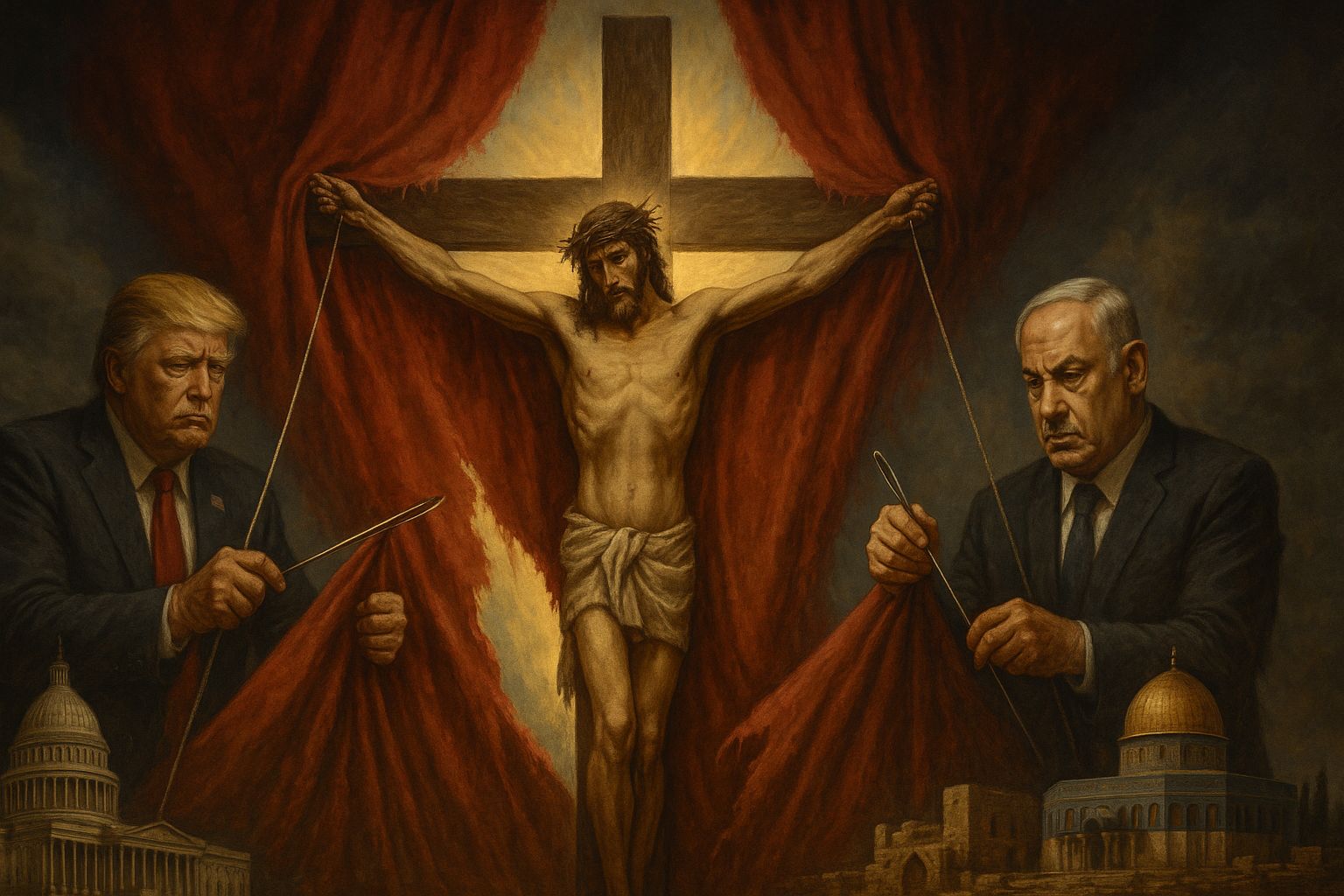
The Torn Veil and Its Denial
The tearing of the temple veil in Jerusalem at the moment of Jesus' death was a divine declaration: the way to God had been opened for all — without mediators, without distinction, without human hierarchies. This supernatural event marked the end of the old covenant and the birth of a new beginning (Matt. 27:51; Mark 15:38; Luke 23:45). Yet today we are witnessing a systematic attempt to stitch that veil back together, as though the events of Calvary could be overturned by political decisions and religious traditions of men.
In the chronicles of the Medes and the Persians, referenced in the Book of Esther, we see history repeating itself. The irrevocable law of the Persian Empire that demanded the destruction of the Jews ultimately turned against the persecutors themselves (Est. 8:11-17). This Purim narrative lives powerfully in the psyche of modern Israel, but its interpretation has been distorted. The original account of God's providential protection has been transformed into a justification for military supremacy and political manipulation. The victory of the oppressed over their persecutors was never meant to signify ethnic superiority or earthly dominion — it was a foreshadowing of Christ's ultimate victory over the enemy of the soul.
Modern Israel selectively appeals to the Old Testament to justify its land ownership and special status while simultaneously rejecting its fulfilment in Jesus Christ. This is a theological paradox that reveals a deeper truth: a return to the old covenant is impossible, for Christ himself is the end and fulfilment of the law. In his letter to the Romans, Paul writes with crystalline clarity: "For they being ignorant of God's righteousness, and going about to establish their own righteousness, have not submitted themselves unto the righteousness of God. For Christ is the end of the law for righteousness to every one that believeth" (Rom. 10:3-4, KJV).
The Rise of Political Religion
The Temple Institute in Jerusalem is actively preparing for the construction of a third temple. Red heifers have been bred, priests trained, sacred vessels crafted. Every one of these acts is a direct denial of what the Epistle to the Hebrews declares: "For Christ is not entered into the holy places made with hands, which are the figures of the true; but into heaven itself, now to appear in the presence of God for us" (Heb. 9:24, KJV). The effort to restore the sacrificial system is not merely a religious curiosity — it is a desecration of the work of Calvary, an attempt to nullify what has already been fulfilled.
At the same time, the Christian world has adopted a culture of silence. Churches speak of "Judeo-Christian roots" while carefully avoiding the fact that these roots hold meaning only in Christ. Influencers like John Hagee proclaim a "dual covenant theology," claiming that Jews are saved without Jesus. This is a blatant denial of the declaration in the Book of Acts: "Neither is there salvation in any other: for there is none other name under heaven given among men, whereby we must be saved" (Acts 4:12, KJV).
The political far right has hijacked Christian rhetoric to forge a new trinity: God, fatherland, and a strong leader. This is not the worship of the God of the Bible but the sanctification of political power through religious language. The elevation of Trump as "God's chosen one" in America, or Netanyahu's use of biblical texts to justify political decisions in Israel, are examples of how God's name is taken in vain to legitimise power.
The Ecumenical Deception
The Abrahamic Family House rising in Abu Dhabi, where a mosque, a synagogue, and a church stand side by side, symbolises the culmination of the ecumenical movement. The message is clear: all children of Abraham worship the same God. This is a complete denial of Jesus' words. He stated unequivocally: "He that honoureth not the Son honoureth not the Father which hath sent him" (John 5:23, KJV). There is no access to the Father that bypasses the Son.
This ecumenical spirit reinforces the legitimacy of the old covenant and dims the focus on Jesus Christ. As the discourse shifts toward a universal common God, the uniqueness of Christ evaporates and the veil begins to rise once more. Paul's warning to the Corinthians is forgotten: "What communion hath light with darkness? And what concord hath Christ with Belial? or what part hath he that believeth with an infidel?" (2 Cor. 6:14-15, KJV).
Europe's hate speech laws reveal the true nature of this spirit. Quoting the Bible on sexual ethics is interpreted as a hate crime, criticising Israel's policies as antisemitism — yet the mocking of Christianity is protected as free speech. Speaking the truth has become a criminal act, while lies draped in the garments of tolerance are elevated to virtue.
Preparing the Anti-Christian System
AIPAC's influence on American politics, where members of Congress effectively pledge allegiance to a foreign state, reveals a deeper spiritual reality. Congregations remain silent about events in Gaza, fearing the label of antisemitism more than the distortion of God's truth. This fear is a chain that silences the prophetic voice at the very hour it is needed most.
Jesus warned: "For many shall come in my name, saying, I am Christ; and shall deceive many" (Matt. 24:5, KJV). We see this being fulfilled as political leaders use Christian rhetoric to justify actions that contradict the teachings of Christ. Strong leadership replaces the guidance of the Holy Spirit, human control replaces divine grace, and ultimately Caesar demands what belongs to God.
The Book of Revelation warns of a religio-political system in which religious authority supports secular power, miracles are used to deceive, and worship is compelled (Rev. 13:11-18). The groundwork for this system is being laid now — as Christian values submit to political agendas and the Gospel of Christ is replaced by nationalist religiosity.
The Only Way
The truth that the current religio-political system is desperately trying to conceal is simple and unchanging: "Jesus saith unto him, I am the way, the truth, and the life: no man cometh unto the Father, but by me" (John 14:6, KJV).
There is no alternative plan of salvation for Jews or liberalised Christians, no second path for Muslims, no detour for anyone. Christ is the end of the law, the fulfilment of the prophets, and the only mediator between God and men (1 Tim. 2:5).
Israel without Jesus is as lost as any other nation. Salvation is not found in DNA, in geography, or in religious rituals. It is found in Christ's atoning work alone — in his blood, in his resurrection. Every attempt to restore the old covenant, to rebuild the temple, or to create alternative roads to salvation is an attempt to stitch back together the very veil that God himself tore in two.
The question each of us must face is clear: do we recognise the signs of the times? Do we see how political religion is replacing the Gospel, how human traditions are displacing divine revelation, how the veil is being woven back together? Do we want to be part of the deception that is preparing the way for the one who comes in his own name, after we have rejected the One who came in the Father's name?
The words of Jesus echo across the centuries as unchanging truth: "The time cometh, that whosoever killeth you will think that he doeth God service. And these things will they do unto you, because they have not known the Father, nor me" (John 16:2-3, KJV). This is the tragedy of our time: religion without Christ, spirituality without the Spirit, worship without God — yet the truth stands unshaken: Christ has conquered, the veil is torn, and the way is open. The only question is whether we will walk through it.