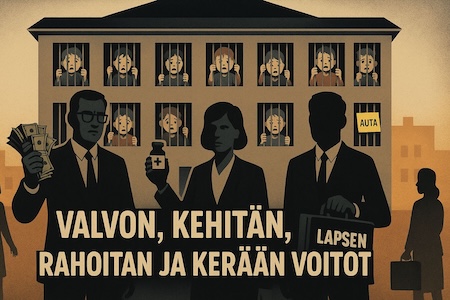
The State's Lie: How Finland's Child Welfare Became a Business Built on Children
On November 20, 2016, something unprecedented happened at Finlandia Hall. Minister of Family Affairs and Social Services Juha Rehula stood before the microphone and spoke words no representative of the Finnish state had ever uttered: "I'm sorry." That moment carried a promise — a promise that the era of silence in child welfare was over, that the voices of children would finally be heard, that the wrongs of the past would never be repeated¹.
Eight years later, that promise stands exposed as a lie more brutal than any single act of abuse. It is a systematic betrayal in which the state's apology became a smokescreen for the massive commercialisation of child welfare. While ministers spoke of children's rights, international private equity investors were preparing to seize control of a market worth billions — a market whose returns flow from the suffering of children.
The Numbers Reveal the Truth
Statistics do not lie. In 2016, when Minister Rehula offered his apology, child welfare reports were filed for approximately 55,000 children. In 2023, the figure was 110,269 — exactly double². What makes this particularly alarming is that one in six children aged 13–15 is now the subject of a child welfare report. This is no coincidence. It is the direct consequence of a system built to generate profit, not to protect children.
The share of out-of-home care was supposed to decrease through broader use of community-based services. The reality? "On the contrary, the number of clients in child welfare — and particularly in out-of-home care — as well as costs have continued to grow"³. The average cost of placing a single child is 51,174 euros per year, but private operators charge up to 15,000 euros per month — 180,000 euros per year per child⁴. The maths is simple: the more children placed, the longer they stay in care, the greater the profits.
CVC Capital Partners and the Billion-Euro Business
In August 2018, just two years after the state's apology, CVC Capital Partners Fund VII acquired Mehiläinen⁵. This private equity fund, registered in Jersey, did not come to Finland by chance. They saw a goldmine: a massively privatising child welfare market where demand perpetually outstrips supply.
Mehiläinen owns Familar Oy, Finland's leading private child welfare service provider⁶. Familar's revenue in 2023: 83.4 million euros, growth of 15.8 per cent, operating profit margin of 9.3 per cent⁷. But the true conflict of interest is revealed in the ownership structure. Among Mehiläinen's other owners: the State Pension Fund (VER), Varma, Ilmarinen⁸.
Do you see the structure? The state acts as both regulator and investor. It collects taxes, uses them to pay private child welfare companies, which generate profits for the very same state pension funds. This is a fundamental conflict of interest: how can the state credibly oversee companies whose success directly benefits its own pension funds? A perfect loop in which every party wins — except the children.
The personal networks expose a glaring conflict of interest. Eveliina Huurre simultaneously sits on the board of Mehiläinen (since 2016) and the board of the THL Foundation (since 2020)⁹. This is a textbook conflict of interest: THL produces the very child welfare statistics and recommendations on which policy is based. At the same time, Huurre profits financially from these decisions as a board member of Mehiläinen — which owns Finland's largest private child welfare operator.
Huurre's career reveals a systematic revolving door: at Sitra from 2014 to 2017 developing the health and social services market, before that a decade at the private care giant Attendo¹⁰. First you create the markets in the public sector, then you move to profit from them in the private sector, and finally you sit at both tables at once. This is not merely an apparent conflict of interest — it is a real, structural problem that undermines the credibility of the entire system.
The Collapse of Oversight
Valvira's credibility collapsed in the case of the fake doctor Esa Laiho. Laiho practised as a physician for 10 years on forged credentials¹¹. Valvira's licensing department director Jussi Holmalahti was convicted of breach of official duty¹². This exposes a systemic incapacity: Valvira processes over 17,600 professional licensing decisions annually with insufficient resources¹³.
Child welfare oversight is fragmented across a bewildering structure. Valvira, six Regional State Administrative Agencies, 21 wellbeing services counties — nobody is responsible when everyone is responsible¹⁴. The focus has shifted to "supervision of self-monitoring." In practice, private institutions monitor themselves¹⁵.
The Silenced Voices of Children
"Is able to understand the significance of the matter" — this legal formulation is the key to the systematic silencing of children¹⁶. It gives authorities full power to decide when a child may participate in decisions about their own life. In practice, it shuts children out of their own existence.
In a THL study, over 700 children in out-of-home care shared their experiences: 29 per cent had experienced physical violence, 47 per cent psychological violence while in care¹⁷. Pesäpuu's "101 Letters" collection documents children's own experiences: constantly changing social workers, violence, the feeling of never being heard¹⁸.
The Staffing Crisis Deepens
In October 2024, child welfare social workers had an average of 26 children per caseload. Seventeen of 22 wellbeing services counties are in violation of the law¹⁹. Approximately 250 workers exceed the statutory limit of 30 children. The tightening of qualification requirements in 2016 has made the situation worse — qualified substitutes cannot be found²⁰.
Meanwhile, private operators recruit the best talent. The public sector is left with those who have no alternatives. When the public sector cannot fulfil its duties, the only option is to purchase services from private providers. The vicious circle is complete.
The Dirty Cycle of Money
According to Gabriel Zucman, Finland lost over 700 million euros to tax havens in 2017²¹. CVC operates from Jersey. The Esperi Care case exposed the methods: intra-group loans at high interest rates, no corporate tax paid in Finland²². According to VATT's estimate, aggressive tax planning costs hundreds of millions per year²³. The situation has not improved since — it has worsened.
Child welfare is part of this machinery. Public funds are converted into private profits that flow to tax havens. Meanwhile, we are told there are not enough resources for child welfare.
The ECtHR Condemns Finland Repeatedly
The European Court of Human Rights has condemned Finland repeatedly: K. and T. v. Finland (2001), K.A. v. Finland, K.U. v. Finland²⁴. Finland responds with cosmetic legislative amendments. The Deputy Chancellor of Justice stated in 2024 that the implementation of ECtHR rulings is systematically delayed²⁵.
The UN Committee on the Rights of the Child expressed concern in 2023 about the privatisation of child welfare and the lack of children's participation rights²⁶. The response? More committees, no real change.
Documented Abuse Continues
Since 2016: violence at the Mynämäki facility in 2019²⁷, children's deaths during "unofficial absences"²⁸, Pesäpuu's "Missing in Finland" report on inadequate tracking of missing children²⁹. The same pattern in every case: shock, investigation, silence. Nothing changes.
The three largest chains control a third of all institutions³⁰. Oversight is theatre: inspections are announced in advance, documents are prepared, children are coached.
The Illusion of Real Change
The LAPE reform programme from 2016 to 2018 produced strategy papers³¹. The 2023 wellbeing services county reform moved the crisis to a new address³². The age limit for aftercare was raised to 25, then lowered to 23 for budgetary reasons³³, then raised again. Every cut costs many times over in social exclusion.
Instead of community-based services, out-of-home care grows. In 2022: 74 per cent of costs, 1.33 billion euros³⁴. Financial incentives favour expensive institutional placements over prevention.
Structural Violence
15.8 per cent of 13-to-15-year-olds are child welfare clients³⁵. That is not an anomaly — it is the new normal. Society has decided that children's wellbeing is a commodity.
"The best interest of the child" is an empty phrase. Adults define it, authorities decide it, courts confirm it. The child is an object, not a subject. While rights are spoken of, the most fundamental right is denied: the right to be heard.
A Dystopian Future
If the current trajectory continues, by 2030 one in five children will be a child welfare client. Private giants will control 95 per cent of services. Artificial intelligence will determine "risk profiles," algorithms will decide on interventions³⁶.
A generation of traumatised children will grow into adulthood. They will not trust authorities, society, or people. The cycle deepens. Child welfare creates the very problems it claims to solve³⁷.
The Path to Change
Finland's child welfare system has not failed — it functions exactly as designed. It generates profit for investors, control for the state, and destroys children as an accepted side effect of the state's market economy.
Real change would require:
- Full nationalisation: no profit from children's suffering
- Independent oversight directly under Parliament
- Children's absolute right to participate in decision-making
- A manifold increase in community-based service resources
- Doubling the number of workers
- Full transparency, in every respect
Above all: the recognition that children are agents in their own lives. That the role of adults is to support, not to control. That wellbeing, not profit, is the foundation of society.
In Closing: A Broken Promise
November 20, 2016, Finlandia Hall. Hundreds in the audience whose childhoods were stolen. They believed in a turning point. That the suffering had not been in vain. That future children would be spared.
Eight years later: the apology was an empty gesture. The system did not change — it learned to cover its tracks. Children are still used as commodities. They are still silenced. But now it is done legally, transparently, profitably.
This is Finland's shame. Every day we allow this to continue deepens our guilt. History will judge — but worse still: the children have already judged and found us guilty.
Sources
- Official state apology, 20 November 2016. Minister of Family Affairs and Social Services Juha Rehula, Finlandia Hall, Helsinki.
- National Institute for Health and Welfare (2023). Child Welfare 2023 — Statistical Report. THL, Helsinki.
- Ministry of Social Affairs and Health (2023). Situational Overview and Development Needs in Child Welfare. STM Reports 2023:4.
- Parempaa lastensuojelua ry (2024). Child Welfare Costs and Resources 2023.
- Private Equity Wire (2018). "CVC Capital Partners Fund VII acquires Mehiläinen". August 2018.
- Familar Oy (2024). "About Us". Company website.
- Trade Register (2024). Familar Oy financial statements 2023.
- Ilmarinen (2024). "Real estate investment". Pension fund investment report.
- Mehiläinen (2024). "Mehiläinen's Management". Company website.
- LinkedIn profiles and public records (2024).
- Suomen Kuvalehti (2017). "Fake doctors: Valvira's fault — or is it?".
- Helsinki District Court (2024). Judgment R 23/4567.
- Valvira (2023). Annual Report 2022.
- National Institute for Health and Welfare (2024). "Child Welfare Oversight". THL Handbook.
- Act on Private Social Services 922/2011, Chapter 6.
- Child Welfare Act 417/2007, Sections 20 and 29.
- THL (2023). "Ask and Listen — Wellbeing of Children in Out-of-Home Care".
- Pesäpuu ry (2020). "101 Letters" publication.
- THL (2024). "Child Welfare Social Work Staffing Levels in October 2024".
- Social Welfare Act 1301/2014, Section 33 a.
- Zucman, Gabriel (2017). "The Hidden Wealth of Nations".
- Yle (2017). "Finnish child welfare: Child protection or 'for profit' foster care?".
- VATT (2023). "Effects of Aggressive Tax Planning".
- ECtHR judgments: K. and T. v. Finland (2001), K.A. v. Finland (2003), K.U. v. Finland (2008).
- Office of the Chancellor of Justice (2024). "Delays in Implementation of ECtHR Judgments".
- UN Committee on the Rights of the Child (2023). Concluding observations on Finland.
- Turun Sanomat (2019). "Violence at Mynämäki child welfare unit".
- Parliamentary Ombudsman (2023–2024). Complaint decisions concerning child welfare.
- Pesäpuu ry (2023). "Missing in Finland" report.
- Finnish Social and Health Care Employers' Association HALI ry (2024). Analysis of the child welfare market.
- Ministry of Social Affairs and Health (2018). LAPE Reform Programme Final Report.
- Act on Wellbeing Services Counties 611/2021.
- Government Bill HE 56/2023 vp. Government proposal to amend the Child Welfare Act.
- Association of Finnish Municipalities child welfare report (2023).
- Save the Children Finland (2023). "Voice of the Child 2023".
- AI and Child Welfare research project. Aalto University (2024).
- THL (2020–2024). Longitudinal study on child welfare clients as adults.