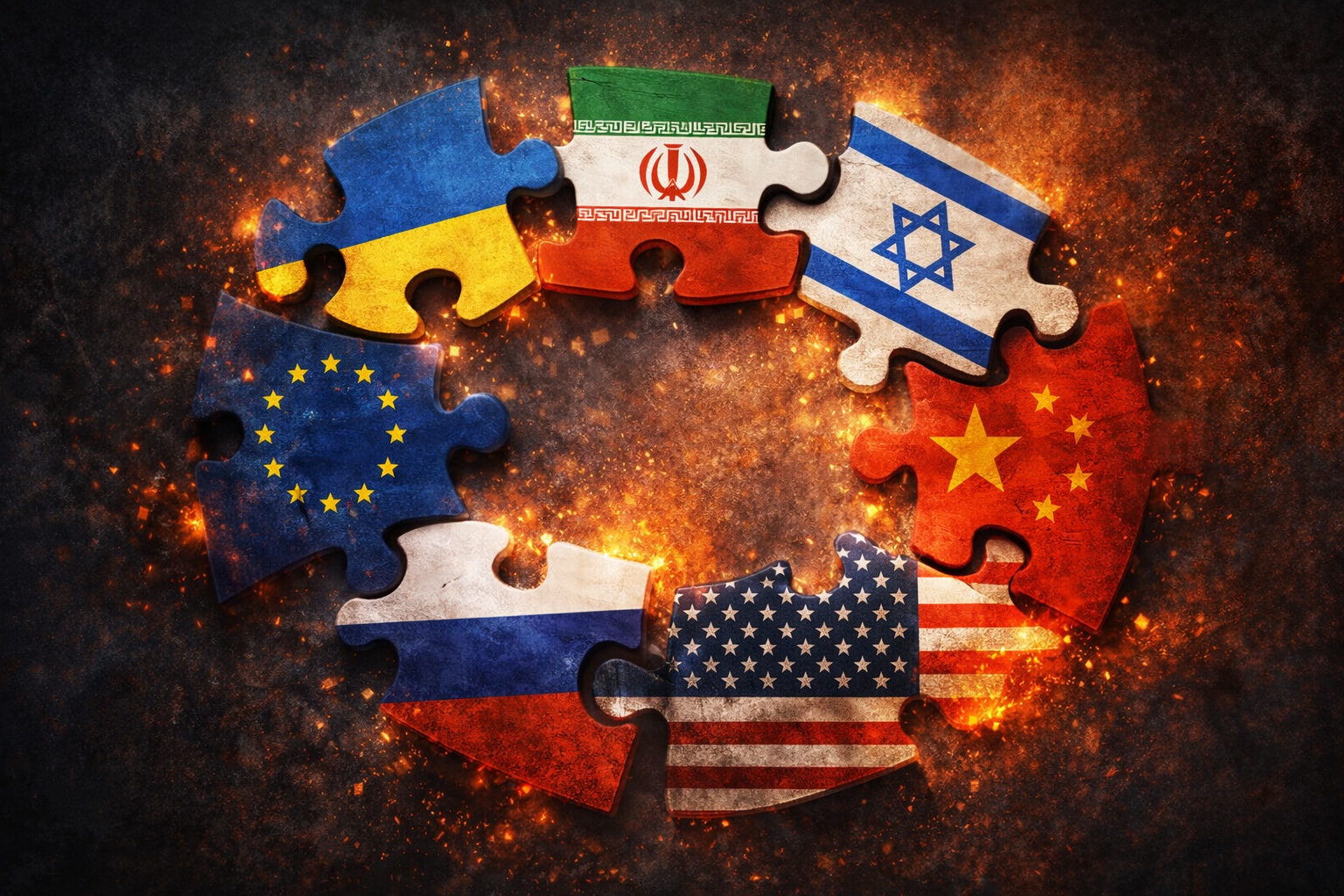
What Connects Ukraine, Iran, Israel, China, Russia, the EU, and the USA?
1.3.2026 | Tomorrow's News
On 17 February 2025, exactly 377 days ago, we published a piece titled Ukraine's Agreed Peace Deal and Why the EU Does Not Oppose It, but Accepts Everything. In that piece we wrote the following:
"The next US focus will be the Middle East, where the US together with Israel will begin neutralising the Iranian threat."
This morning, Sunday 1 March 2026, international media reports that Iran's long-standing leader Ayatollah Ali Khamenei has been killed in an operation that began on 28 February, in which Israel and the United States launched a large-scale joint strike against Iran. The operation is designated "Roaring Lion" on the Israeli side and "Operation Epic Fury" in Pentagon terminology. The strikes began in the morning Iran time, as people were on their way to work and to the markets. Tehran, Isfahan, Qom, Kermanshah, Karaj, Tabriz: missiles rained down on cities across the country. In Minab, southern Iran, a strike hit a girls' school, killing at least 51 children.
Trump declared the goal to be regime change in Iran. Netanyahu described Iran as "an existential threat." Iran responded by launching missiles at Israel and at US military bases in Qatar, Kuwait, Bahrain, the United Arab Emirates, and Saudi Arabia.
This is not a surprise. This is the next move in a game whose logic has been visible for a year.
In this piece, we explain why.
Oil First, Rhetoric Later
To understand the strike on Iran, we need to go back two months. On 3 January 2026, US special forces seized Venezuelan President Nicolás Maduro. Trump announced that the USA would "lead Venezuela until further notice" and that the task of American oil companies was to go in and rebuild the country's oil infrastructure.
This was not mere rhetoric. The White House officially confirmed that the US was taking control of Venezuelan oil sales and marketing, that all revenues would first be directed to US-controlled accounts, and that this would continue "until further notice." At least ten oil tankers were seized by military force in the Caribbean, the Atlantic, and the Indian Ocean. Maduro is now in New York facing drug trafficking charges.
Venezuela holds the world's largest proven oil reserves: 303 billion barrels, or 17 per cent of the entire planet's reserves. Production has collapsed from 3.5 million barrels per day (1990s) to roughly 800,000 barrels, but rebuilding infrastructure could restore production within a few years. Chevron, ExxonMobil, and ConocoPhillips are already waiting at the door.
Now keep this in mind and turn to Iran.
The Strait of Hormuz: 20 Per Cent of the World's Oil
Iran announced on 28 February that it was closing the Strait of Hormuz. The Revolutionary Guard sent VHF radio messages to vessels in the area: no one is allowed to pass through.
Here is the crucial detail that often gets buried in the news coverage: the Strait of Hormuz does not carry only Iranian oil. It carries the vast majority of the entire Persian Gulf region's oil exports. Saudi Arabia, Iraq, Kuwait, the United Arab Emirates, Qatar, and Bahrain all depend on this single narrow waterway for their exports. Approximately 20 million barrels of oil flow through the strait every day — one fifth of the world's total supply. Iran's own share of this is only a fraction. The bulk belongs to the other Persian Gulf producing nations.
When the strait closes, it is not just Iran's cheap oil that disappears from the market. One fifth of the entire planet's oil supply disappears. The gap is massive.
Analysts forecast that Brent crude will open on Monday heading towards $80 or even $100 per barrel. According to a Swiss bank estimate, a prolonged disruption could temporarily push the price above one hundred.
Now let us look at who benefits.
The United States: Venezuelan Oil Awaits Buyers
The Persian Gulf producing nations produce the world's cheapest oil. Saudi Arabia's production cost is around $3 per barrel, Iraq's and Kuwait's around $10, the UAE's around $12. Venezuelan and American oil costs $40 or more. In a normal market, this cheap Persian Gulf oil takes customers away from more expensive producers. When the Strait of Hormuz closes, the situation reverses: Saudi Arabia, Iraq, Kuwait, and the UAE cannot get their oil out, so more expensive oil finds buyers because there are simply no alternatives.
The United States seized Venezuela's oil industry in January. In February, the entire Persian Gulf's oil exports grind to a halt. The equation is straightforward: first acquire the reserves, then remove the competition, then sell. This is not just about replacing Iranian oil — it is about filling the entire Persian Gulf gap. The scale is many times greater.
After the Venezuela operation, Trump said it directly: "Oil companies are going in there and rebuilding the system." Defence Secretary Hegseth confirmed: "We are going to get American companies in there." The White House declared that Venezuelan oil would be sold on the world market on US terms.
Two months later, a vast gap opens in the market when not just Iranian but the entire Persian Gulf's oil disappears. Who fills it? The answer has already been given.
Russia: Winner Without Firing a Shot
Russia's position in this game is astonishing. Let us look at the facts.
First, the price of oil. Every dollar the per-barrel price rises brings Russia millions in additional revenue per day. The closure of the Strait of Hormuz drives prices up in a way that the removal of Iranian oil alone never could, because the entire Persian Gulf's production is at stake. Russia does nothing to achieve this. It simply collects the money.
Second, Russia's decisive advantage: its oil exports do not pass through the Strait of Hormuz. Russia exports its oil through Baltic, Black Sea, and Northern Sea Route ports. Unlike Saudi Arabia, Iraq, Kuwait, and the UAE, Russian exports do not stop when the strait closes. This makes Russia one of the few major producers still able to deliver in a situation where one fifth of the world's oil is trapped in the Persian Gulf.
Third, sanctions. Western sanctions against Russia are already leaking. India and many other countries buy Russian oil at a discount, circumventing the G7 price cap with a shadow fleet. When the Strait of Hormuz closes, more and more countries are forced to buy from wherever oil is still available. The effectiveness of sanctions erodes further because buyers are desperate. They are not buying from Russia for ideological reasons but because there is no other option.
Fourth, Ukraine. This is the decisive point. US military resources are finite. Right now there are two aircraft carriers in the Persian Gulf, dozens of fighter jets, and over 40,000 troops. These resources are not in Europe. They are not supporting Ukraine. They are not countering the Russian threat. The Iran war absorbs US attention, resources, and political capital away from Ukraine in a way that serves Russian interests perfectly.
Fifth, arms sales. In December 2025, Russia sold Iran air defence systems worth nearly $590 million: portable Verba MANPADS systems and thousands of missiles. A defence system tested in real combat is many times more valuable than one tested in a laboratory. Iran is right now a live testing ground for Russia's arms industry. Every intercepted or penetrating missile generates data that can be sold to the next customer.
Russia condemned the strikes as "unprovoked armed aggression" and offered to mediate peace. At the same time, it is counting its money and watching the United States exhaust itself in another war. You cannot play it smarter than this.
Why has Russia not advanced significantly in Ukraine in recent months? Because it has not needed to. It is enough to wait. Every day the United States spends in Iran is a day that support for Ukraine weakens. Every energy crisis Europe faces is a step closer to the moment when Ukraine must bend. Russia knows this.
China: Master of the Long Game
China's strategy is different but equally effective. Beijing did not declare war and did not fire missiles. It operates on another level.
Iran is a significant oil supplier to China. The weaker Iran becomes, the more dependent it becomes on China. Chatham House's analysis states this directly: the weaker Iran becomes, the more dependent it becomes on Beijing. This is an ideal position for China. China does not lose oil — it can buy from Russia and other suppliers. What it gains instead is political leverage over a country that holds the world's fourth-largest oil reserves.
China is also close to finalising a deal in which Iran receives CM-302-type supersonic anti-ship missiles. These missiles are particularly significant in the context of the Strait of Hormuz: they are designed specifically to prevent naval movement in narrow waterways. Just like Russia's air defence systems, China's maritime defence systems are now receiving a real combat test. A system tested in real conditions is more valuable than any simulation. The Iran war is a live R&D laboratory for both Russia and China.
At the same time, US resources are tied down in the Middle East, far from the Pacific. Every aircraft carrier in the Persian Gulf is an aircraft carrier that is not near Taiwan. China does not say this aloud. It does not need to.
The EU: A Hostage Without a Voice
The European Union lost Russian gas in 2022. It survived — barely — by shifting to liquefied natural gas, Norwegian gas, and renewable energy. The balance is fragile.
Now the Strait of Hormuz threatens to close, and this is not just about Iranian energy. Saudi, Iraqi, Kuwaiti, and Emirati oil and gas flows to Europe are cut off at the same time. A significant portion of the world's liquefied natural gas — the very gas with which Europe replaced Russian supplies — also passes through the strait. Europe therefore faces rising oil prices, a gas supply crisis, and soaring industrial costs simultaneously, in a way that an already weak economy cannot withstand.
Germany is especially vulnerable. Energy-intensive industry is already in recession. France is battling a budget crisis. Italy is heavily indebted. In Finland the situation is particularly painful: fuel prices are already high, economic growth is sluggish, and industrial competitiveness is declining.
Herein lies the mechanism that forces peace in Ukraine.
EU citizens feel the rising energy prices directly in their daily lives. Political pressure on governments grows. At the same time, supporting Ukraine demands resources that simply do not exist if the energy crisis deepens. European leaders are forced to choose: continue supporting Ukraine at any cost, or yield to reality?
Russian oil and gas start looking like a viable option. Not because Europe wants to buy from Russia, but because it cannot afford not to. Russia's exports are not dependent on the Strait of Hormuz, making them one of the few energy sources still delivering. Cracks appear in the sanctions wall — first quietly, then publicly. As energy flows resume from Russia to Europe, Ukraine's negotiating position collapses.
Here we must recognise a mechanism that has operated throughout world history. The EU did not yield to direct political pressure regarding peace in Ukraine. It held its line. So the tool that has always worked is deployed: energy. No need to say a word, no need to send ultimatums, no need to apply public pressure. It is enough for the tap to close. Hunger and cold accomplish what diplomacy could not. This is nothing new. The OPEC oil embargo of 1973, Russia's gas politics towards Europe over decades, US energy sanctions against Iran — energy has always been a more effective weapon than any army. Now it is aimed at Europe, without anyone saying so aloud.
Ceding Donetsk has been the hardest question of the Ukraine peace process. Under the pressure of an energy crisis, it becomes an inevitability. Not because it is right, but because Europe can no longer afford to maintain a position in which it simultaneously rejects Russian energy and absorbs the consequences of the Strait of Hormuz closing.
This is the mechanism we described a year ago: the Iran war is not an isolated event — it is now forcing peace in Ukraine indirectly, through energy. Every day the Strait of Hormuz remains closed is a day closer to Ukraine being forced to bend.
India: Caught Between Two Fires
India is rarely discussed in this context, but it is one of the biggest losers. India imports roughly half of its crude oil and nearly 60 per cent of its natural gas through the Strait of Hormuz. It is the world's third-largest oil consumer.
What is essential to understand here is that India's dependency is not limited to Iranian oil. India purchases significant volumes from Saudi Arabia, Iraq, and the UAE — all of whose exports pass through the same strait. When the strait closes, India's entire Persian Gulf imports halt, not just the Iranian portion.
India is thrown into immediate crisis. It must source oil elsewhere, fast. In practice there are two options: Russia and the United States. Russia offers a discount. The United States offers Venezuelan oil at a premium price. Both want India's dependency.
Despite its BRICS membership and strategic autonomy, India is drifting into a situation where it depends on both superpowers simultaneously. This is not autonomy. This is being caught between two fires.
Israel: Obstacles Removed One by One
At this point we need to take a broader look at what has happened to Israel over the past two years.
Hamas has been destroyed as a military force in Gaza. Hezbollah has lost a significant part of its capacity. Syria has collapsed. Iraq is in a drought crisis. Egypt has no political will to resist. Jordan intercepts Iranian missiles in its airspace. Now Iran — the last regional military power capable of threatening Israel conventionally — is in the line of fire.
Every threat in Israel's immediate vicinity has been weakened or neutralised. This is not coincidence — it is the result of years of strategic work. Gaza has been emptied. The northern border has quieted after Hezbollah's losses. The eastern threat is gone. What remains is Iran.
Understanding this opens a view into what comes next.
Al-Aqsa: The Last Stone in the Shoe
On the Temple Mount in Jerusalem stands the Al-Aqsa Mosque, the third holiest site in Islam. Its existence is the sole reason Israel has not built the Third Temple. Politically, diplomatically, and militarily, Israel cannot touch the mosque because doing so would unite the entire Islamic world against Israel in a way no alliance could withstand.
Unless someone else did it.
Iran is firing missiles at Israel right now. Iron Dome, David's Sling, and the Arrow systems intercept the vast majority, but no system is one hundred per cent effective. If a single Iranian missile got through and struck the Al-Aqsa Mosque, the narrative would shift in an instant. Islam would have destroyed its own holy site. By itself. Israel would be the victim, not the perpetrator. The Temple Mount would be clear.
The Temple Institute has been preparing for the Third Temple for decades. Over 70 sacred vessels have been crafted. Over 500 men of the tribe of Levi have been trained for sacrificial service. The red heifer breeding programme continues. In January 2026, Netanyahu for the first time openly supported changes to prayer arrangements on the Temple Mount. 62 coalition members of the Knesset signed a letter of support. A pilgrimage route from the Pool of Siloam to the Temple Mount was opened to the public.
Everything is ready. The only obstacle is Al-Aqsa.
Looking back at that article from last February and the foreword to our book Truth About Hypnosis published on 13 June 2025, we now see the world moving, regrettably, in precisely the direction we wrote about. When the Heavens Close, written in August, goes deeper into what lies ahead, and finally the review published on 14 February 2026 of what has happened since August 2025 shows that everything is advancing, in seemingly random fashion, toward the commencement of sacrifices on the Temple Mount on 21 May 2026. 81 days from now.
At the same time, it is important to acknowledge that we as writers do not ourselves know, nor can we see into the future. We write only what has been granted to our hands in this moment. If any detail proves correct, it is solely and entirely by the Lord's grace, and no one else's.
Today, 1 March 2026, the last regional military obstacle is being removed.
81 days.
The Big Picture: Who Is Sitting at the Table?
Let us look once more at what happens when we connect all the threads.
The United States seized Venezuelan oil in January. In February it strikes Iran and the Strait of Hormuz closes, halting the entire Persian Gulf's oil exports. The gap is enormous and those ready to fill it are already in position: Venezuelan and American oil at a premium price. Resources are being shifted in a controlled manner.
Russia receives massive additional revenue from rising oil prices without firing a single shot. Its oil exports do not pass through Hormuz, making it one of the few major producers still able to deliver. Sanctions weaken as buyers grow desperate. Support for Ukraine crumbles as Europe's energy crisis deepens. Russia's arms industry gets a combat test in Iran.
Israel has the last regional obstacle removed. The neutralisation of Hezbollah, Hamas, Syria, and now Iran frees the Temple Mount situation to develop without military threat. The fate of Al-Aqsa is open.
China gains a dependent Iran, combat-tested missile systems, and the commitment of US resources far from the Pacific.
The EU pays the bill. With the Strait of Hormuz closed, Europe loses access to the entire Persian Gulf's energy, not just Iran's. The economy weakens, support for Ukraine crumbles, political pressure mounts. Europe has no voice in this game — no military capacity to influence events and no energy security to endure a prolonged crisis.
India loses access to all Persian Gulf imports and becomes dependent on both superpowers simultaneously, forfeiting its strategic autonomy.
Finland occupies a special position: the most prepared country in Europe and at the same time the most controllable. Nine months of grain reserves, 4.8 million civil shelter places, and a comprehensive security model are in place. Whether they serve the people or serve as instruments of control depends on whose hands hold the keys.
One Table
A year ago we wrote that international politics does not follow the simple narrative presented by the media. Behind the scenes, resource struggles, strategic interests, and power-political calculations operate beyond the borders of any single nation.
Today we see this in concrete form. The US and Russia are ostensibly on opposite sides, yet both benefit from the Iran war. Israel and Russia are ostensibly in different camps, yet both benefit from Iran's weakening — and the Epstein files reveal that the Israeli-Russian "backchannel" is standard practice, not a rarity. China condemns the strikes publicly but quietly collects the gains. The EU issues cautious statements but lacks the ability to influence anything.
The table is the same. The names on the seats change, but the game continues. What is also consistent is that the EU does not sit at these tables, because EU power is limited to internal meetings among member states about the situation — meetings we will no doubt read about in the papers in the coming days.
Every crisis — whether war, energy crisis, pandemic, or famine — has historically led to the centralisation of control, and crises are not becoming fewer. They are accelerating.
What happens next depends on whether we see the big picture or only look at the part the news feed chooses to show us.
81 days.
Sources:
Ukraine article: Ukraine's Agreed Peace Deal and Why the EU Does Not Oppose It, 17.2.2025, yirah.fi
Iran strike 28.2.2026: Washington Post, Al Jazeera, Times of Israel, NPR, NBC News
Strait of Hormuz closure: Gulf News, Reuters, Bloomberg, PBS
Venezuela operation: Wikipedia (United States intervention in Venezuela 2026, United States oil blockade during Operation Southern Spear), CNN, CNBC, Al Jazeera, PBS, CSIS, Center for Global Development, Fordham International Law Journal
Russian arms sales to Iran: Caspian Post, Modern Diplomacy
China's strategy: Chatham House
Temple Mount preparations: Times of Israel, Temple Institute, Jerusalem Post, Beyadenu
Epstein files and backchannel: One Table: How Epstein Connected Norway, Israel, Russia, and Silicon Valley, yirah.fi
EU and Finland situation: When the Heavens Close: What Has Happened, 14.2.2026, yirah.fi